
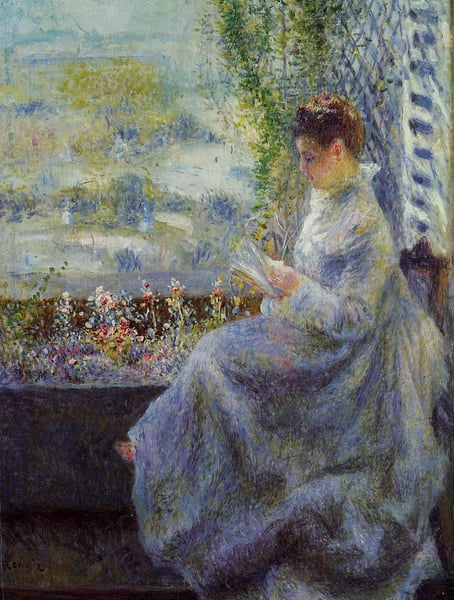
Analisi esperta di Madame Chocquet Reading di Pierre-Auguste Renoir
Stile: Impressionism · Genere: portrait
Expert Analysis: "Madame Chocquet Reading" by Pierre-Auguste Renoir
This portrait, executed within Renoir’s period of association with the Impressionists, exemplifies the movement’s radical break from academic portraiture. Instead of a formal, static likeness, Renoir captures a fleeting, intimate moment—a woman absorbed in reading, her attention turned inward.
Significance within Impressionism:
- Modern Life and Casual Intimacy: The painting elevates a private, everyday activity (reading) to the status of a major subject, a hallmark of Impressionism. Madame Chocquet is not posed grandly but is shown in a relaxed, informal posture, suggesting the new bourgeois leisure of the late 19th century.
- Light and Color as Protagonists: Renoir employs soft, dappled brushstrokes and a luminous palette—creamy whites, warm pinks, and muted greens—to simulate natural light filtering through the room. The figure’s face and hands are modeled with delicate, broken color, while the background dissolves into atmospheric patches, emphasizing vibration of light over precise contours.
- Portrait as Sensation, Not Documentation: True to Impressionist goals, the work prioritizes the optical experience—the shimmer of fabric, the glow of skin, the hush of absorbed reading—over psychological depth or social status. The sitter’s identity is secondary to the overall harmony of color and light.
Artistic Context:
Painted during the height of Renoir’s Impressionist period (c. 1870s), this portrait reflects the group’s rejection of the Salon’s finish and narrative. The loose, visible brushwork—particularly in the background—was radical for its time, emphasizing the artist’s immediate perception over academic precision. Madame Chocquet was the wife of Victor Chocquet, an early champion of Impressionism, and her repeated appearances in Renoir’s work (as well as in Cézanne’s) underscore the close ties between artist and patron.
In short, Madame Chocquet Reading is significant as a perfect synthesis of Impressionist principles: transient light, modern leisure, and the primacy of the painter’s visual sensation—all captured in a sensitive, unforced portrait that feels like a stolen glance rather than a commissioned likeness.
Museum / Gallery
Visivamente simili
20 opere con composizione e palette affini
Sewing in the Garden at Marquayrol
Henri Martin
The Blue Dress
Henri Martin
Woman with a Black Dog
Pierre-Auguste Renoir
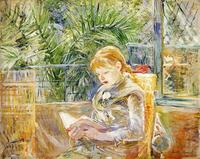
Reading
Berthe Morisot
Sewing at Marquayrol
Henri Martin
Lady in the Park (aka In the Garden)
Childe Hassam

Pond Lilies
Robert Lewis Reid
The Artist's Sister at a Window
Berthe Morisot
Eleanor
Frank W. Benson
Trio fleuri
Jan Toorop
Profile of a seated young woman
Berthe Morisot
Woman with Needlework
Mary Cassatt
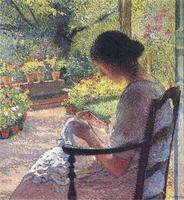
A Woman Sewing
Henri Martin
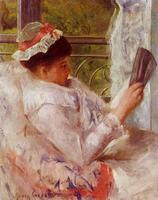
The Reader
Mary Cassatt
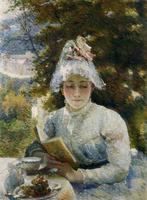
Le Gouter
Marie Bracquemond

In the Garden
Childe Hassam
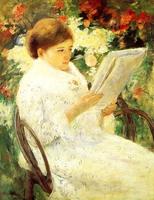
Woman Reading in a Garden
Mary Cassatt
The Garden Seat
Robert Lewis Reid
The Embroiderer (Woman Embroidering in a Garden)
Pierre-Auguste Renoir
The New York Window
Childe Hassam