
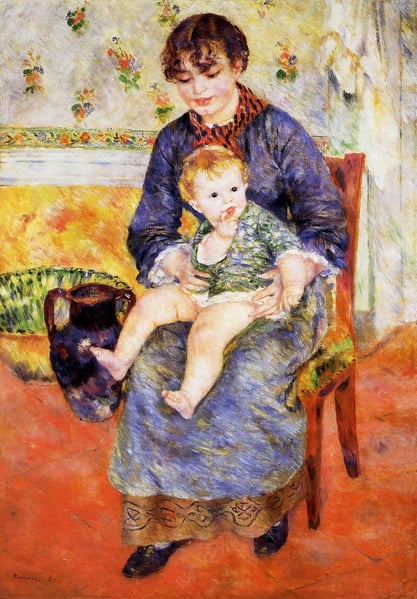
Expertenanalyse zu Pierre-Auguste Renoirs Mother and Child
Stil: Impressionism · Genre: genre painting
Of course. Here is an expert analysis of Pierre-Auguste Renoir's Mother and Child, focusing on its significance within the artist's career and the broader context of Impressionism.
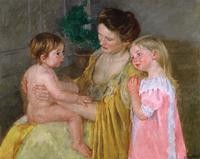
Pierre-Auguste Renoir, Mother and Child Circa 1885–1890 (late period)
Analysis:
This painting stands as a pivotal work in Renoir’s career, marking his deliberate shift away from the pure, spontaneous opticality of High Impressionism toward a more structured, classical mode of representation. The subject—a tender, intimate domestic scene—is a staple of genre painting, but Renoir transforms it into a statement of artistic reinvention.
Significance within Renoir’s "Rejection of Impressionism"
Around the mid-1880s, Renoir grew dissatisfied with Impressionism’s emphasis on transient light and loose brushwork. He famously declared he had "wrung Impressionism dry" and sought a more disciplined, linear approach inspired by Renaissance masters like Raphael and Ingres. Mother and Child exemplifies this "Ingres period" (sometimes called his "dry" or "aigre" phase). Here, the composition is carefully balanced: the mother’s seated form creates a stable pyramid, while her child nestles into a secure, protective curve. The contours are crisp and defined, a stark contrast to the fuzzy, dissolving edges of earlier works like Luncheon of the Boating Party (1881).
Key stylistic features that reveal this transition:
- Line and form over atmosphere: The figures are solidly modeled with clear outlines. The mother’s arm and the child’s rounded limbs are sculptural, almost porcelain-like in their smooth finish. This is a deliberate retreat from the "unfinished" look of Impressionism.
- Controlled palette: While Renoir retains his love for vibrant flesh tones and warm highlights, the colors are more subdued and unified than the high-key, broken color of his 1870s works. The background is simplified, using soft, blended strokes to suggest a gentle interior rather than a specific environment.
- Emotional intimacy with classical restraint: The mother’s gaze is inward, tender yet composed. There is no theatrical sentimentality; the bond is conveyed through the calm, physical closeness of the poses. This aligns with Renoir’s desire to capture "eternal" human truths, not fleeting moments.
Why this work matters:
Mother and Child is significant precisely because it documents the internal conflict within Impressionism itself. Renoir did not abandon Impressionist achievements in light and color—the soft glow on the mother’s cheek and the satiny texture of the child’s skin still radiate warmth—but he subordinated them to a new sense of order. The painting thus bridges two worlds: the joyful, sensory revolution of Impressionism and the timeless, idealized beauty of the classical tradition. It is a testament to Renoir’s belief that art must be both felt and structured, and it stands as a key example of how Impressionism evolved into the more synthetic styles of the late 19th century.
Museum / Gallery
Visuell ähnlich
20 Werke mit ähnlicher Komposition und Farbpalette
Mother And Child
Mary Cassatt
Mother about to Wash her Sleepy Child
Mary Cassatt
Emmie and Her Child
Mary Cassatt
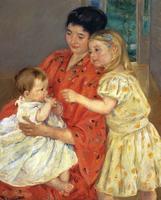
Mother and Sara Admiring the Baby
Mary Cassatt
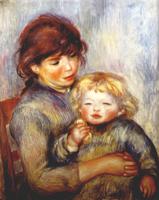
Maternity (child with a biscuit)
Pierre-Auguste Renoir
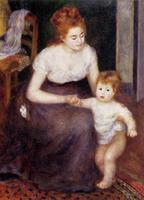
The First Step
Pierre-Auguste Renoir
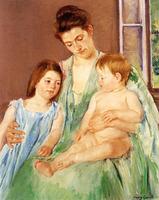
Young Mother and Two Children
Mary Cassatt
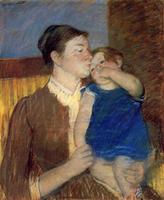
Mother s Goodnight Kiss
Mary Cassatt
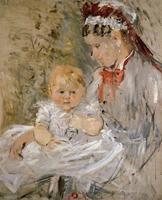
Julie Manet and her Nurse
Berthe Morisot
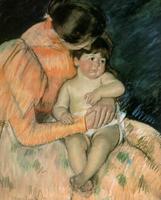
Mother and Child
Mary Cassatt
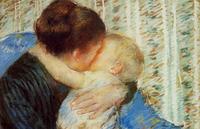
Mother and Child
Mary Cassatt
Reine Lefebre and Margot before a Window
Mary Cassatt
Mother and Child
Julian Alden Weir
Jenny and Her Sleepy Child
Mary Cassatt
Mother Combing Her Child's Hair
Mary Cassatt
Children Playing with a Cat
Mary Cassatt
Mother and Child
John Henry Twachtman
Mother And Child
Mary Cassatt
Nurse and Child
Mary Cassatt
Mother and Two Children
Mary Cassatt