
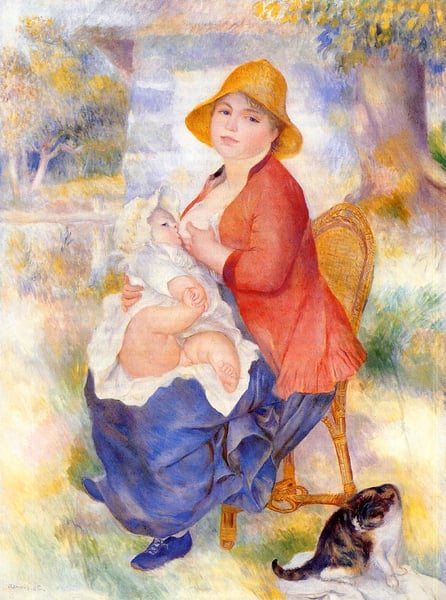
Analisi esperta di Motherhood (Woman Breast Feeding Her Child) di Pierre-Auguste Renoir
Stile: Impressionism · Genere: genre painting
Expert Analysis: Motherhood (Woman Breast Feeding Her Child) by Pierre-Auguste Renoir
This painting is a pivotal example of Renoir’s transition away from pure Impressionism toward a more structured, classical ideal—a phase art historians sometimes call his “rejection of Impressionism.” Executed in the late 1880s or early 1890s, it belongs to the period when Renoir, dissatisfied with the formlessness of his earlier work, sought the discipline of Ingresque line and volumetric solidity, while still retaining Impressionism’s warmth and luminosity.
Stylistic and Period Significance
- From ephemeral to eternal: Unlike Renoir’s earlier, feathery brushwork that dissolved figures into light and atmosphere, here the mother and child are modeled with greater contour and physical weight. The woman’s face, neck, and hands are painted with smoother, more deliberate strokes, and her pose—calm, monumental, with a gentle tilt of the head—evokes Renaissance Madonnas. This shift reflects Renoir’s study of Raphael and the Pompeian frescoes during his travels, marking his deliberate move from the immediacy of Impressionism to a timeless, humanist classicism.
- Light as structure, not dissolution: The light still falls warmly across the mother’s shoulder and the baby’s skin, but it is used to define form rather than to obscure it. The background remains loosely brushed, but the central figures are anchored by a careful distribution of shadow and highlight, showing Renoir’s new commitment to draftsmanship without sacrificing painterly charm.
- Genre as ideal: As a genre painting of everyday maternal care, the work elevates a private, tender moment into an archetype of nurturing. Renoir’s lifelong focus on women, children, and domestic bliss here takes on a solemn, almost religious dignity—a quality absent from his earlier, more spontaneous scenes of leisure.
What Makes It Significant
This painting is significant precisely because it embodies Renoir’s rejection of Impressionism’s radical spontaneity in favor of a more enduring, structured beauty. It stands as a bridge between the ethereal colorism of his mid-career and the firm, rosy nudes of his late work. In Motherhood, Renoir proves that Impressionist color can coexist with academic form—a synthesis that influenced later modernists who sought emotional depth without abandoning visual pleasure. The work is a testament to Renoir’s belief that art, at its core, must celebrate life with both exuberance and clarity.
Museum / Gallery
Genere
Stile
Visivamente simili
20 opere con composizione e palette affini
Mother
Kuzma Petrov-Vodkin
Mother Jeanne Nursing Her Baby
Mary Cassatt
Breastfeeding mother of Paula Modersohn-Becker
Paula Modersohn-Becker
Louise Nursing Her Child
Mary Cassatt
Maternity: Mary Henry Breastfeeding
Meijer de Haan
Maternity
Mary Cassatt
Mother Rose Nursing Her Child
Mary Cassatt
Nurse with baby
Zinaida Serebriakova
First son
Egisto Ferroni
Motherhood
Maurice Denis
Mother. Anxiety
Mykhailo Vainshtein
Motherhood
Laura Knight
Maternity
Gino Severini
Young Mother
Pierre-Auguste Renoir
Motherhood
Stanisław Wyspiański
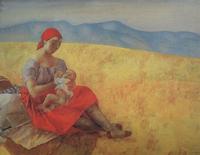
Mother
Kuzma Petrov-Vodkin
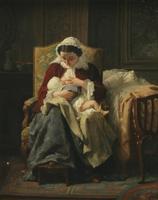
Mother and Child
Jules Trayer

Young Mother
Léon Augustin Lhermitte
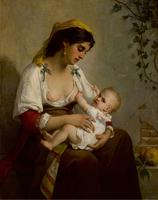
The nurturing mother
Jules Salles
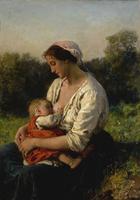
Young Mother Breastfeeding Her Child
Jules Breton