
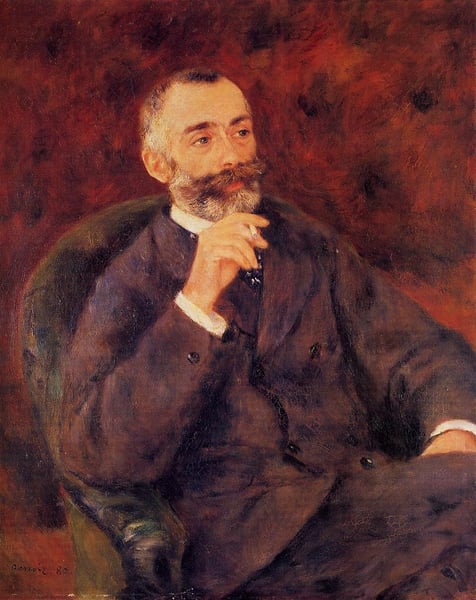
Analisi esperta di Paul Berard di Pierre-Auguste Renoir
Stile: Impressionism · Genere: portrait
Expert Analysis: Paul Berard by Pierre-Auguste Renoir
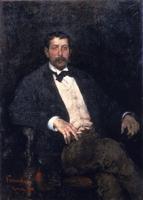
This portrait exemplifies Renoir’s mastery within the Impressionist movement, demonstrating how he adapted the style’s core principles—fleeting light, broken brushwork, and vibrant color—to the inherently stationary genre of portraiture. Painted during his association with the Impressionist circle, the work captures not only the likeness of Paul Berard but also the intimate, casual atmosphere that defined Renoir’s approach to his sitters.
Significance within Impressionism and the Portrait Genre:
-
Blurring of Formality: Unlike traditional commissioned portraits of the era, Renoir’s Paul Berard treats the sitter with a soft, almost informal immediacy. Berard, a French diplomat and art patron who supported Renoir throughout his career, is depicted not as a stiff public figure, but as a relaxed individual. The loose, feathery strokes typical of Impressionism dissolve hard outlines, infusing the face and clothing with dappled light that suggests a moment caught in time.
-
Patronage and Artistic Freedom: The painting is significant as a testament to the symbiotic relationship between Renoir and his patron. Berard’s support allowed Renoir the freedom to experiment with color and composition. Here, Renoir uses a warm, muted palette—ochres, soft greens, and creamy whites—to create a harmonious, contemplative mood. The background, treated with rapid, visible brushwork, evokes a sense of environment without narrative distraction, pure Impressionism in service of character.
-
Psychological Depth Through Technique: Renoir achieves psychological presence not through meticulous detail, but through the play of light across Berard’s features. The slight tilt of the head, the diffuse glow on the cheek, and the calm, direct gaze convey a thoughtful, refined personality. The painting stands as a key example of how Impressionists redefined portraiture: by prioritizing perceptual truth—how light and color reveal inner life—over academic precision.
In short, Paul Berard is significant because it merges the revolutionary visual language of Impressionism with the intimacy of personal portraiture, while also reflecting the crucial patronage network that enabled the movement to flourish. It captures both an individual and an artistic moment, proving that even in a style defined by landscapes and modern life, the human figure could be rendered with unprecedented vitality and warmth.
Museum / Gallery
Visivamente simili
20 opere con composizione e palette affini
Portrait of doctor A. D. Yesersky
Vasily Surikov
Untitled
Ivan Kramskoy
Portrait of the Artist Ivan Kramskoy
Ilya Repin
Portrait of Professor Dr. Carl Bernstein
Max Liebermann
Portrait of the composer Pyotr Ilyich Tchaikovsky
Nikolai Kuznetsov
Portrait of Carl Moll
Oskar Kokoschka
Portrait of a man
Nikos Nikolaou
Thomas Earp (1830–1910), Mayor of Newark
Harold Knight
Portrait of Nikolay Panafidin.
Isaac Levitan
Portrait of A.Kuzhetsov
Konstantin Makovsky
The Count of Artal
Joaquín Sorolla
Self Portrait
Henri Martin
Portrait of Pál Szinyei Merse
Karoly Ferenczy
Portrait of an art critic V. A. Nikolsky
Pyotr Konchalovsky
Portrait of the Singer Angelo Mazini
Valentin Serov
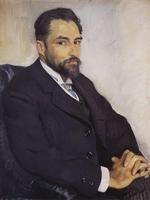
Portrait of M. Benois
Zinaida Serebriakova
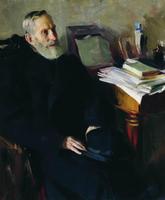
Portrait of Stjepan Nikolsky, uncle of the artist
Boris Kustodiev
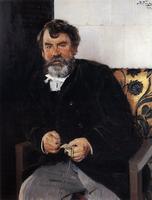
A portrait of E. S. Sorokin
Vladimir Makovsky
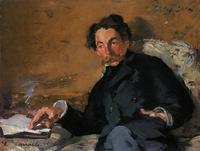
Stephane Mallarme
Edouard Manet
Portrait of a man
Umberto Veruda