
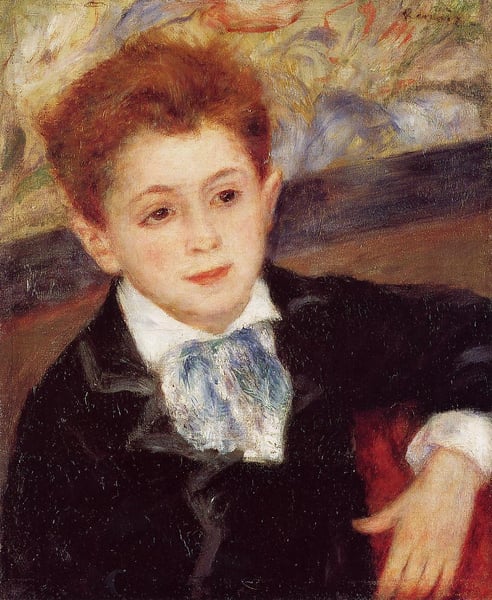
Expertenanalyse zu Pierre-Auguste Renoirs Paul Meunier
Stil: Impressionism · Genre: portrait
Expert Analysis of Paul Meunier by Pierre-Auguste Renoir
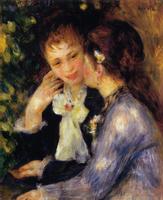
Pierre-Auguste Renoir’s Paul Meunier is a quintessential Impressionist portrait that demonstrates the movement’s revolutionary approach to capturing human presence. Executed during Renoir’s period of association with the Impressionists, the work embodies the core tenets of the style—emphasizing light, color, and immediacy over rigid academic finish.
Significance within Impressionism:
- As a portrait, the painting departs from traditional studio conventions. Rather than imposing a stiff, formulaic pose, Renoir treats the sitter with a sense of naturalness and psychological warmth. The brushwork is loose and expressive, with visible strokes that model the face and clothing through patches of pure color rather than smooth blending. This technique—hallmark of Impressionism—creates a vibrant, living surface that seems to shift in changing light.
- Renoir’s handling of light is central to the portrait’s significance. Soft, dappled illumination falls across the subject’s features, typical of the Impressionist fascination with plein air effects even in interior or studio settings. The interplay of warm and cool tones suggests atmosphere and immediacy, transforming a static likeness into a fleeting moment captured on canvas.
- The genre of portraiture was pivotal to Renoir’s career and to Impressionism’s broader acceptance. By applying modern, perceptual techniques to a traditional genre, Renoir demonstrated that Impressionism could dignify everyday life and personal relationships without sacrificing artistic innovation. Paul Meunier stands as a testament to this synthesis—both a tender character study and a manifesto of painterly freedom.
In short, the work’s significance lies in its embodiment of Impressionist ideals: a commitment to sensory truth, a rejection of academic finish, and a celebration of the transient beauty of a single human presence.
Museum / Gallery
Genre
Stil
Visuell ähnlich
20 Werke mit ähnlicher Komposition und Farbpalette
Master Robert Kelso Cassatt
Mary Cassatt
Woman with a white jabot
Pierre-Auguste Renoir
Jeanne Samary
Pierre-Auguste Renoir
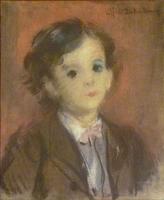
Portrait of Edmond, Son of the Artist
Alfred Dehodencq
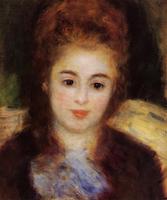
Head of a Young Woman Wearing a Blue Scarf (Madame Henriot)
Pierre-Auguste Renoir
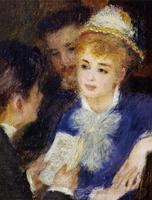
Reading the Part
Pierre-Auguste Renoir
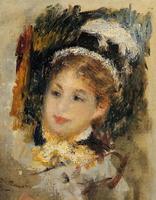
Dame en toilette de Ville
Pierre-Auguste Renoir
The boss's daughter
Paul Gauguin
Portrait of a Young Woman
Pierre-Auguste Renoir
The Reader (Young Woman Reading a Book)
Pierre-Auguste Renoir
A Young Woman
Pierre-Auguste Renoir
Reading Couple (Edmond Renoir and Marguerite Legrand)
Pierre-Auguste Renoir
V.A. Repina
Ilya Repin
Nude Sitting Back
Bela Czobel
Young Man and Young Woman
Pierre-Auguste Renoir
Portrait of an Anonymous Sitter
Pierre-Auguste Renoir
Susan in a Toque Trimmed with Two Roses
Mary Cassatt
Madame Claude Monet
Pierre-Auguste Renoir
Nora
Robert Henri
Confidences
Pierre-Auguste Renoir