
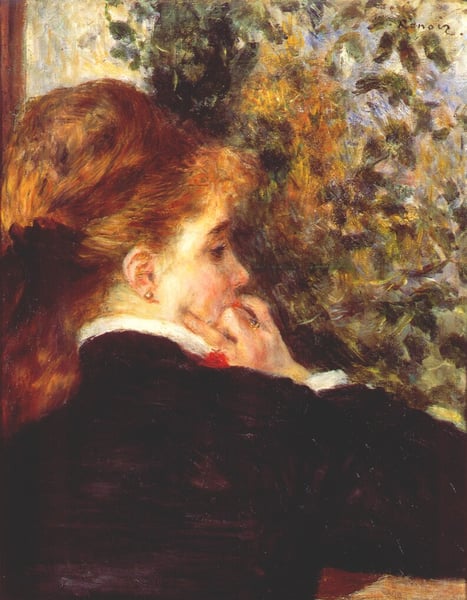
Analisi esperta di Pensive di Pierre-Auguste Renoir
Stile: Impressionism · Genere: portrait
Expert Analysis of “Pensive” by Pierre-Auguste Renoir
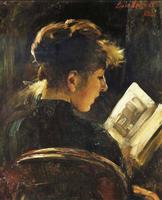
Pierre-Auguste Renoir’s “Pensive” stands as a quintessential example of Impressionist portraiture, a genre he helped redefine during his active years with the Impressionist group. The work derives its significance from several key characteristics that align with the movement’s revolutionary aims.
1. Capturing Fleeting Mood and Inner Life
The title itself, “Pensive,” signals a departure from the static, posed formality of academic portraiture. Instead of merely recording a likeness, Renoir focuses on a transient psychological state—contemplation. The sitter’s downward gaze, softened features, and relaxed posture invite the viewer into a private, introspective moment. This emphasis on a fleeting emotion over fixed identity was a hallmark of Impressionism, which sought to capture the ephemeral nature of modern life.
2. Luminous Color and Broken Brushwork
Renoir’s palette in “Pensive” exemplifies the Impressionist obsession with light and atmosphere. He builds the face and background using short, visible strokes of pure color—pinks, blues, and warm ochres—rather than smooth, blended transitions. The skin tones glow with subtle variations, as light seems to caress the sitter’s cheek and neck. That “broken color” technique, applied with rapid, feathery touches, dematerializes form and creates a shimmering, vibrant surface. This approach, central to Renoir’s mature style, transforms a conventional portrait into a study of light’s effect on perception.
3. Intimate, Unstudied Compositions
Unlike the stiff, full-length poses favored by the Salon, Renoir cropped the figure closely, making the viewer feel like a quiet observer in the same room. The background is deliberately indistinct—a blur of soft greens and browns—ensuring that all attention remains on the sitter’s expression. Such compositions, which often seem “snapshot-like,” were a direct challenge to academic rules. They reflect Renoir’s belief that a portrait should feel alive and informal, as if caught in a passing moment.
4. Significance within the Impressionist Movement
Painted during Renoir’s association with the Impressionist circle (roughly 1874–1883), “Pensive” shows how he applied the movement’s principles to the most intimate of subjects—the human face. While many Impressionists focused on landscapes or urban scenes, Renoir consistently returned to people, using portraiture to explore the interplay of light, color, and mood. This work demonstrates that Impressionism was not merely an outdoor-painting style but a radical new way of seeing all subjects, including the human form, through a lens of sensory immediacy and psychological depth.
Conclusion
“Pensive” is significant because it distills Renoir’s genius: a seemingly simple portrait that becomes a luminous meditation on color, light, and inner feeling. It embodies the Impressionist break from tradition by privileging subjective impression over objective record, and by making the very act of perception—the artist’s brush, the viewer’s gaze—an integral part of the artwork’s meaning.
Genere
Stile
Visivamente simili
20 opere con composizione e palette affini
Portrait of Margot (Portrait of a Model)
Pierre-Auguste Renoir
Reflection
Pierre-Auguste Renoir
Nini Lopez
Pierre-Auguste Renoir
Confidences
Pierre-Auguste Renoir
The Reader
Pierre-Auguste Renoir
Mademoiselle Demarsy (Woman Leaning on Her Elbow)
Pierre-Auguste Renoir
Young Woman Reading an Illustrated Journal
Pierre-Auguste Renoir
Female Profile. Studio For 'Lovers' (Autumn Evening)
Émile Friant
The Cup of Chocolate
Pierre-Auguste Renoir
On watch
Giuseppe De Nittis
Portrait of a Young Woman
Pierre-Auguste Renoir
Head of a Young Woman (Yellow Hat)
Pierre-Auguste Renoir
Portrait of Tatiana Rechinskay
Ilya Repin
Reading Couple (Edmond Renoir and Marguerite Legrand)
Pierre-Auguste Renoir
Young Woman Wearing a Black Hat
Pierre-Auguste Renoir
Madame Manet in conservatory
Edouard Manet
Portrait of an Anonymous Sitter
Pierre-Auguste Renoir
A Portrait of Violet
John Singer Sargent
Miss Reynolds
Berthe Morisot
Reading Woman
Lovis Corinth