
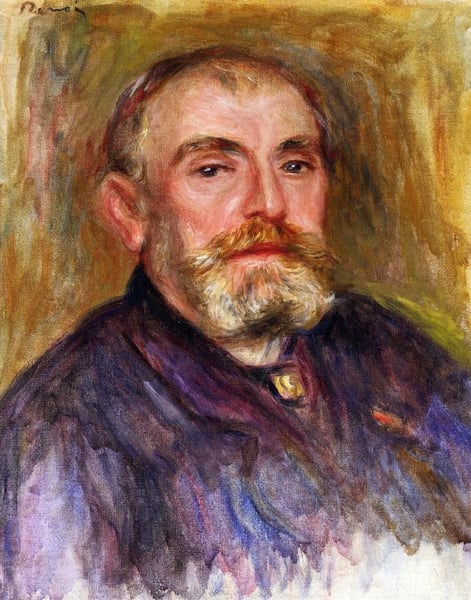
Analisi esperta di Portrait of Henri Lerolle di Pierre-Auguste Renoir
Stile: Impressionism · Genere: portrait
Expert Analysis: "Portrait of Henri Lerolle" by Pierre-Auguste Renoir
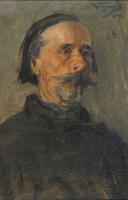
This portrait exemplifies Renoir’s mature, later-period style, wherein the artist synthesized his earlier Impressionist brilliance with a renewed interest in formal structure and human intimacy. Painted around 1885–1890, it belongs to a phase often called Renoir’s “Ingresque” or “dry” period, marked by crisper contours and a more restrained palette—yet the work retains the luminous warmth central to Impressionism.
Significance within Impressionism and Renoir’s Career
-
A bridge between spontaneity and classicism: Unlike the loose, flickering brushstrokes of Renoir’s 1870s works (e.g., Luncheon of the Boating Party), this portrait shows firmer draftsmanship and smoother modelling, reflecting his study of Renaissance masters after a trip to Italy. The face and hands are carefully delineated, while the background and clothing retain softer, feathery touches—a dialogue between fleeting sensation and enduring form.
-
Intimate psychological depth: Henri Lerolle was a fellow painter, art collector, and patron of the Impressionists. Renoir captures not merely a likeness but the subject’s intellectual poise and gentle authority. The direct, contemplative gaze and relaxed posture suggest a rapport between artist and sitter, elevating the portrait beyond a commission to a personal tribute.
-
Color harmony and atmospheric lightness: Renoir’s signature use of warm, opalescent flesh tones is tempered here by a cooler, more tonal background—subtle greens, grays, and muted blues. This balance prevents sentimentality and anchors Lerolle in a quiet, airy space. The play of light across his face and hands recalls Impressionist plein-air observation, but the composition is carefully staged, typical of Renoir’s later portraits.
-
Cultural importance: Lerolle’s circle included composers (Debussy), writers, and avant-garde artists. By painting him, Renoir documented the intellectual ferment of late 19th-century Paris, where art, music, and literature converged. The portrait thus serves as a historical marker of the Impressionist network and its patrons.
In sum, Portrait of Henri Lerolle is significant as a refined synthesis of Impressionist color and classical order, demonstrating Renoir’s enduring ability to convey personality through a fluid yet structured technique. It stands as a testament to his artistic evolution and the intimate social world that sustained Impressionism beyond its revolutionary beginnings.
Museum / Gallery
Visivamente simili
20 opere con composizione e palette affini
Portret Malarza Ludomira Benedyktowicza
Leon Wyczółkowski
Portrait of Stephane Mallarme
Pierre-Auguste Renoir
Self Portrait
Henri Martin
Portrait of Charles L. Freer
James McNeill Whistler
Federico Rubio y Gali
Alejandro Cabeza
Stephane Mallarme
Pierre-Auguste Renoir
Jacques Eugene Spuller
Pierre-Auguste Renoir
Self Portrait
Eastman Johnson
Self portrait
Isaac Levitan
Portrait of Monsieur Louis Estruc
Camille Pissarro
Portrait of Georges de Bellio (1828-94)
Giovanni Boldini
L’Antiquaire Georges Joseph Demotte
Henri Matisse
Portrait of Leopold Czihaczek (Head of a Bearded Man I)
Egon Schiele
Self-portrait
Alessandro Zezzos
Self Portrait
Eastman Johnson
Portrait of Philibert Favre
Paul Gauguin
Self-Portrait
Pierre-Auguste Renoir
Portrait of N. S. Matveev
Vasily Surikov
Thomas Alexander Graham, Artist
James Archer
Etude of the male head
Nikolai Kuznetsov