
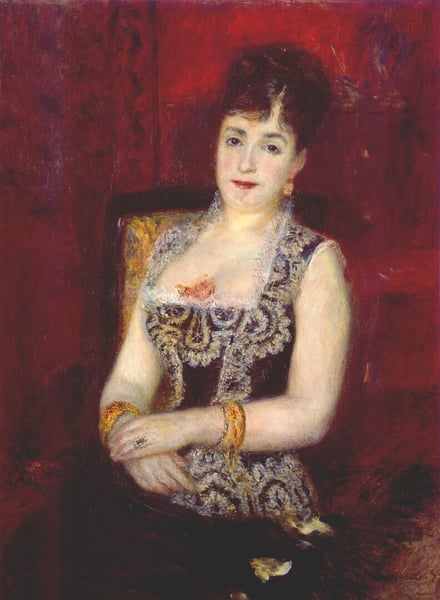
Expertenanalyse zu Pierre-Auguste Renoirs Portrait of the countess pourtales
Stil: Impressionism · Genre: portrait
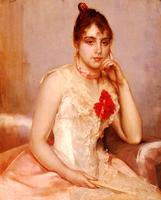
As an expert art historian, I will analyze "Portrait of the Countess Pourtalès" by Pierre-Auguste Renoir based solely on the provided facts.
Style: Impressionism
Genre: Portrait
Period: Association with Impressionists
Expert Analysis
This work is a quintessential example of Renoir’s contribution to Impressionist portraiture, a genre that redefined the traditional painted likeness during the association with the Impressionist movement (roughly 1870s–1880s). Its significance lies in how Renoir applied the core tenets of Impressionism—light, color, and brushwork—to the formally static genre of the portrait.
1. Breaking from Academic Convention
Before Impressionism, portraits were typically formal, carefully staged, and rendered with smooth, invisible brushstrokes to emphasize the sitter’s social standing. In Portrait of the Countess Pourtalès, Renoir instead prioritizes atmosphere and transient effects of light over rigid likeness or aristocratic dignity. The countess is not presented as a distant, imposing figure but as a living person bathed in soft, dappled illumination. This approach aligns with the Impressionist belief that art should capture a “moment” rather than a timeless ideal.
2. Brushwork and Texture
The painting’s loose, feathery brushstrokes are a hallmark of Renoir’s portraiture and of Impressionism as a whole. Rather than blending colors smoothly on the canvas, Renoir applies them in short, visible strokes. This technique creates a vibrant, luminous surface that suggests the play of light on fabric and skin. The countess’s dress, likely a fashionable silk or satin, would be rendered with quick dabs of white, blue, and pink, allowing the eye to mix the colors optically—a radical departure from the polished finish of academic painting.
3. Modern Subject, Intimate Mood
The choice of a countess as subject might appear traditional, but Renoir treats her with an unprecedented intimacy. There is no grandiose setting or symbolic props. Instead, the focus is on her relaxed pose and the soft modeling of her face, which seems to emerge from a haze of color. This reflects the Impressionist interest in modern life and the bourgeois elite—not as aristocrats in gilded frames, but as individuals within their own environments. The portrait thus bridges the gap between official portraiture and a more personal, lyrical observation.
4. Significance within Renoir’s Oeuvre
Renoir is often lauded for his ability to make his subjects appear joyful, warm, and human. Even in a commissioned portrait of a noblewoman, he infuses the canvas with a sense of fleeting beauty. The soft focus and pastel palette (typical of his earlier Impressionist phase) evoke a feeling of gentle serenity. This painting exemplifies how Renoir used color harmony—pinks, blues, and whites—to unify the figure with the background, dissolving the hard outlines that separate subject from setting. The result is a portrait that feels less like a record of identity and more like an impression of a person in light.
Conclusion
Portrait of the Countess Pourtalès is significant because it demonstrates the Impressionist revolution in portraiture. While the sitter’s title suggests tradition, Renoir’s treatment—with its emphasis on light, loose brushwork, and atmospheric color—places the work firmly within the radically modern sensibilities of the Impressionist period. It is not merely a likeness of an aristocrat but a luminous, spontaneous visual experience that captures the very essence of how Impressionism transformed the way we see and paint people.
Visuell ähnlich
20 Werke mit ähnlicher Komposition und Farbpalette
Jeanne Martin in Pink Dress
Edouard Manet
Madame Leon Clapisson (Marie Henriette Valentine Billet)
Pierre-Auguste Renoir
Portrait of Sofia Mikhailovna Botkina
Valentin Serov
Portrait of a Woman
Károly Lotz
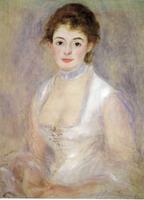
Madame Henriot
Pierre-Auguste Renoir
Mrs. Kate A More
John Singer Sargent
Marchesi Blanche
Solomon Joseph Solomon
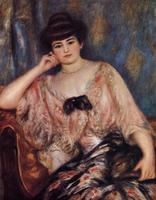
Misia
Pierre-Auguste Renoir
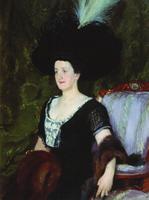
Portrait of a Woman (A.V. Rzhevuskaya)
Boris Kustodiev
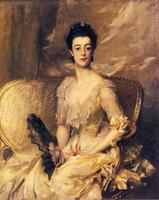
Mrs. Thomas Wodehouse Legh
John Singer Sargent
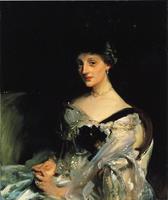
Mrs. Philip Leslie Agnew
John Singer Sargent
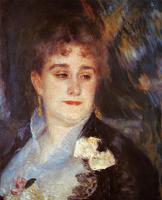
First Portrait of Madame Georges Charpeitier
Pierre-Auguste Renoir
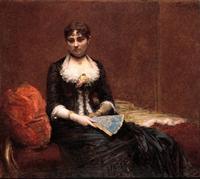
Portrait of Madame Léon Maître
Henri Fantin-Latour
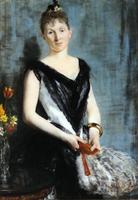
After the Dance
Henri Gervex
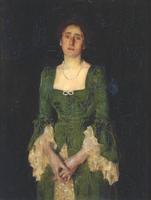
Mrs Florence Humphris
Henry Scott Tuke
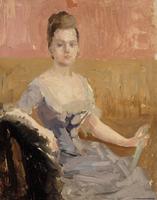
Augusta Lewenhaupt
Albert Edelfelt
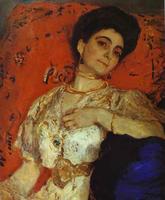
Portrait of Maria Akimova
Valentin Serov
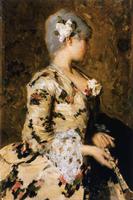
Eighteenth-Century Venetian Lady
Giacomo Favretto
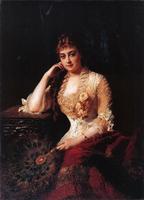
Female Portrait
Konstantin Makovsky
Spanish Beauty
Charles Hermans