
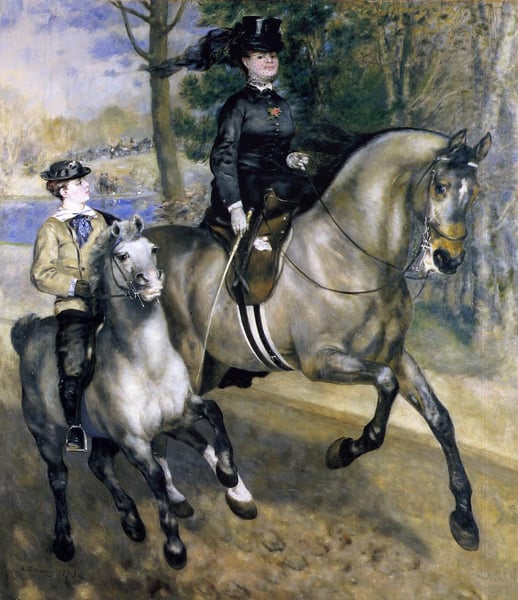
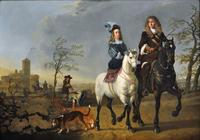
Riding in the Bois de Boulogne (Madame Henriette Darras or The Ride)
Details
Expertenanalyse zu Pierre-Auguste Renoirs Riding in the Bois de Boulogne (Madame Henriette Darras or The Ride)
Stil: Realism · Genre: genre painting
Expert Analysis: "Riding in the Bois de Boulogne (Madame Henriette Darras or The Ride)" by Pierre-Auguste Renoir
Pierre-Auguste Renoir’s Riding in the Bois de Boulogne (also known as Madame Henriette Darras or The Ride) occupies a fascinating transitional moment in the artist’s career. Though Renoir is celebrated as a central figure of Impressionism, this work is classified under Realism—a deliberate stylistic choice that underscores its significance as a bridge between the objective depiction of contemporary life and the looser, light-filled experimentation that would define his later Impressionist masterpieces.
Composition and Subject Matter
The painting depicts a stylishly dressed woman—identified as Madame Henriette Darras—on horseback in the Bois de Boulogne, a fashionable Parisian park. This setting was a favorite subject for Realist and Impressionist painters alike, as it captured the leisure activities of the burgeoning bourgeoisie. Renoir’s treatment here is notably grounded in Realist principles: the figure is clearly defined, the anatomy of the horse is rendered with careful observation, and the background retains a sense of spatial depth without dissolving into the atmospheric blur typical of high Impressionism. The woman’s riding habit and composed posture convey a specific social identity—elegant, modern, and self-possessed.
Significance within Realism and the Impressionist Period
What makes this work significant is its synthesis of Realist clarity with proto-Impressionist vitality. While Renoir adheres to Realism’s commitment to depicting everyday scenes with accuracy—the horse’s musculature, the rider’s tailored costume, the dappled light filtering through the trees—he also introduces subtle touches that foreshadow his Impressionist concerns. The brushwork, though tighter than his later style, already shows a sensitivity to light and movement: the grass, the horse’s coat, and the sky are handled with broken touches of color that suggest rather than define form. This places the painting at a critical juncture in the 1860s–70s when artists like Renoir were moving away from the academic idealization of history painting toward a fresh, immediate depiction of modern urban and suburban life.
Art-Historical Context
As an association with the Impressionists, Renoir’s choice here to portray a specific, named sitter in a contemporary leisure activity aligns with the group’s manifesto: to paint scenes of modern life as they truly appeared. Yet the work’s Realist label reminds us that not all Impressionist-associated artists abandoned precision outright. The Ride demonstrates that Realism remained a vital undercurrent, even as Impressionism pushed toward ephemeral sensory effects. In this painting, Renoir proves that capturing the social texture of Paris—the pride of a woman riding in a park, the quiet dignity of a moment of recreation—requires both the eye of a Realist and the soul of an Impressionist.
Conclusion
Ultimately, Riding in the Bois de Boulogne is significant because it embodies the tension and dialogue between two movements. It is not merely a genre painting of a lady on horseback; it is a document of how Renoir refined his approach to color, light, and modernity. For viewers, it offers a rare glimpse of the artist before he fully committed to the flickering brushstrokes of Impressionism, showing that even his realist foundations were already luminous with the promise of the new.
Museum / Gallery
Visuell ähnlich
20 Werke mit ähnlicher Komposition und Farbpalette
Cavalcade in front of Heiligenberg Castle Prince Karl Egon II of Fürstenberg and Amalie, b. Princess of Baden
Albrecht Adam
The amazon (Alice Regnault)
Giovanni Boldini
Portrait équestre de l’empereur Nicolas Ier et de sa suite
Adolphe Ladurner
Portrait of Ye. Mussart and E. Mussart. (Riders)
Karl Bryullov
Amazone
Edmond-Georges Grandjean
Countess Caroline von Waldbott-Bassenheim, b. Oettingen-Wallerstein on horseback on a hill near Leutstetten; in the background Leutstetten Castle
Albrecht Adam
Pleasant Company
Heywood Hardy
Rider. Portrait of Giovanina and Amacilia Pacini, the Foster Children of Countess Yu. P. Samoilova
Karl Bryullov
A White Horse
Diego Velazquez
Horsewoman and Dog
Henri de Toulouse-Lautrec
Portrait équestre de François Adolphe Akermann
Franz Xaver Winterhalter
The blank signature
Rene Magritte
Laetitia, Lady Lade
George Stubbs
Out for a Scamper
Heywood Hardy
King Charles II and Jane Lane Riding to Bristol
Isaac Fuller
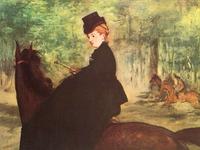
The Horsewoman
Edouard Manet
Painting of a young boy riding a pony
Penry Williams
Queen Marie riding in front of Pozzuoli on the Gulf of Naples in front of Vesuvius
Filippo Palizzi
Napoleon on a horse
Piotr Michałowski
Lady and Gentleman on Horseback
Aelbert Cuyp