
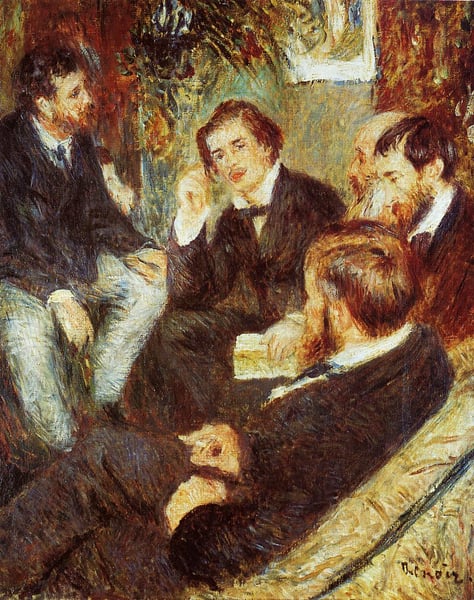
Expert analysis of Pierre-Auguste Renoir’s The Artist s Studio, Rue Saint Georges
Style: Impressionism · Genre: genre painting
Expert Analysis: The Significance of Renoir’s The Artist’s Studio, Rue Saint Georges
This work by Pierre-Auguste Renoir exemplifies the core preoccupations of Impressionism while also offering a rare, self-reflective look at the artist’s own creative environment. Painted in 1876—the height of Renoir’s association with the Impressionist group—the canvas transforms a humble interior into a vibrant study of light, social interaction, and modern life.
Composition and Subject
The scene depicts Renoir’s studio at 35 Rue Saint Georges in Paris, a space he shared briefly with fellow Impressionist Frédéric Bazille before Bazille’s death in 1870. However, Renoir populates the room not with historical figures but with contemporary friends and models, including the critic Georges Rivière (seated, reading) and the artist’s lover Lise Tréhot (standing near the easel). The painting functions as a genre painting—a snapshot of everyday bourgeois life—but with an added layer of meta-commentary: it shows painters at work, canvases stacked against walls, and the tools of the trade. This self-awareness makes it a document of Impressionist practice itself.
Significance Within Impressionism
-
Light and Atmosphere: Renoir’s hallmark feathery brushstrokes and broken color capture the diffuse, silvery light filtering through the studio’s large north-facing windows. The palette—soft blues, warm ochres, and muted greens—creates a sense of airy intimacy, turning a mundane workspace into a shimmering, harmonious environment. This embodies Impressionism’s goal of rendering the fleeting effects of natural light on a scene.
-
Modern Life and Leisure: The painting rejects academic hierarchy by elevating a casual, unposed gathering of friends into high art. No historical or mythological allegory here—only the “heroism of modern life” that Édouard Manet and the Impressionists championed. Renoir’s studio becomes a stage for sociability, art, and the pursuit of pleasure, aligning with Impressionist themes of leisure (later seen in works like Luncheon of the Boating Party).
-
The Artist’s Self-Portrayal: Unlike the formal studio scenes of earlier masters (e.g., Velázquez’s Las Meninas), Renoir shows himself not as a solemn genius but as a participant in a convivial moment. He is barely visible, a tiny figure at the back near the easel, suggesting that the creative process is collaborative and embedded in daily life. This humility and focus on community are hallmarks of Impressionist identity.
Historical Context
Painted during the second Impressionist exhibition (1876), where Renoir showed fifteen works, this piece affirms the group’s commitment to depicting contemporary Parisian life. Yet it also hints at the tensions between studio practice and plein-air ideals: the studio itself is the subject, celebrating the very space that allows Impressionism to flourish.
In sum, The Artist’s Studio, Rue Saint Georges is significant not only as a masterful exercise in Impressionist technique but as a rare, affectionate glimpse behind the scenes of the movement’s making. It captures the camaraderie, innovation, and everyday beauty that Renoir and his circle sought to immortalize.
Museum / Gallery
Genre
Style
Visually similar
20 works with related composition and palette
Jeantaud, Linet and Laine
Edgar Degas
Pagan and Degas' Father
Edgar Degas
Conversation
Pierre-Auguste Renoir
Alfred Sisley
Pierre-Auguste Renoir
Man reading (Father)
Walter Gramatté
The Sailor
Paul Cezanne
Portrait of Jan Stanislawski
Oleksandr Murashko
Portrait of Alexander Lensky and Alexander Yuzhin
Valentin Serov
Portrait of a seated man
Paul Gauguin
Portrait of Chaliapin
Konstantin Korovin
Portrait of An Armenian Artist V. Akhikyan
Fedir Krychevsky
The Lecture by Emile Verhaeren
Theo van Rysselberghe
Henri Rouart and His Son Alexis
Edgar Degas
Portrait of Feodor Chaliapin
Konstantin Korovin
Stephane Mallarme
Edouard Manet
The secret
Vladimir Makovsky
Portrait of a Man
Edgar Degas
Portrait of Alexander J. Cassatt
Mary Cassatt
Portrait of Eugene Pierre Lestringuez
Pierre-Auguste Renoir
Group portrait of painters of the World of Art
Boris Kustodiev