Analisi esperta di The Farm di Pierre-Auguste Renoir
Stile: Impressionism · Genere: genre painting
Expert Analysis of "The Farm" by Pierre-Auguste Renoir
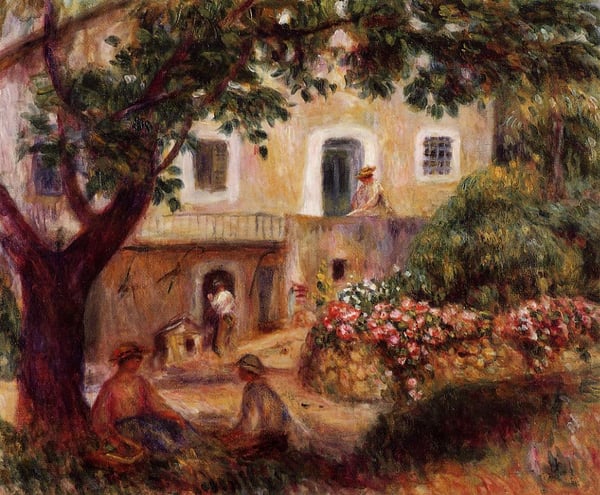
As an Impressionist painting from Renoir’s later years, "The Farm" marks a significant evolution in the artist’s approach to color, form, and subject matter, while still embodying the core tenets of the movement. Created after Renoir had returned from his travels in Italy and undergone a period of stylistic re-evaluation, this work exemplifies his shift toward a more structured, yet still luminous, depiction of everyday life.
Significance within Impressionism and Renoir’s Later Period
-
Genre Painting with a Pastoral Focus: As a genre painting, "The Farm" captures a slice of rural life—a common Impressionist interest—but Renoir treats it with the same warmth and intimacy he reserved for portraits and scenes of leisure. The subject matter reflects his later preference for tranquil, domestic landscapes over the bustling Parisian scenes of his earlier career.
-
Evolution of Brushwork and Color: In his later years, Renoir softened his famously feathery brushstrokes into a more flowing, rounded rhythm, while retaining the Impressionist commitment to capturing light. In "The Farm," this manifests as a harmonious palette of greens, ochres, and rosy highlights, where dappled sunlight is rendered not in broken strokes but in gentle, blending transitions—presaging the almost classical serenity of his final works.
-
Thematic Shift: Unlike the fleeting moments of modern life that defined early Impressionism, "The Farm" suggests permanence and rootedness. The farm itself becomes a symbol of enduring human connection to nature, a theme Renoir explored increasingly as he aged and sought comfort in the Mediterranean countryside. This places the painting within a broader narrative of Impressionism’s maturation, where artists moved from capturing the ephemeral to celebrating the timeless.
-
Stylistic Synthesis: The work is significant for how it balances Renoir’s lifelong sensuality (evident in the lush foliage and gentle forms) with a newfound compositional discipline. The farmhouse and figures are more solidly modeled than in his 1870s works, yet the overall effect retains the airy, atmospheric quality that defines Impressionism. In this way, "The Farm" stands as a bridge between the radical innovations of the movement’s peak and the more decorative, monumental style of Renoir’s final decade.
While not as widely reproduced as Luncheon of the Boating Party, "The Farm" is a compelling testament to Renoir’s enduring ability to find beauty in the ordinary—and to transform a simple rural scene into a luminous meditation on light, color, and the quiet dignity of rural life.
Museum / Gallery
Genere
Stile
Visivamente simili
20 opere con composizione e palette affini
House in Collett at Cagnes
Pierre-Auguste Renoir
Houses in Cagnes
Pierre-Auguste Renoir
Woman picking flowers
Pierre-Auguste Renoir
Landscape
Pierre-Auguste Renoir
Algiers Landscape
Pierre-Auguste Renoir
Landscape from Saint Tropez
Nicolae Darascu
Mas de Galeron
Augustus John
The Farm at Collettes
Pierre-Auguste Renoir
Cagnes Landscape
Pierre-Auguste Renoir
Tatar Women in Mangalia
Francisc Sirato
Houses at Cagnes
Pierre-Auguste Renoir
Sunny Doorway
Henri Martin
Young Woman Standing near a Farmhouse in Milly
Pierre-Auguste Renoir
House with Vine and Staircase
Henri Martin
House in Provence
Paul Cezanne
Пейзаж от Казанлък
Anton Mitov
The open door
Henri Martin
Italian Courtyard
Fyodor Bronnikov
Spring on the Riviera
Guy Rose
Medlar Trees, Cagnes
Pierre-Auguste Renoir