
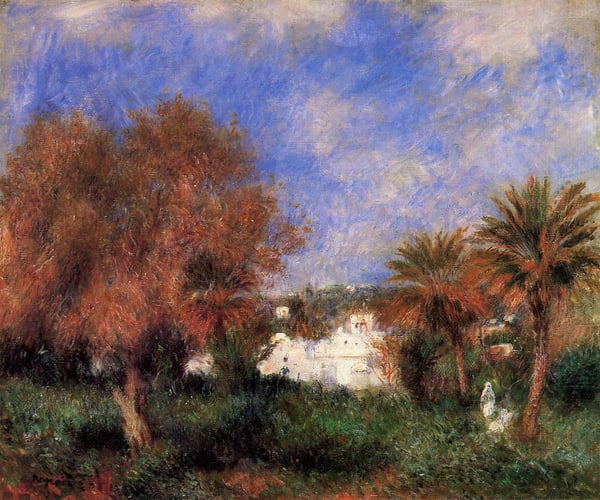
Analisi esperta di The Garden of Essai in Algiers di Pierre-Auguste Renoir
Stile: Impressionism · Genere: landscape
Expert Analysis of "The Garden of Essai in Algiers" by Pierre-Auguste Renoir
Art Historical Context & Significance
Structured facts: Style is Impressionism; Period is "Rejection of Impressionism."
This painting occupies a pivotal moment in Renoir’s career—the early 1880s—when he deliberately moved away from the pure, optical spontaneity of High Impressionism toward a more disciplined, classical approach. During his travels to North Africa (including Algeria in 1881–82), Renoir sought to fuse the vibrant palette he had mastered with a firmer sense of structure and form. The Garden of Essai in Algiers exemplifies this transitional phase: the subject is still unmistakably Impressionistic in its dappled light and saturated colors, yet the composition is more stable, with clearly defined spatial zones (path, foliage, figures) and a greater emphasis on solid human form—harbingers of his later "Ingresque" or "dry" manner.
Formal & Thematic Significance
- Color & Light: Renoir retains the Impressionist fixation on atmospheric effects, layering brilliant greens, ochres, and blues to suggest the intense Algerian sunlight filtering through palm and banana leaves. The shadows are not gray but shot through with violet and complementary hues, a hallmark of Impressionist optical mixing.
- Composition: Unlike earlier free-form, cropped views, this landscape is carefully balanced. The winding path draws the eye inward, while the seated figures (possibly locals or European visitors) anchor the foreground. This structured arrangement reflects Renoir’s rejection of the snapshot-like immediacy of Impressionism in favor of more permanent, classical order.
- Cultural & Travel Dimension: The choice of an exotic garden en plein air allowed Renoir to test his evolving style against a radically unfamiliar environment. The work is significant as a record of his artistic restlessness—proof that even within a defined style (Impressionism), he was already turning away from its core tenets to forge a more synthetic, monumental vision that would culminate in the 1880s.
Why This Work Matters
The Garden of Essai in Algiers is not a "typical" Renoir of the 1870s (e.g., Luncheon of the Boating Party) but rather a signpost of his personal crisis and reinvention. It demonstrates that Impressionism was never a static dogma; its leading practitioners constantly subverted its own principles. Here, Renoir borrows the vibrancy of Impressionist color while rejecting its improvisatory composition, creating a work that looks both forward (to his classical phase) and sideways (to the Post-Impressionist synthesis of structure and light). This duality gives the painting its historical weight.
Museum / Gallery
Visivamente simili
20 opere con composizione e palette affini
The Bay of Algiers
Pierre-Auguste Renoir
Landscape
Pierre-Auguste Renoir

Landscape
Pierre-Auguste Renoir
The Valley of Sasso, Bordighera
Claude Monet
Medlar Trees, Cagnes
Pierre-Auguste Renoir
Landscape Near Cagnes
Pierre-Auguste Renoir
Landscape at Collettes
Pierre-Auguste Renoir
Small Country Farm in Bordighera
Claude Monet
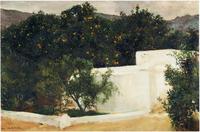
Orange trees on the road to Seville
Joaquín Sorolla
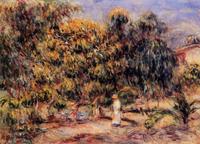
Woman in White in the Garden at Colettes
Pierre-Auguste Renoir
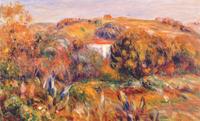
Landscape at cagnes
Pierre-Auguste Renoir
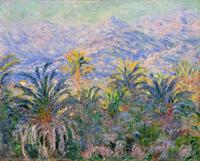
Palm Trees at Bordighera
Claude Monet
Garden in Cannes
Edouard Vuillard
Városmajori Villa Kertjében,
Berény Róbert
Landscape with a View of the Sea
Pierre-Auguste Renoir
Cabin with Aloe Plants
Pierre-Auguste Renoir
Strada Romada in Bordighera
Claude Monet
Meadow in Martinique
Paul Gauguin
Landscape at Grasse
Pierre-Auguste Renoir
Untitled
Henri-Edmond Cross