
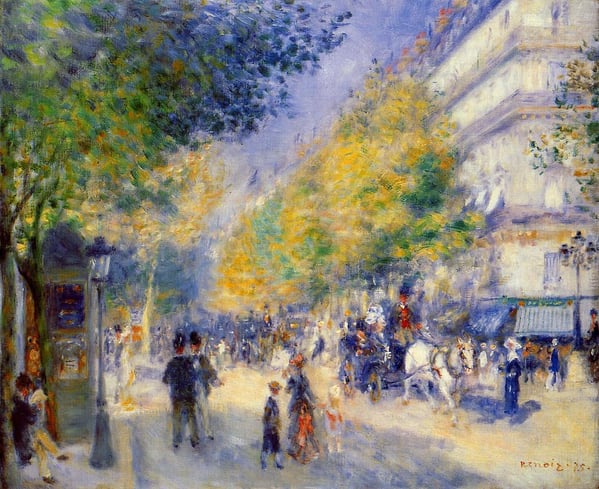
Expert analysis of Pierre-Auguste Renoir’s The Great Boulevards
Style: Impressionism · Genre: cityscape
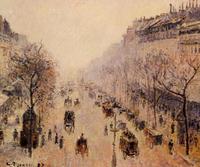
Pierre-Auguste Renoir’s The Great Boulevards (c. 1875) is a quintessential Impressionist cityscape that captures the vibrant, modern energy of late‑19th‑century Paris. Painted during Renoir’s close association with the Impressionist circle, the work exemplifies the movement’s core aims: to record contemporary life en plein air and to convey the fleeting effects of light and atmosphere.
Significance within Impressionism:
-
Broken brushwork and luminous color. Renoir employs rapid, feathery strokes of pure pigment—blues, greens, whites, and warm ochres—to evoke the shimmer of sunlight filtering through trees and the movement of bustling crowds. The paint is applied directly onto a light ground, creating a sense of optical vibration that mirrors the ephemeral experience of a city boulevard.
-
Capturing urban modernity. Unlike pastoral or historical subjects, The Great Boulevards focuses on a distinctly modern scene: the newly widened Haussmannian boulevards, lined with fashionable shops, carriages, and strolling Parisians. This choice reflects the Impressionist interest in the spectacle of modern life—a theme that Renoir often celebrated with a sense of intimacy and pleasure.
-
Dynamic composition and perspective. The painting offers a diagonal view down the boulevard, with the pavement and buildings receding rapidly. Renoir crops the figures and vehicles at the edges, suggesting a candid, snapshot‑like viewpoint. This informal framing, borrowed from photography and Japanese prints, heightens the sense of spontaneity and immersion in the moment.
-
Renoir’s characteristic warmth. While other Impressionists like Monet or Pissarro often focused on the objective analysis of light, Renoir infuses the scene with a gentle, human warmth. The figures are animated but not anonymous; their interactions—a woman adjusting her shawl, a child skipping—convey the leisurely, sociable character of Parisian boulevard life. This fusion of atmospheric effect with a sense of joy and comfort distinguishes Renoir’s approach.
In summary, The Great Boulevards is significant as a masterful synthesis of Impressionist technique and subject matter. It demonstrates how Renoir harnessed broken color and rapid brushwork to immortalize the fleeting charm of the modern city, while his lyrical touch makes the painting an enduring celebration of everyday urban beauty.
Museum / Gallery
Genre
Style
Visually similar
20 works with related composition and palette
Place Saint Augustin, Misty Weather
Gustave Caillebotte
Boulevard Montmartre, Spring
Camille Pissarro
Boulevard Montmartre Morning, Grey Weather
Camille Pissarro
Boulevard de Clichy
Louis Abel-Truchet
The Boulevard of Clichy
Louis Abel-Truchet
The Grands Boulevard, Paris
Childe Hassam
Boulevard Montmartre, Sunset
Camille Pissarro
Boulevard of Capucines
Claude Monet
The Porte Saint Martin
Edouard Cortes
Boulevard Montmartre Afternoon, Sunlight
Camille Pissarro
Boulevard Montmartre Mardi Gras
Camille Pissarro
Boulevard Montmartre, Spring Rain
Camille Pissarro
At the Café
Childe Hassam
Boulevard Montmartre Spring Rain
Camille Pissarro
Boulevard Montmartre Winter Morning
Camille Pissarro
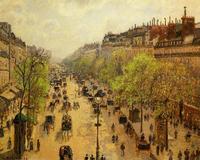
Boulevard Montmartre Spring
Camille Pissarro
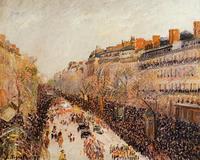
Mardi Gras on the Boulevards
Camille Pissarro
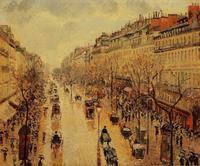
Boulevard Montmartre Afternoon, in the Rain
Camille Pissarro
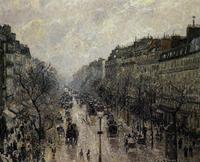
Boulevard Montmartre Foggy Morning
Camille Pissarro
Boulevard Montmartre Morning, Sunlight and Mist
Camille Pissarro