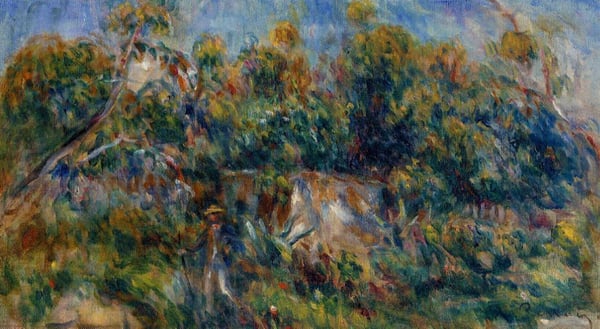
Analysis of "The Painter Taking a Stroll at Cagnes" by Pierre-Auguste Renoir
As an Impressionist landscape, this work exemplifies the movement's core commitment to capturing transient light, atmosphere, and everyday leisure. Renoir's choice of Cagnes—a sun-drenched town in the South of France—reflects the Impressionist fascination with outdoor, natural settings. The title itself highlights the act of strolling, a typical Impressionist motif that emphasizes the fleeting, spontaneous experience of a moment in nature.
What makes this painting significant within the Impressionist style is its fusion of personal narrative (the painter himself as a figure in the landscape) with the genre's signature techniques: loose, broken brushwork that dissolves form into shimmering patches of color, and a high-key palette that conveys the brilliant Mediterranean light. Renoir's treatment of the scene prioritizes sensory impression over precise detail, inviting the viewer to share in the casual, sensory pleasure of a walk—a hallmark of Impressionism's celebration of modern life and the beauty of the everyday.