
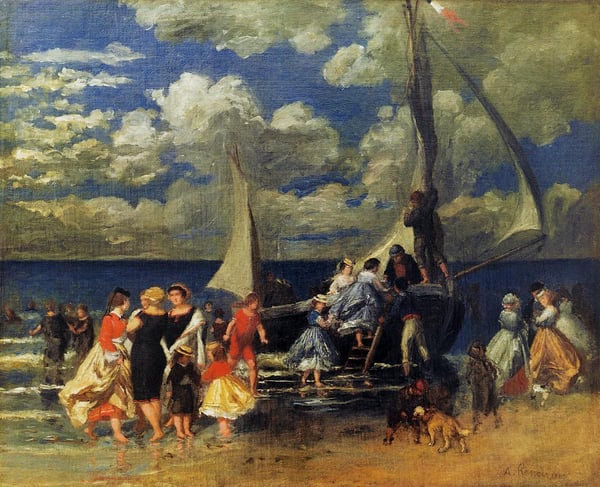
Pierre-Auguste Renoir sanatçısının The Return of the Boating Party eseri hakkında uzman analizi
Tarz: Realism · Tür: marina, genre painting
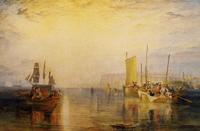
Artwork: The Return of the Boating Party by Pierre-Auguste Renoir
Style: Realism | Genre: Marina, genre painting | Period: Early Years
Expert Analysis
Despite Renoir’s later fame as a leading Impressionist, this early work firmly belongs to the Realist tradition—a crucial foundation for his artistic development. Painted during his formative years, The Return of the Boating Party exemplifies the Realist commitment to depicting contemporary life with unsentimental accuracy, while also hinting at the luminous observations that would define his later style.
Significance as a Realist Marina and Genre Painting
-
Everyday Life on the Water: As a marina (a scene of boats and waterways) merged with genre painting (scenes of ordinary people), the artwork documents a quintessentially French leisure activity. The “boating party” theme reflects the rise of recreational boating along the Seine, a subject that fascinated Realist and later Impressionist painters. Renoir captures not a heroic maritime event but a quiet, unglamorous return—people, perhaps workers or middle-class families, ending a day on the water. This ordinariness is a hallmark of Realism’s rejection of idealized history painting.
-
Realist Technique and Palette: In this early period, Renoir’s brushwork is more restrained than his later feathery Impressionist strokes. The composition is solidly structured, with clear outlines and a subdued, earthy palette—browns, muted greens, and greyed blues—that prioritizes tonal accuracy over atmospheric shimmer. The figures are carefully delineated, their postures and clothing suggesting specific social types rather than generalized archetypes. This precision aligns with Courbet’s Realist manifesto: to paint “the living, the real, the possible.”
-
Transitional Role within Renoir’s Career: The painting marks a pivotal moment. While firmly Realist in execution, the choice of subject—a casual boating outing—foreshadows the Impressionist obsession with modern leisure and fleeting light. Renoir is already drawn to the interplay of water, sky, and human activity, but here he records it with the documentary clarity of a Realist observer. The work thus bridges his academic training (evident in the careful modeling of figures) and the radical new vision he would soon develop with Monet and Sisley.
What Makes It Significant
- Document of Social Change: It provides a visual record of the newly accessible waterways, reflecting how Realists turned their gaze to the everyday pleasures of the emerging bourgeoisie and working class.
- Foundation for Impressionism: The painting contains the seeds of Renoir’s future fascination with water reflections and outdoor sociability—themes that would bloom into masterpieces like Luncheon of the Boating Party. Here, however, that fascination is still grounded in Realist factuality.
- Rare Early Example: As a work from Renoir’s early years—before he fully embraced Impressionism—it offers invaluable insight into the artist’s technical and thematic evolution, showing a painter learning to see modern life with the unflinching eye of a Realist.
In sum, The Return of the Boating Party is significant precisely because it is a Realist painting in an artist who would later change art history as an Impressionist. It anchors Renoir’s roots in the honest, socially aware observation of his time, making his later departure into light and color all the more remarkable.
Museum / Gallery
Görsel olarak benzer
İlişkili kompozisyon ve renk paletine sahip 20 eser
Beach Scene, Trouville
Eugene Boudin
Coastal Landscape
Melbourne Havelock Hardwick
Scheveningen Beach
Edward William Cooke
Am Lagerfeuer
Bengt Nordenberg
Scheveningen, Holland
James Webb
Farewell to the Fleet
Andreas Achenbach
Storm and rain in a Dutch harbor
Andreas Achenbach
The Beach at Scheveningen
Simon de Vlieger
[Unkown]
Carl Frederik Sorensen
Fish market in Ostend
Andreas Achenbach
Sunset Glow (recto)
Thomas Pollock Anshutz
Beach Scene
Eugene Boudin
Fisherwomen on the Beach, Valencia
Joaquín Sorolla
Fishermen and Sailboats near Trouville
Eugene Boudin
Beach Scene
William Collins
On the Dutch Coast
James Webb
Harbour Scene
Samuel Prout
Douarnenez, Fishing Boats at Dockside
Eugene Boudin
Brighton Sands
Edward William Cooke
Sunrise, Whiting Fishing at Margate
J.M.W. Turner