
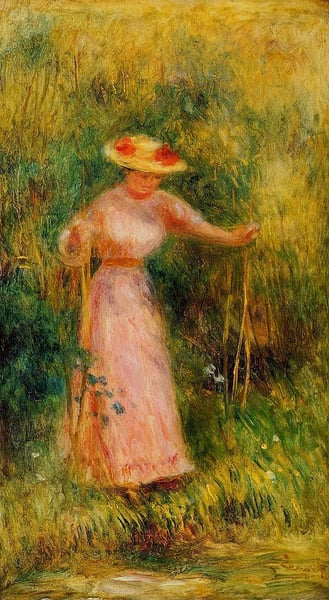
Expert analysis of Pierre-Auguste Renoir’s The Swing
Style: Impressionism · Genre: genre painting
Artwork: The Swing (La Balançoire)
Artist: Pierre-Auguste Renoir
Style: Impressionism
Genre: Genre painting
Period: Later Years
Renoir’s The Swing exemplifies the mature phase of his Impressionist practice, where he increasingly turned to intimate, joyful scenes of modern life. As a genre painting, it captures a fleeting, unposed moment—two women and a child in a sun-dappled garden, one woman gently swinging while her companion watches. The work’s significance lies in how Renoir uses the Impressionist toolkit to transform a simple social interaction into a study of light, color, and atmosphere.
Key features that define its importance within Impressionism and Renoir’s later years:
- Luminous brushwork and broken color: The canvas is alive with soft, feathery strokes that dissolve solid forms into shimmering patches of light. Sunlight filters through leaves, casting dappled patterns on the figures’ dresses and the ground. Renoir avoids black shadows, instead using violet, blue, and green tones to suggest depth—a hallmark of high Impressionism.
- Celebration of leisure and femininity: True to Impressionist genre painting, The Swing depicts a carefree, bourgeois pastime. The woman’s flowing white dress and the gentle motion of the swing evoke a sense of weightless pleasure. Renoir’s later years often focused on sensuous, optimistic subjects, and this work shows his enduring fascination with the play of light on human skin and fabric.
- Compositional immediacy: The scene feels candid, as if glimpsed through the trees. The figures are slightly off-center, and the swing’s arc pulls the viewer’s eye diagonally across the canvas. This informal arrangement, coupled with cropped edges, suggests a snapshot—a moment frozen in time, which was a core goal of Impressionism.
- Mastery of outdoor light: Unlike earlier genre painters who staged interiors, Renoir painted en plein air in a friend’s garden (the same setting as Dance at Le Moulin de la Galette). The dappled sunlight becomes the true subject, uniting the figures with their environment. This integration of human activity with natural light is a defining achievement of Renoir’s later period.
Significance in context:
The Swing stands as a testament to Renoir’s ability to merge genre painting’s narrative charm with Impressionism’s radical optical experiments. It captures the fleeting beauty of modern life—a moment of innocence and delight—while demonstrating how the movement’s later years refined its techniques into a poetic, almost tactile celebration of everyday joy. The painting remains a quintessential example of how Impressionism transformed ordinary scenes into luminous, atmospheric masterpieces.
Museum / Gallery
Genre
Style
Visually similar
20 works with related composition and palette
Young Woman Taking a Walk
Pierre-Auguste Renoir
Young Woman in Red in the Fields
Pierre-Auguste Renoir
Woman in a Landscape
Pierre-Auguste Renoir
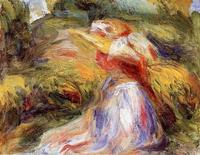
Young Woman in a Hat
Pierre-Auguste Renoir
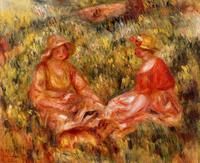
Two Women in the Grass
Pierre-Auguste Renoir
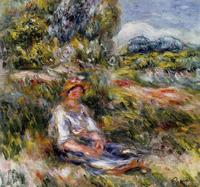
Young Girl Seated in a Meadow
Pierre-Auguste Renoir
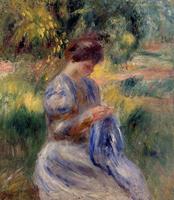
The Embroiderer (Woman Embroidering in a Garden)
Pierre-Auguste Renoir
Head of a Young Woman (Red Hat)
Pierre-Auguste Renoir
Woman in a Blue Dress, Standing in the Garden of Saint Cloud
Pierre-Auguste Renoir
Young Woman Seated on the Grass
Pierre-Auguste Renoir
Aline Charigot with a Dog
Pierre-Auguste Renoir
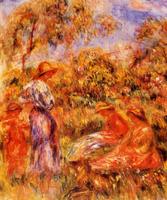
Three Women and Child in a Landscape
Pierre-Auguste Renoir
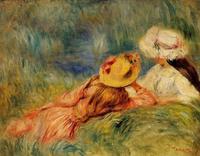
Young Girls by the Water
Pierre-Auguste Renoir
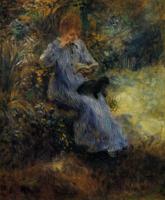
Woman with a Black Dog
Pierre-Auguste Renoir
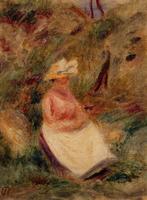
Young Girl in the Woods
Pierre-Auguste Renoir
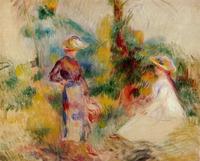
Two Women in a Garden
Pierre-Auguste Renoir
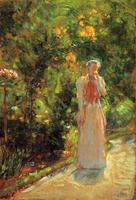
Mrs. Hassam in the Garden
Childe Hassam
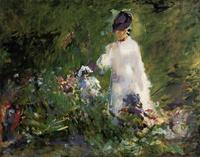
Young woman among the flowers
Edouard Manet
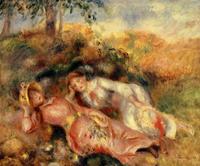
Reclining Women
Pierre-Auguste Renoir
In the garden
Giuseppe De Nittis