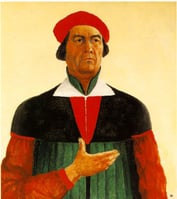
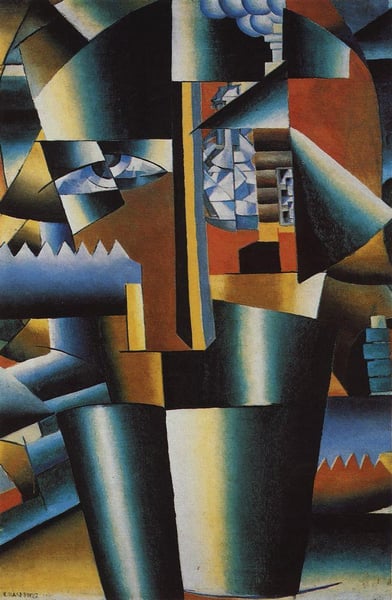
Análisis experto de Portrait of Ivan Kliun de Kazimir Malevich
Estilo: Cubo-Futurism · Género: portrait
Expert Analysis: Portrait of Ivan Kliun by Kazimir Malevich
This portrait stands as a pivotal example of Cubo-Futurism, a uniquely Russian avant-garde movement that fused the fractured planes of Cubism with the dynamic energy and machine-age velocity of Futurism. Malevich’s work here is significant not merely as a representation of his fellow artist Ivan Kliun, but as a transitional artifact—a precise moment when representational portraiture began to dissolve into pure geometric abstraction, paving the way for Malevich’s later Suprematist breakthrough.
Key aspects of its significance within Cubo-Futurism:
-
Deconstruction of the human figure: Malevich dismantles Kliun’s face and torso into a series of sharp, overlapping facets and cylindrical volumes. The nose, cheekbones, and collar are reduced to angular, metallic-looking planes that intersect like shards of glass. This is not a psychological portrait but an analytical one—the subject is treated as a system of forms in motion.
-
Dynamic, anti-naturalistic composition: The painting’s grid of diagonal lines and offset shapes creates a sense of centrifugal energy. The head tilts, the shoulders are asymmetrical, and the background is shattered into competing spatial zones. This reflects the Futurist obsession with capturing the “vibration” of modern life, yet Malevich’s structure remains more rigorous and geometric than the Italian Futurists’ swirling motion.
-
Materiality and the machine aesthetic: The muted grays, blacks, and whites, punctuated by touches of ochre and blue, evoke industrial materials—steel, sheet metal, glass. This aligns with Cubo-Futurism’s interest in the modern urban environment and the artist as a “constructor” rather than a mere depictor.
-
Relationship to the subject: Ivan Kliun was a fellow avant-garde painter and close associate of Malevich. The portrait thus functions as a kind of formal dialogue between two artists exploring the limits of representation. By rendering Kliun as a faceted construction, Malevich signals that the human form is no longer an end in itself but a springboard for radical formal invention.
Why it matters: Portrait of Ivan Kliun is a key document of the leap from recognizable figuration to total abstraction. Within a few years, Malevich would paint Black Square and renounce the object entirely. Here, the face remains—but it is already broken into geometry, shimmering on the edge of disappearance. This work embodies the restless, experimental spirit of Russian Cubo-Futurism, where the portrait genre became a laboratory for the art of the future.
Género
Estilo
Visualmente similares
20 obras con composición y paleta relacionadas
Bodegón Cubista
Maria Blanchard
Window opened to the street Penthieure
Pablo Picasso
Bureau and Room
Kazimir Malevich
Composition
Fernand Leger
La Table
Louis Marcoussis
Head
Auguste Herbin
Fruit Bowl, Pipe and Newspaper
Juan Gris
Peasant Woman with Buckets
Kazimir Malevich
Naked model in the workshop
Fernand Leger
Composition
Georges Valmier
The typographer
Fernand Leger
Vanity Box
Kazimir Malevich
The lady at the piano
Kazimir Malevich
Bodegón Con Frutero, Periódico Y Vaso. Naturaleza Muerta (La Botella)
Maria Blanchard
Cubist Composition
Maria Blanchard
Newspaper, Glass and Pear
Juan Gris
Cubist Composition
Maria Blanchard
Propellers 2nd state
Fernand Leger
Naturaleza Muerta
Maria Blanchard
Seated Lovers
Carloluigi Colombo