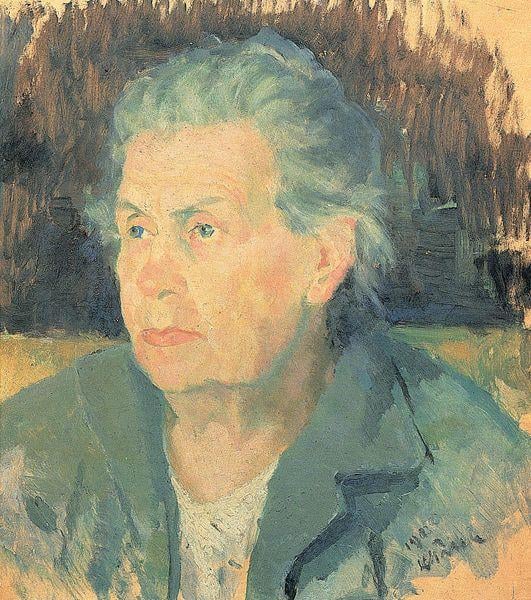
Portrait of Mother
Analisi esperta di Portrait of Mother di Kazimir Malevich
Stile: Realism · Genere: portrait
Expert Analysis: "Portrait of Mother" by Kazimir Malevich
Though Kazimir Malevich is historically celebrated as the father of Suprematism—a radical non-objective style that abandoned representation altogether—his early work in Realism reveals the foundational discipline that made his later avant-garde breakthroughs possible. "Portrait of Mother" stands as a crucial touchstone in understanding Malevich’s artistic evolution.
Style & Context (c. 1900–1905)
Painted during his formative years, this work belongs to Malevich’s period of academic Realism, heavily influenced by the Russian Peredvizhniki (The Wanderers) and the penetrating psychological depth of Ilya Repin. The style is marked by meticulous observation, earthy tonalities, and a somber, intimate mood. At this stage, Malevich was grounded in the humanist tradition, mastering anatomy, light, and texture—qualities he would later systematically dismantle.
Significance within Malevich’s Career
This portrait is significant precisely because it contrasts so starkly with his later iconic works like Black Square (1915). It demonstrates that Malevich’s revolutionary move toward abstraction was not born from technical inability but from deliberate choice. Portrait of Mother shows his command of realistic representation: the careful modeling of facial planes, the soft fall of light across the sitter’s features, and the restrained palette of browns, grays, and blacks. The subject—his mother—is depicted with quiet dignity and a melancholic directness, suggesting a personal, emotional resonance.
Thematic & Historical Significance
Within the Realist portrait genre, the painting holds importance as a document of early 20th-century Russian life. The mother’s worn expression and simple attire evoke the hardships of the provincial lower-middle class, aligning with the social consciousness that defined the Wanderers. At the same time, it prefigures Malevich’s later tendency to reduce form: the background is kept flat and non-descript, the clothing simplified into broad masses. One can already sense his latent impulse to compress volume into shape—a seed that would later bloom into geometric abstraction.
Why It Matters
For art historians, Portrait of Mother is not merely a student exercise; it is a foundational artifact that contextualizes Malevich’s entire project. It proves that his leap into Suprematism was a conscious rejection of the very skills he had mastered. In this way, the portrait becomes a bridge between tradition and rupture, reminding us that avant-garde innovation often rests on a bedrock of classical training.
Visivamente simili
20 opere con composizione e palette affini
Self Portrait
Tetyana Yablonska
Portrait of the artist's mother
Umberto Veruda
Portrait of Madame Monnon, the Artist s Mother in Law
Theo van Rysselberghe
Sister Maria Ciureanu
Ion Theodorescu-Sion
Aline
Lucian Freud
The Painter's Mother II
Lucian Freud
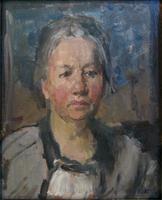
Portret Van Johanna Van Gogh-Bonger
Isaac Israels
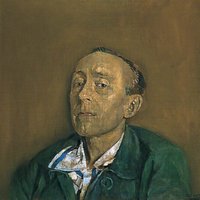
The Honourable Edward Sackville West
Graham Sutherland
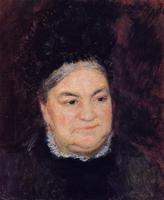
Portrait of an Old Woman (Madame le Coeur)
Pierre-Auguste Renoir
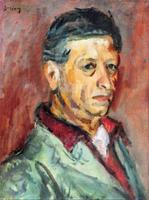
Berény Róbert Önarckép, 1940
Berény Róbert
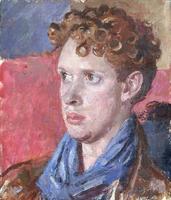
Dylan Thomas
Augustus John
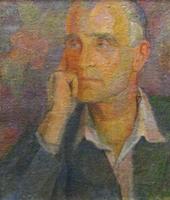
Portrait of the Artist R. Turin
Margit Selska
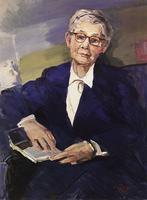
Portrait of art critic Lydia Durnovo
Martiros Sarian
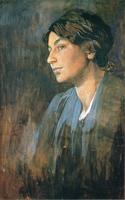
Portrait of Marushka, Artist s Wife
Alphonse Mucha
Portrait of a Woman
Abbott Handerson Thayer
Portrait of the Artist's Mother
Konstantin Somov
Portrait of L.I. Shestakova, sister of composer Mikhail Glinka
Ilya Repin
Portrait of Maria van Rysselberghe
Theo van Rysselberghe
Adolf Loos
Oskar Kokoschka
Self-Portrait
Roderic O'Conor