Analyse experte de Reaper de Kazimir Malevich
Style : Cubo-Futurism · Genre : genre painting
Analysis of "Reaper" by Kazimir Malevich
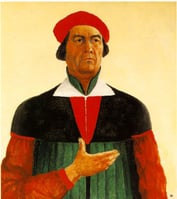
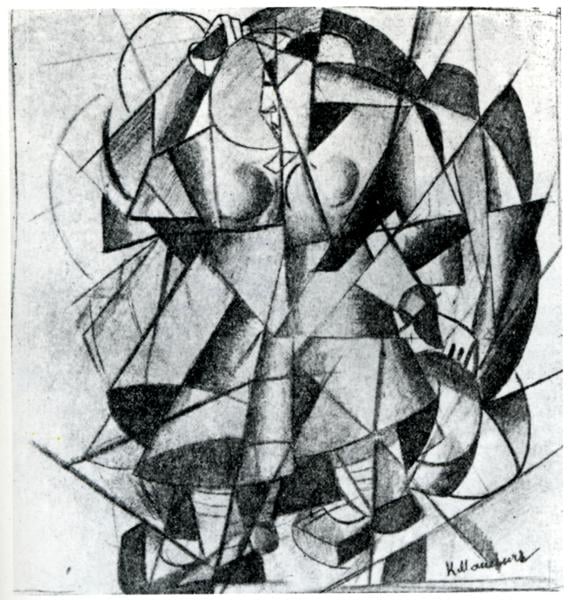
Kazimir Malevich’s Reaper stands as a pivotal work within the Cubo-Futurist movement, showcasing the artist’s early engagement with the fragmentation of form and the dynamism of rural life before his shift toward pure abstraction. The painting is classified as a genre scene, depicting a peasant laborer—a common subject in Russian avant-garde art—but Malevich transforms this everyday figure into a bold, geometric composition.
Significance within Cubo-Futurism and its Period:
-
Synthesis of Cubism and Futurism: The work exemplifies Cubo-Futurism’s core goal: merging Cubism’s multi-perspective, faceted planes with Futurism’s emphasis on speed, motion, and modern energy. The reaper is not rendered naturalistically but as a series of intersecting, angular shapes that suggest both solidity and movement, reflecting the rhythms of agricultural labor.
-
Transitional Importance: Reaper belongs to Malevich’s pre-Suprematist phase, where he still engaged with representational subjects but pushed toward abstraction. This painting demonstrates his method of deconstructing the human figure into geometric volumes, a crucial step toward the non-objective forms he would later champion. The interplay of sharp diagonals and blocky forms reveals his fascination with the machine age even when depicting traditional work.
-
Elevation of the Common Subject: By treating a peasant reaper with the same analytical rigor applied to urban or industrial themes, Malevich elevates genre painting to a high-art inquiry into perception and structure. The figure’s faceted torso and scythe become almost iconic symbols of labor, stripped of sentimentality and reframed as a dynamic interaction of color and shape.
-
Color and Composition: The palette—likely earthy yellows, greens, and browns with contrasting blacks or reds—anchors the work in the Russian folk tradition while the fractured composition aligns with European avant-garde experimentation. This fusion makes Reaper a landmark of Russian Cubo-Futurism, demonstrating how regional identity could be expressed through an international modernist language.
In essence, Reaper is significant as a bridge between Malevich’s early narrative concerns and his later Suprematist breakthroughs, while also encapsulating the Cubo-Futurist ethos of capturing life’s energy through geometry.
Genre
Style
Visuellement similaire
20 œuvres à la composition et à la palette proches
Pilot
Kazimir Malevich
The Piano Accordionist
Pablo Picasso
Figure
Georges Valmier
Man with a Guitar
Georges Braque
Poet
Pablo Picasso
Pecheurs sur la riviere
Jean Degottex
Looping
Félix Del Marle
Man with guitar
Pablo Picasso
Portrait of an Actor (Félix Barré)
Jacques Villon
Peasant Woman Carrying Buckets with Water
Kazimir Malevich
Untitled
Andre Lanskoy
The Portuguese (The Emigrant)
Georges Braque
Kneeling nude
Theo van Doesburg
Synchromy
Morgan Russell
A glass
Pablo Picasso
Untitled (Cubist Figure)
Arshile Gorky
Untitled
Andre Lanskoy
Encounter
Ernst Ludwig Kirchner
Improvisation (plate, Page 11) from the Periodical Der Schwarze Turm, Vol. 1, No. 3 (July 1919)
Georg Tappert
Still life with Compote
Lyubov Popova