Analisi esperta di Beggar man and woman di Rembrandt
Stile: Baroque · Genere: genre painting
Expert Analysis of "Beggar man and woman" by Rembrandt
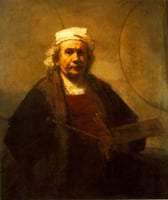
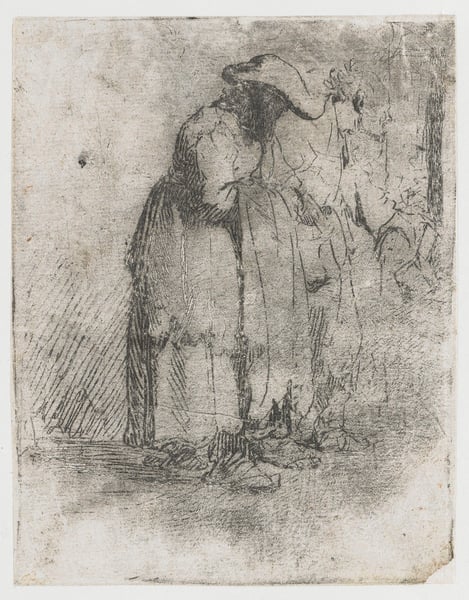
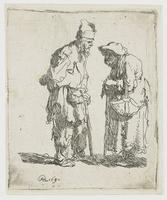
Rembrandt’s Beggar man and woman is a quintessential Baroque genre painting that captures a moment of everyday life with profound psychological depth. Executed during the Dutch Golden Age, the work exemplifies the period’s shift away from idealized religious or mythological scenes toward the unvarnished realities of society. Rembrandt elevates the marginal figures of his time—beggars—to subjects worthy of serious artistic attention, demonstrating a core Baroque interest in the dramatic and the authentic.
Significance within Baroque art:
-
Realism and human dignity: Unlike many Baroque artists who focused on grandeur or theatrical emotion, Rembrandt treats the beggars with quiet respect. The subtle interplay of light and shadow (chiaroscuro) typical of Baroque painting here serves not to glorify but to reveal texture—the worn fabric, weathered hands, and contemplative expressions. The pair are not caricatures but individuals caught in a private, unposed moment. This humanistic approach marks a departure from the period’s frequent glorification of wealth or saintly suffering.
-
Genre painting as social commentary: In the Baroque era, genre scenes often carried moral or allegorical undertones. Beggar man and woman likely contrasts the transience of material wealth with the permanence of human struggle, a theme resonant with Calvinist Dutch society. Rembrandt’s emphasis on the resilience and shared humanity of these figures challenges viewers to see dignity where many saw only poverty, making the work a subtle critique of social hierarchies.
-
Technical mastery within the style: Rembrandt’s loose, expressive brushwork and his ability to suggest form with minimal detail are hallmarks of his late Baroque approach. The painting’s muted palette and soft focus on the figures’ faces draw the eye to their eyes and hands—the silent language of survival. This technique underscores the Baroque fascination with capturing the fleeting, the imperfect, and the emotionally charged.
Conclusion: In Beggar man and woman, Rembrandt transforms a simple genre subject into a meditation on the human condition. Its significance lies in how it quietly reframes Baroque drama: not through epic gestures or divine light, but through the tender, unadorned truth of two people who exist on the margins. It stands as a testament to the artist’s belief that every life, no matter how humble, deserves to be seen with compassion and clarity.
Visivamente simili
20 opere con composizione e palette affini
The strolling musicians
Rembrandt
Beggar man and woman behind a bank
Rembrandt
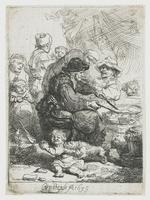
The pancake woman
Rembrandt
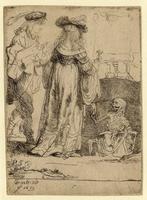
Death appearing to a wedded couple from an open grave
Rembrandt
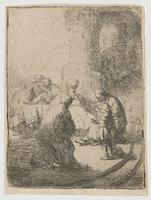
Christ disputing with the doctors
Rembrandt
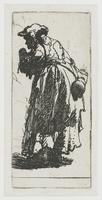
Old beggar woman with a gourd
Rembrandt
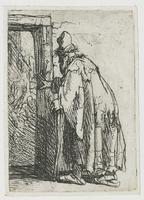
The blindness of Tobit
Rembrandt
Les Propos de Thomas Vireloque: Ego! ego...ego - all equal (egaux-ego, buth pronounced alike)
Paul Gavarni
The Angel Departing from the Family of Tobias
Rembrandt
A woman making water
Rembrandt
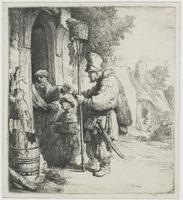
The rat poison peddler (The rat catcher)
Rembrandt
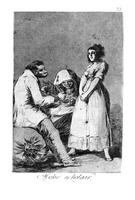
It is better to be idle
Francisco Goya
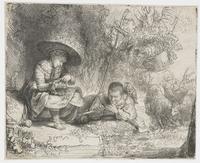
The flute player
Rembrandt
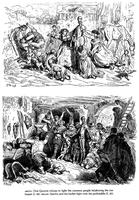
Don Quixote
Gustave Dore
Jesus Disputing with the Doctors
Rembrandt
The Schoolmaster
Rembrandt
Beggar man and beggar woman conversing
Rembrandt
Christ and the woman of Samaria an arched print
Rembrandt
The Spanish Gypsy
Rembrandt
Simeon`s hymn of praise
Rembrandt