
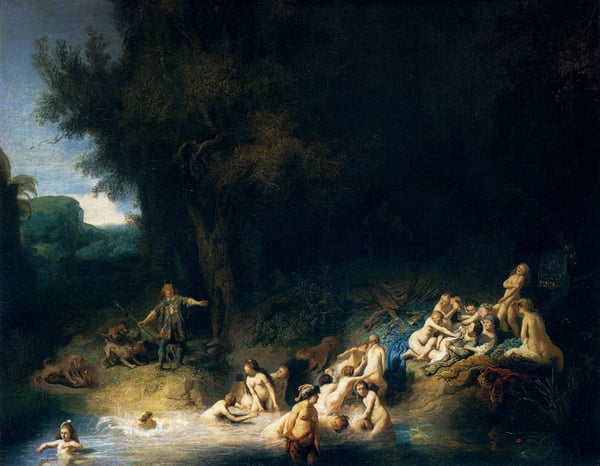
Expert analysis of Rembrandt’s Diana Bathing, with the Stories of Actaeon and Callisto
Style: Baroque, Tenebrism · Genre: mythological painting
Expert Art Historical Analysis
Artwork: Diana Bathing, with the Stories of Actaeon and Callisto
Artist: Rembrandt van Rijn
Style: Baroque, Tenebrism
Genre: Mythological painting
This work exemplifies Rembrandt’s masterful synthesis of Baroque dynamism and the chiaroscuro extremes characteristic of Tenebrism. Within the Baroque period—a time defined by dramatic intensity, emotional immediacy, and theatrical composition—Rembrandt subverts the typical heroic treatment of mythological subjects. Instead, he focuses on the human vulnerability and psychological complexity of the goddess Diana and her attendants.
The painting is significant for its dual narrative structure: it simultaneously presents the stories of Actaeon (the hunter who stumbles upon Diana bathing and is transformed into a stag) and Callisto (a nymph seduced by Jupiter and later punished by Diana). By compressing two episodes into one spatial and temporal moment, Rembrandt amplifies the Baroque fascination with interconnected, unfolding drama. The use of Tenebrism—with stark pools of light emerging from deep, enveloping shadow—directs the viewer’s eye across the canvas, heightening the tension of discovery, shame, and impending punishment. Light falls selectively on Diana’s exposed body, Actaeon’s startled face, and Callisto’s pregnant belly, creating a moral and emotional hierarchy that underscores themes of voyeurism, transgression, and divine retribution.
Rembrandt’s treatment departs from the idealized nudes of Italian Renaissance or French Baroque predecessors. Here, the figures are palpably fleshly, their poses awkward and naturalistic, their expressions arrested mid-motion. This psychological realism, fused with Tenebrist chiaroscuro, makes the mythological scene feel both intimately human and ominously supernatural. The painting thus stands as a landmark of Baroque art: it uses tenebrist lighting not merely for ornamental effect but to interrogate the fraught boundary between the sacred and the profane, the divine gaze and the mortal trespasser.
Museum / Gallery
Visually similar
20 works with related composition and palette
The Mermaid's Haunt
Julius Caesar Ibbetson
Narcissus and Echo
Benjamin West
Diana and Actaeon
Jacob Jordaens
Pharoah's Daughter Discovers Moses in the Rush Basket
Ferdinand Bol

Apolo Visitando Admeto
Nicolas Antoine Taunay
Farao's Dochter Vindt Mozes in Het Biezen Mandje.
Ferdinand Bol
Nymphes au bois
Karl Becker
Landscape with Nymphs
Jan Dirksz Both
Leda and the swan
Vieira Portuense
Diana and Actaeon
Thomas Gainsborough
Le Bain De Diane
Jean-Baptiste van Loo
Nymphs and Satyrs
Peter Paul Rubens
Nymphs bathing
Jan Brueghel the Elder
The Judgment of Paris
Joachim Wtewael
Pan punished by the Nymphs
Jacob Jordaens
Landscape with Mercury and Argus
Jan Dirksz Both
The Four Elements
Jan Brueghel the Younger
Diana and Actaeon
Jacopo Bassano
Apollo and Marsyas
Giovanni Battista Tiepolo
Treated by the Muses
Jacob Jordaens