
Expertenanalyse zu Rembrandts Flora
Stil: Baroque · Genre: portrait
Expert Analysis: "Flora" by Rembrandt (Baroque, Portrait)
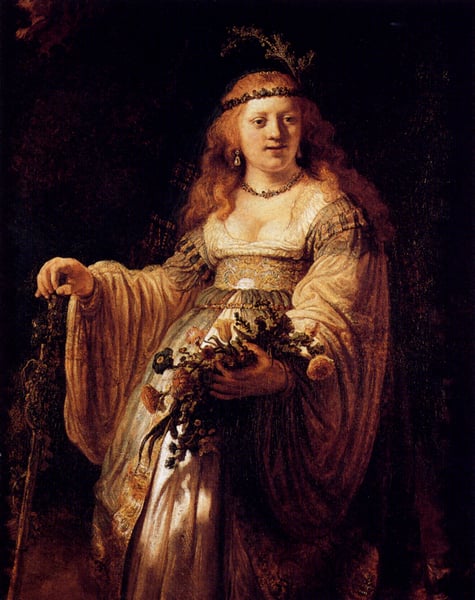
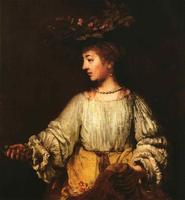
Rembrandt’s Flora (likely depicting his wife Saskia as the Roman goddess of spring) exemplifies the Baroque era’s fusion of realism, theatricality, and psychological depth. While the work is categorized as a portrait, it transcends conventional likeness by embedding mythological allegory into an intimate, naturalistic study.
Significance within the Baroque Period:
- Light as Narrative: Rembrandt’s hallmark chiaroscuro (dramatic light-and-shadow) draws the eye to Flora’s face and the cascade of flowers in her hair. The soft, warm illumination models her features with three-dimensionality, while deep shadows in the background and her collar heighten the sense of presence. This treatment of light not only showcases Baroque technical virtuosity but also infuses the figure with a subtle, inner radiance.
- Psychological Intimacy: Unlike the idealized, detached deities of earlier Mannerism, Rembrandt presents Flora as a tangible, approachable woman. Her direct gaze and gentle smile convey both self-possession and vulnerability—a humanizing approach that aligns with the Baroque interest in emotional engagement with the viewer.
- Blurring of Genres: The painting merges portraiture with history/allegorical painting. Saskia’s recognizable features ground the mythological subject in contemporary Dutch life. The lavish floral wreath and staff (symbols of spring and renewal) are rendered with botanical precision, yet they remain secondary to the sitter’s character. This integration of the real and the symbolic was a hallmark of Rembrandt’s mature work.
- Brushwork and Texture: Loose, expressive strokes in the flowers and fabric contrast with the carefully modeled skin, demonstrating Rembrandt’s mastery of varied paint application. The rough, tactile quality of the petals and the shimmer of silk evoke a sensory richness that invites close viewing.
Why It Matters:
Flora is significant because it redefines mythological portraiture: a goddess becomes a neighbor, a wife, a living woman. Rembrandt elevates the mundane to the timeless, using the Baroque toolkit of light, shadow, and naturalism to create an image that feels both immediate and eternal. It stands as a testament to his ability to find the extraordinary within the everyday—a defining characteristic of Dutch Baroque genius.
Museum / Gallery
Visuell ähnlich
20 Werke mit ähnlicher Komposition und Farbpalette
Saskia van Uylenburgh in Arcadian Costume
Rembrandt
Flora
Rembrandt
Portrait of Anne Carr, Countess of Bedford
Anthony van Dyck
Portrait Présumé De Julie D'Angennes En Costume D'Astrée
Claude Deruet
Young Russian
Leopold Pollak

Patricipance of Venice
Alexandre Cabanel
Portrait of a Young Lady
Frans van Mieris the Elder
A young woman at her toilet
Rembrandt
Helena Fourment
Peter Paul Rubens
Artemisia
Rembrandt
Portrait of Portrait of a Woman Dressed as a Huntress
Ferdinand Bol
Ophelia
Henri Lehmann
Portrait of a Lady
John Michael Wright

Woman at Her Dressing Table
Ferdinand Bol
Portrait of a Lady
Titian
Mary, Wife of Sir Charles Scarburgh
John Hayls

Queen Henrietta Maria Of England
Anthony van Dyck
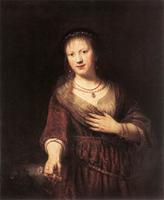
Saskia with a Red Flower
Rembrandt
Portrait of Hendrickje Stofells as Flora
Rembrandt
Catherine Dormer Daughter of Montagu Bertie 2nd Earl of Lindsey
John Michael Wright