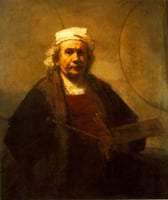
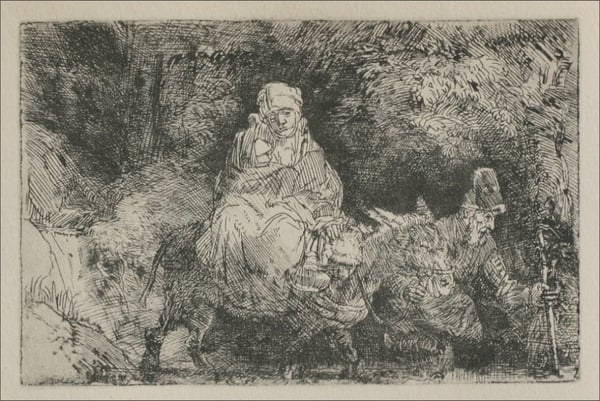
Expert analysis of Rembrandt’s Jesus and his Parents Returning from Jerusalem
Style: Baroque · Genre: religious painting
This analysis is based solely on the provided structured facts: Artwork: Jesus and his Parents Returning from Jerusalem by Rembrandt; Style: Baroque; Genre: religious painting.
Expert Art Historical Analysis
Rembrandt’s Jesus and his Parents Returning from Jerusalem exemplifies the core tenets of Baroque religious painting while simultaneously subverting its typical grandeur. The work’s significance lies in its intimate, human-centered approach to a biblical narrative—a hallmark of Rembrandt’s genius within the Baroque period.
In the Baroque tradition, religious scenes were often characterized by dramatic action, stark chiaroscuro, and an emotional intensity designed to inspire devotion. Rembrandt adheres to this by using his signature tenebrist lighting to sculpt the figures from a dark, indeterminate background, focusing the viewer’s attention on the psychological exchange between the Holy Family. However, instead of depicting a moment of divine epiphany or triumphant action (as many Baroque masters would), he chooses the quiet, fraught moment of the return journey from Jerusalem, the tension of the “Finding in the Temple” episode lingering in the air.
What makes this painting profoundly significant within Baroque religious art is Rembrandt’s radical humanization of the sacred subject. Jesus is not a small deity but a troubled adolescent. Mary and Joseph are not idealized saints but weary, concerned parents. The light does not highlight a miracle but rather the emotional weight of a parent-child misunderstanding. Rembrandt turns a biblical story into a universal family drama, using the Baroque language of shadow, volume, and gesture to explore guilt, relief, and the dawning self-awareness of a messianic child. This fusion of high Baroque technique with profound psychological realism marks the painting as a masterful redefinition of what a religious painting could be: not a spectacle of the divine, but an intimate meditation on the ordinary within the extraordinary.
Genre
Style
Visually similar
20 works with related composition and palette
The flight into Egypt crossing a brook
Rembrandt
The Flight into Egypt
Rembrandt
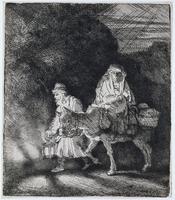
The flight into Egypt a night piece
Rembrandt
A boy on a donkey
Fyodor Bronnikov
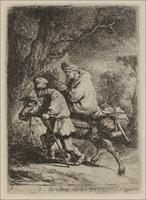
The Flight into Egypt
Rembrandt
Mule Train Crossing the Sierras
Frederic Remington
Flight into Egypt
Maurice Prendergast
Vegetables
Martín Tovar y Tovar
A Merry Return
Karl Bryullov
Robert Besnard and His Donkey
Paul-Albert Besnard
The Donkey
Nikolaos Lytras
Christ s Entry into Jerusalem
Albrecht Durer
Boy and Girl Riding Donkeys
Isaac Israels
Mikhail Nikolaevich and Nikolay Nikolaevich Raevsky
Filippo Palizzi
Sketch of a Donkey
Vincent van Gogh
Family of milk seller
Le Nain brothers
Stable with two donkeys and three figures
Filippo Palizzi

The Return from the Mill
Rosa Bonheur
The bride of Mitrovica
Gazmend Freitag
Will the student be wiser?
Francisco Goya