
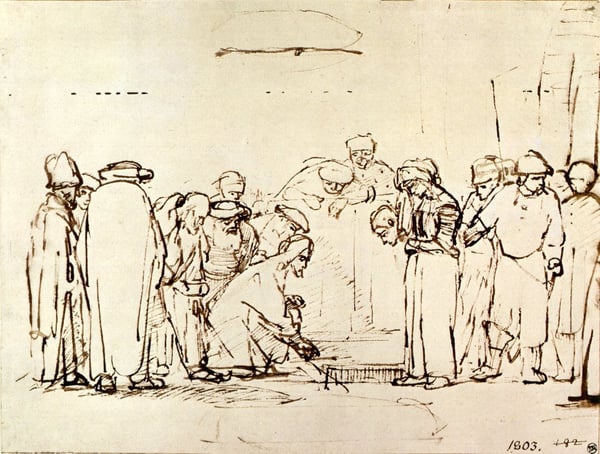
Analisi esperta di Jesus and the adulteress by Rembrandt di Rembrandt
Stile: Baroque · Genere: sketch and study
Expert Analysis: "Jesus and the Adulteress" by Rembrandt
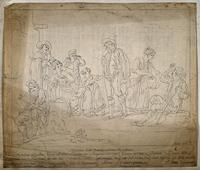
This artwork, a sketch and study by Rembrandt, occupies a unique position within the Baroque tradition. While the finished painting of the same subject is renowned for its masterful chiaroscuro and psychological depth, this preparatory work reveals the raw, experimental core of Rembrandt’s genius.
Significance within the Baroque Style and Rembrandt’s Oeuvre:
-
Emphasis on Spontaneity and Process:
As a sketch and study, the piece departs from polished Baroque grandiosity. Instead, it captures Rembrandt’s immediate, fluid thought process. The swift, economical lines and loose washes demonstrate his ability to distill a complex biblical narrative—the confrontation between Jesus and the accusers—into its essential emotional and compositional elements. This rawness prefigures the later 17th-century shift toward valuing artistic disegno (the idea or initial design) as a window into the creator’s mind. -
Baroque Drama through Minimal Means:
Baroque is defined by drama, movement, and tenebrism. Here, Rembrandt achieves all three without heavy shadow or painted light. The sharp contrast between the few dark ink marks and the blank paper functions as a form of proto-chiaroscuro, guiding the viewer’s eye to the central figure of Jesus. The slight hatching around the adulteress suggests her vulnerability, while the vague, angular forms of the accusers imply accusation and crowd pressure—all through the sparest of gestures. -
Innovative Genre:
The fact that Rembrandt devoted a full sketch to this specific moment, rather than the more frequently painted “Christ and the Woman Taken in Adultery,” underscores his interest in human judgment and mercy. In Baroque art, studies were often preparatory for larger commissions; here, the sketch itself is a finished statement. It stands as a testament to Rembrandt’s belief that a single, fleeting notation could carry as much theological weight as a finished canvas. -
Influence on Later Art:
This study embodies the Baroque’s evolution from static iconography to dynamic expression. Rembrandt’s handling—loose, almost calligraphic—anticipates the Romantic and Impressionist emphasis on sketch-like immediacy. The work is significant because it demonstrates how Baroque masters could break their own rules of finish to explore narrative truth.
Conclusion:
In “Jesus and the Adulteress,” Rembrandt elevates a sketch from mere preparatory tool to a work of art worthy of analysis. It is a pivotal example of Baroque art distilling complexity into simplicity, and it reveals the artist’s relentless focus on human emotion over decorative detail. For scholars, it is a key to understanding how Rembrandt thought with his hand—and how Baroque art, at its finest, could be both monumental and intimately provisional.
Visivamente simili
20 opere con composizione e palette affini
Mocking of Christ
Rembrandt
Jesus Disputing the Doctors a Larger Print
Rembrandt
Christ and the Canaanite Woman
Rembrandt
Jacob shown the Bloodstained Coat of Joseph
Rembrandt
Lot and His Family Leaving Sodom
Rembrandt
Joseph Recounting His Dreams
Rembrandt
The man of Gibeah
Rembrandt
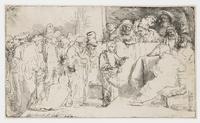
Christ disputing with the doctors
Rembrandt
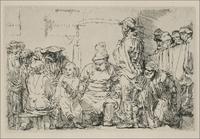
Jesus Disputing with the Doctors the Smaller Print
Rembrandt
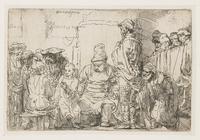
Christ seated disputing with the doctors
Rembrandt
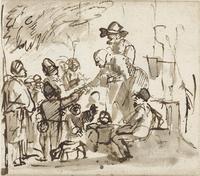
Elderly Couple Distributing Goods to Children in Open Air
Carel Fabritius
Studies of Peasant Women, and a Horseman
John Varley
Study to "Boyarynya Morozova"
Vasily Surikov
The Denial of Peter
Adam Elsheimer
Boas und Ruth
Rembrandt
Boyarynya Morozova (study)
Vasily Surikov
Christ appearing to the apostles
Rembrandt
The Wedding (initial sketch Catalog #G-46.002)
Chaim Goldberg
Beggar Man and Woman
Rembrandt
Several Neapolitan mutoparlant gestures
Saverio della Gatta