
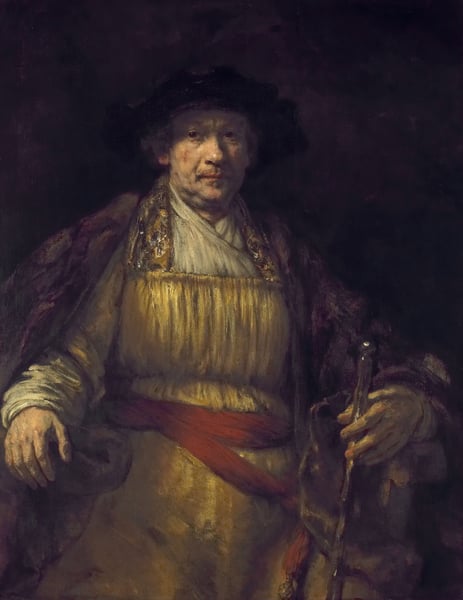
Expert analysis of Rembrandt’s Self-portrait
Style: Baroque, Tenebrism · Genre: self-portrait
This self-portrait by Rembrandt exemplifies the Baroque era’s emphasis on drama, emotion, and psychological depth, while its use of tenebrism heightens the sense of intimacy and introspection.
As a self-portrait, the work belongs to a genre Rembrandt repeatedly turned to throughout his career, creating a unique visual autobiography. Here, the artist employs tenebrism—a stark contrast of light and shadow derived from Caravaggio—to focus attention on the face and hands, while the background recedes into near darkness. This technique not only intensifies the theatricality typical of Baroque art but also forces the viewer into an immediate, personal encounter with the artist’s gaze.
The significance lies in how Rembrandt transforms a conventional self-portrait into a profound study of individuality and mortality. The play of light across the features—perhaps highlighting the lines of age or the directness of the eyes—conveys a sense of psychological realism that was revolutionary for the period. Unlike many formal Baroque portraits, this work feels unguarded, capturing the fleeting moment of self-examination. It demonstrates how Rembrandt merged the dramatic chiaroscuro of tenebrism with the Baroque passion for emotional truth, elevating the self-portrait from mere likeness to a universal meditation on human experience.
Museum / Gallery
Genre
Visually similar
20 works with related composition and palette
Portrait of an Old Man in Red
Rembrandt
Portrait of Hendrickje Stofells as Flora
Rembrandt
Portrait of Lizzie Ansingh
Thérèse Schwartze
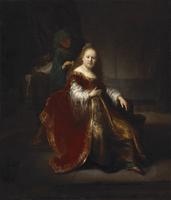
A young woman at her toilet
Rembrandt
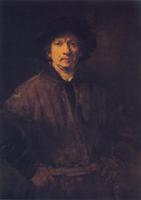
Large Self-portrait
Rembrandt
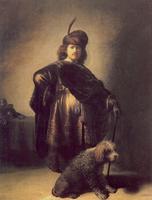
Self-portrait in oriental attire with poodle
Rembrandt
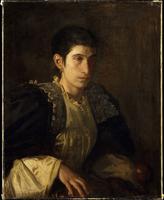
Signora Gomez d Arza
Thomas Eakins
Elizabeth Hamilton
Henry Raeburn
Portrait of Johann Melchior Dinglinger
Antoine Pesne
Portrait of an old Woman
Rembrandt
Portret Królowej Ludwiki Marii Gonzagi De Nevers
Ferdinand Bol
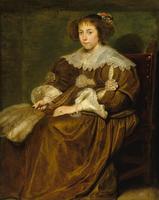
Portrait of a Young Woman
Cornelis de Vos
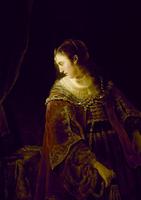
Woman at Her Dressing Table
Ferdinand Bol
Terzi
Nicola Samorì
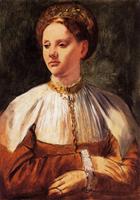
Portrait of a Young Woman (after Bacchiacca)
Edgar Degas
Portrait of an old woman
Ilya Repin
Portrait of Geertruy Gael, Second Wife of Gerrit Gerritsz Schouten
Jan Steen
Portrait of Helene Fourment with Gloves
Peter Paul Rubens
Artemisia
Rembrandt
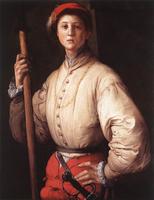
Halberdier
Jacopo Pontormo