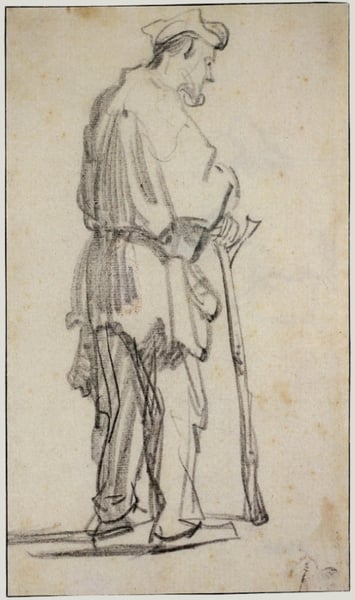
Analisi esperta di Standing Beggar Turned to the Right di Rembrandt
Stile: Baroque · Genere: sketch and study
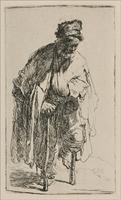
As an expert art historian, I can offer the following analysis of "Standing Beggar Turned to the Right" by Rembrandt, based solely on the provided facts.
This work is a sketch and study executed within the Baroque style, and its significance lies in how it embodies a core tenet of that movement: the elevation of raw, human reality to a subject worthy of artistic mastery.
First, its significance within the Baroque period: The Baroque era is often associated with dramatic religious scenes and opulent portrait commissions. However, Rembrandt’s sketch stands as a powerful counterpoint, demonstrating the Baroque’s deeper commitment to naturalism and emotional truth. By choosing a marginalized figure—a beggar—as a subject for a formal study, Rembrandt aligns himself with Caravaggio’s revolutionary idea that the divine and the profane exist in the same humble flesh. The sketch captures the transient, unidealized moment of a person in distress, which was a radical form of realism for its time.
Second, its significance as a sketch and study: This artwork reveals the artist’s process. The sketch is not a finished painting, but a rapid capture of posture and psychology. In this, it showcases Rembrandt’s legendary ability to convey a complete character through swift, economical lines. The figure is turned to the right, suggesting a momentary pause in motion—a snapshot of urban existence. The bent posture and implied tattered clothing (conveyed through the sketch's energetic strokes) communicate weariness and social fragility. This study format allowed Rembrandt to build a visual vocabulary for depicting the poor with dignity, a hallmark of his later, more famous works.
In summary, "Standing Beggar Turned to the Right" is significant because it crystallizes the Baroque’s turn toward the authentic human condition, and because it demonstrates Rembrandt’s profound skill at using the simplest medium—a sketch—to extract monumental character from the most overlooked figures of society. It is a testament to the idea that in Baroque art, even a beggar’s gesture can be a subject of timeless study.
Visivamente simili
20 opere con composizione e palette affini
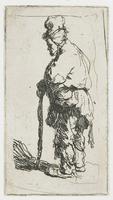
Beggar leaning on a stick, facing left
Rembrandt
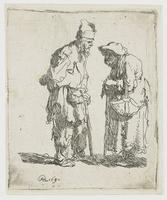
Beggar man and beggar woman conversing
Rembrandt
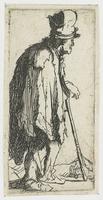
Beggar with a crippled hand leaning on a stick
Rembrandt
Farewell participating female figure
Ferdinand Hodler
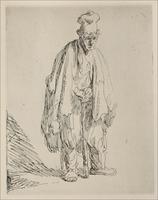
A Beggar Standing and Leaning on a Stick
Rembrandt
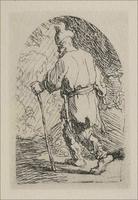
A Sketch for a Flight into Egypt
Rembrandt
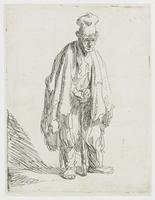
Beggar in a High Cap Standing
Rembrandt
La Ville Lointaine
Theophile Steinlen
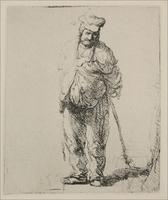
A Ragged Peasant with his Hands Behind Him
Rembrandt
La Ville Lointaine
Theophile Steinlen
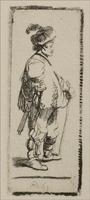
The Little Polander
Rembrandt
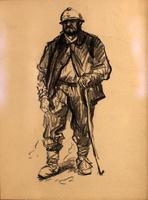
Soldiers of the First World War
Julien Le Blant
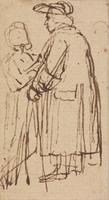
Study of a Gentleman, Called Dr. Johnson
John Flaxman
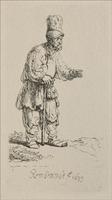
A Jew with the High Cap
Rembrandt
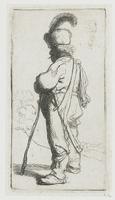
Polander leaning on a stick
Rembrandt
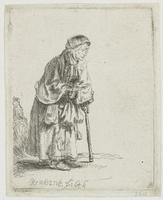
Beggar woman leaning on a stick
Rembrandt
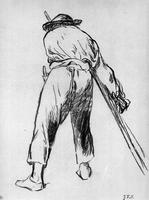
Sketch of moving farmer
Jean-Francois Millet
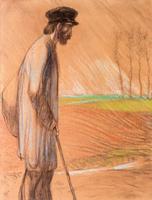
Standing Man
Theophile Steinlen
A Beggar with a Wooden Leg
Rembrandt
Peasant family on the tramp
Rembrandt