
Analisi esperta di The Conspiracy of the Batavians di Rembrandt
Stile: Baroque · Genere: history painting
Expert Art Historical Analysis: "The Conspiracy of the Batavians" (c. 1661–1662) by Rembrandt van Rijn
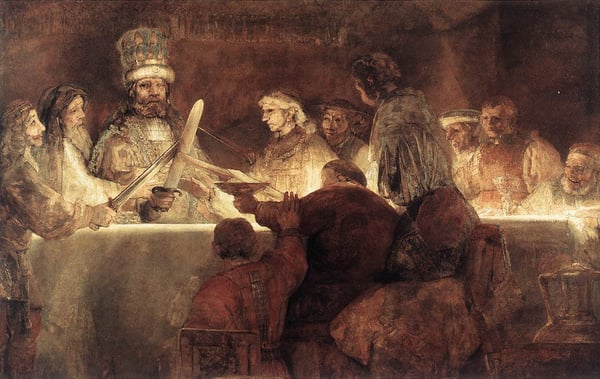
Rembrandt’s The Conspiracy of the Batavians stands as a singular and audacious achievement within the Baroque history painting tradition. Executed during the artist’s late, most introspective phase, the work was originally designed as one of twelve monumental canvases for the Amsterdam Town Hall’s gallery—a cycle meant to glorify the Dutch Revolt through the ancient Batavian uprising. The painting depicts the legendary one-eyed chieftain Claudius Civilis (right, in profile) swearing his followers to revolt against Roman rule. Here is what makes this artwork significant:
1. Radical departure from classicist decorum
Unlike the idealized, orderly compositions favored by contemporaries such as Jacob Jordaens or the official Town Hall painters, Rembrandt plunges the scene into a gritty, nocturnal chiaroscuro. The light source—a single, intense flame from a brazier—isolates the conspirators’ faces in stark relief, casting vast shadows that obscure most details. This creates an atmosphere of clandestine tension, emphasizing the brutal, visceral reality of conspiracy rather than heroic allegory.
2. Psychologically raw characterisation
Rembrandt subverts conventional heroism. Civilis’s disfigured eye socket is unflinchingly prominent (the historical leader was one-eyed), and the surrounding Batavians are depicted as rough, bearded men with anxious or stern expressions—not polished Roman-style soldiers. Their hands, gestures, and gazes communicate distrust, loyalty, and solemnity, making the pivotal oath feel immediate and human rather than staged.
3. Bold composition and spatial compression
Rembrandt crops the figures tightly into a shallow, stagelike space, pressing them together around a diagonal table running from lower left to upper right. This asymmetrical arrangement and the truncated, monumental figures (especially the giant Civilis at right) break with the balanced, open-air designs typical of history painting. The effect is claustrophobic, forcing the viewer into the role of a fellow conspirator.
4. Unprecedented handling of light and color
The palette is dominated by deep earth tones—browns, ochres, dark reds—punctuated by sudden gleams of gold and white (note the sword blade, the wine glass, the polished metal). The flame illuminates faces unevenly, leaving some features in near-total darkness. This technique prefigures the expressive, tenebristic style Rembrandt would pursue in his final decade, prioritizing emotional truth over decorative finish.
5. Cultural and historical audacity
The painting was rejected by the Town Hall commissioners shortly after delivery, likely because its raw, un-idealized vision clashed with the civic desire for dignified, triumphal imagery. Rembrandt later cut down the original huge canvas (once nearly 5 meters wide) to its present size, surviving only as a fragment—a testament to his uncompromising artistic integrity. This rejection marks a turning point in his career, isolating him from official patronage but freeing him to create his most profound late works.
Conclusion:
The Conspiracy of the Batavians is significant not as a standard Baroque history painting, but as a proto-modern critique of the genre. Rembrandt replaces pomp with authenticity, symmetry with psychological intensity, and idealized heroism with flawed humanity. Its dramatic chiaroscuro, compressed space, and stark honesty make it a masterpiece of emotional realism, directly opposing the prevailing classicism of the Dutch Golden Age. The work remains a powerful study of leadership, rebellion, and the dark theatre of political oaths.
Museum / Gallery
Visivamente simili
20 opere con composizione e palette affini
The Conspiracy of Claudius Civilis
Rembrandt
Village Wedding in the Tambov Province
Andrei Ryabushkin
Macbeth seeing the specter of Banco
Theodore Chasseriau
Wladyslaw the Short
Jan Matejko
Brno
Ivan Grohar
In The Tavern
Adriaen Brouwer
Joseph tells his dreams to his parents and brothers
Rembrandt
Clownish coat. Boyar Morozov A. in front of Ivan the Terrible
Mikhail Nesterov
Interior with persons gathered. From Harboøre, Denmark
Elisabeth Jerichau-Baumann
Escape of Grigory Otrepyev from inn on the Lithuanian border
Grigoriy Myasoyedov
Samson at the Wedding
Rembrandt
Konung Ellas Sändebud Inför Ragnar Ladbroks Söner
August Malmstrom
Sorcerer Wedding
Vassily Maximov
The denial of Peter
Rembrandt
"One of the Men Who Remained at the Table Laughed, and the Other Began Singing a Low Song"
Richard Caton Woodville Jr.
Peasants playing cards in a tavern
Adriaen Brouwer
Even if all falls away, I will not
Ilya Repin
Parable of the Laborers in the Vineyard
Rembrandt
Sketch of the Paris City Hall
Adolphe Yvon
Tobias's Farewell to his Parents
Samuel Dirksz van Hoogstraten