
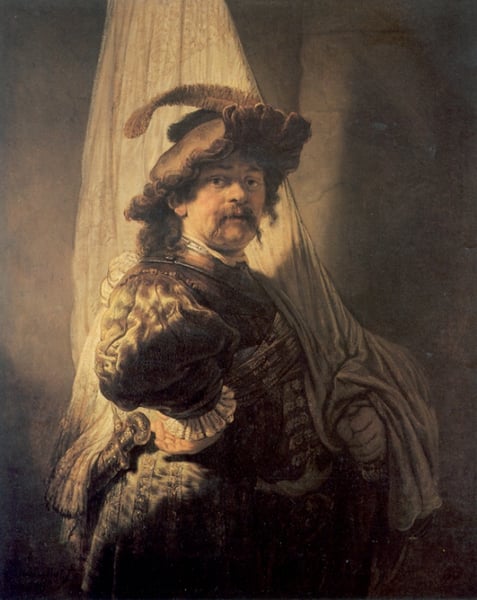
Análisis experto de The Standard Bearer de Rembrandt
Estilo: Baroque · Género: portrait, tronie
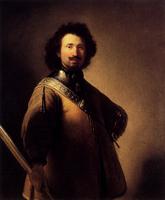
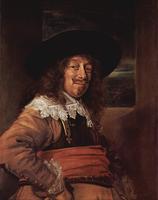
"The Standard Bearer" is a quintessential Baroque tronie—a character study rather than a formal portrait—that showcases Rembrandt’s unrivaled ability to animate a single figure with psychological depth and dramatic presence. Painted during his most confident period, the work immediately captivates with its masterful chiaroscuro: a strong, raking light from the left illuminates the standard bearer’s face, the folds of his sumptuous orange-and-gold sleeve, and the gleaming metal of his helmet and breastplate, while the background dissolves into deep, velvety shadow. This contrast not only heightens the sense of three-dimensional volume—a Baroque hallmark—but also focuses our attention on the man’s fleeting expression: his lips slightly parted, his eyes meeting the viewer with a mixture of pride, alertness, and a touch of melancholy.
The subject is neither a generalized soldier nor a commissioned nobleman; rather, Rembrandt transforms him into a living, breathing individual. The loosely painted banner, billowing as if caught by a gust of wind, adds a tactile energy to the composition, while the subtle texture of the cloth and the cold sheen of armor demonstrate the artist’s legendary handling of materials. As a tronie, the work transcends mere likeness to explore human character—a key innovation of Dutch Baroque portraiture. Rembrandt’s brushwork is both bold and precise: thick impasto highlights on the cheekbone and sleeve catch the light, while softer, almost feathery strokes define the hair and feather plume. The significance of "The Standard Bearer" lies in its synthesis of theatrical Baroque drama and intimate genuineness. It is not a static symbol but a fleeting moment captured in oil—a soldier who, for an instant, reveals his inner world, making the viewer feel the weight of his role and the quiet humanity beneath the armor. This balance of grandeur and immediacy is what makes Rembrandt’s approach to the Baroque portrait so enduringly powerful.
Museum / Gallery
Visualmente similares
20 obras con composición y paleta relacionadas
A Warrior
Rembrandt
Portrait of a Man
Frans Hals
Marechal De France En 1643
Jean Alaux
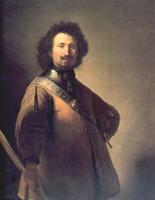
Joris de Caullery
Rembrandt
GENTLEMAN'S PORTRAIT
Roman Ribera Cirera
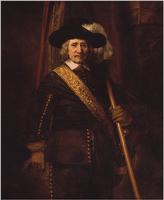
Portrait of Floris Soop
Rembrandt
Portrait of Vasily Alekseevich Perovsky
Orest Kiprensky
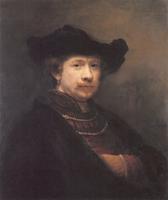
Self-portrait
Rembrandt
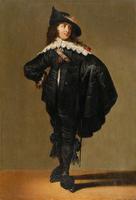
Portrait of a Young Man
Jacob Fransz. van der Merck
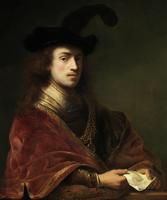
Self Portrait Behind a Parapet
Ferdinand Bol
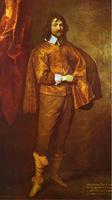
Arthur Goodwin, M.P. (oil on canvas)
Anthony van Dyck
Henry Howard, 6th Duke of Norfolk
Gilbert Soest
Portrait Of Joris de Caullery
Rembrandt
Portrait of a Condottiero
Artemisia Gentileschi
Portrait of a Man
Ferdinand Bol
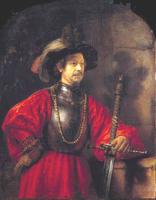
Portrait of a man in military costume
Rembrandt
Self-Portrait
Peter Paul Rubens
Portrait of a Gentleman Dressed in Black, in Front of a Pillar
Anthony van Dyck
Charles Howard, 11th Duke of Norfolk
Thomas Gainsborough
Portrait of a Member of the Haarlem Civic Guard
Frans Hals