Analisi esperta di The triumph of Mordechai di Rembrandt
Stile: Baroque · Genere: religious painting
Expert Analysis of The Triumph of Mordechai by Rembrandt
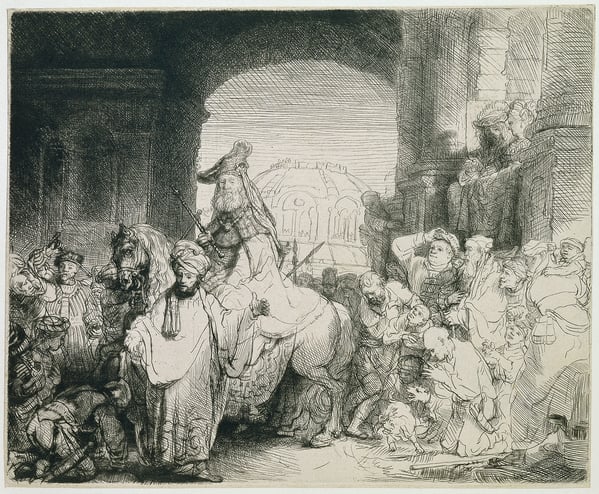
As a religious painting executed in the Baroque style, Rembrandt’s The Triumph of Mordechai exemplifies the period’s defining emphasis on dramatic storytelling, emotional intensity, and chiaroscuro—the stark contrast of light and shadow to heighten psychological impact. Within the Baroque tradition, such works typically sought to make biblical narratives vivid and accessible, often capturing a pivotal moment of revelation or reversal. Here, Rembrandt portrays the Old Testament episode from the Book of Esther where Mordechai, once a humbled Jew, is paraded through the streets on the king’s horse, honored by his former enemy Haman.
The painting’s significance lies in how Rembrandt subverts the expected grandeur of a “triumph.” Rather than a static, celebratory composition, he imbues the scene with subtle human tension. The lighting—likely falling on Mordechai’s face—emphasizes his quiet dignity and inner reflection, while the surrounding figures react with a mix of awe, envy, or submission. This psychological depth, characteristic of Rembrandt’s Baroque approach, transforms a standard religious narrative into a meditation on pride, humility, and divine justice. The work thus stands as a masterful example of how Baroque religious painting could transcend mere illustration, using chiaroscuro and nuanced expression to explore the moral complexities of faith.
Genere
Stile
Visivamente simili
20 opere con composizione e palette affini
Peter and John healing the cripple at the gate of the Temple
Rembrandt
Eulalia Suffocated and Burned, Villa Nova, Portugal, AD 302
Jan Luyken
The Sculptures
Gustave Dore
Christ driving the moneychangers from the Temple
Rembrandt
St. Peter and St. John at the Entrance to the Temple
Rembrandt
Jeanne de Bourgogne
Achille Devéria
Jullieta Killed Along with Her Daughter, Tarsus, AD 304
Jan Luyken
The tribute money
Rembrandt
Simeon`s hymn of praise
Rembrandt
Virgil in The Basket
Lucas van Leyden
Johannes, Merchent of Cordoba, Being Taken for Execution, AD 850
Jan Luyken
Torture of Waldensians, Forcing Them to Hold a Red Hot Iron Bar, AD 1214
Jan Luyken
The large lion hunt
Rembrandt
Torture of Tharacus, Probus, and Adronicus, Tarsus, AD 290
Jan Luyken
The Punishment of Antiochus
Gustave Dore
Jesus carried to Calvary
Giovanni Battista Piranesi
Apostle Paul Beheaded, Rome, AD 69
Jan Luyken
The ship of fortune
Rembrandt
Christ before Herod
Albrecht Durer
The Cross of Christ with Saint Veronica
Albrecht Durer