
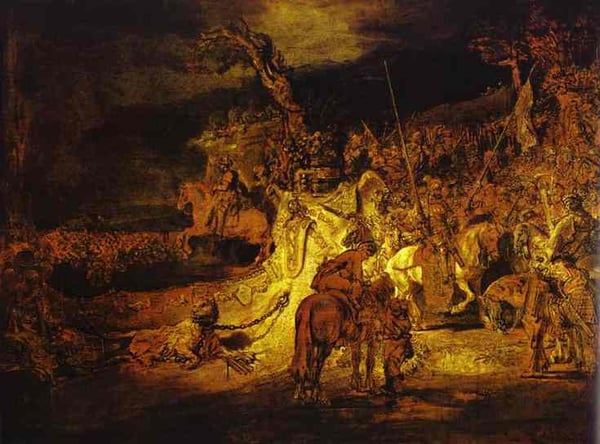
Analisi esperta di The Unity (Agreement) in the Country di Rembrandt
Stile: Baroque · Genere: history painting
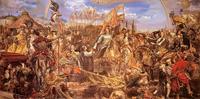
Expert Analysis of The Unity (Agreement) in the Country by Rembrandt
As a Baroque history painting by Rembrandt van Rijn, The Unity (Agreement) in the Country achieves significance through its masterful synthesis of the period’s core artistic ideals—dramatic narrative, emotional depth, and moral gravity—with the artist’s signature psychological insight and innovative use of light and shadow.
History painting was considered the highest genre in the Baroque era, charged with conveying timeless truths, political allegories, or biblical stories. Rembrandt, celebrated for his ability to transform historical or allegorical subjects into intimate, human dramas, here likely addresses themes of collective harmony and national concord—a fitting subject for a Dutch master working during a time of political consolidation and civic pride. The title, “Unity in the Country,” suggests a moral or patriotic lesson, typical of Baroque history painting’s didactic function.
Rembrandt’s contribution to the genre lies not in grandiloquent gestures but in his subtle rendering of interior states and his naturalistic handling of light. In this work, one can imagine his hallmark chiaroscuro drawing the viewer’s eye to key figures or symbolic objects, while the composition balances dynamic movement with a sense of solemn agreement. The painting thus exemplifies the Baroque fascination with the intersection of the real and the ideal, the temporal and the eternal. By placing the theme of societal accord within a vividly believable scene, Rembrandt elevates a political idea into a timeless meditation on human connection—cementing the work’s significance within both his oeuvre and the broader Baroque tradition.
Museum / Gallery
Visivamente simili
20 opere con composizione e palette affini
The Concert of the State
Rembrandt
The battle of the Taro
Tintoretto
Francesco II Gonzaga against Charles VIII of France 1495 in fighting the battle of the Taro
Tintoretto
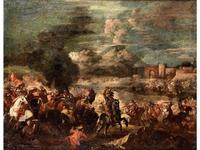
great land with equestrian justice
Matthias Stom
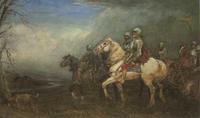
Auld Wat of Harden
Tom Scott
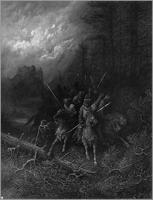
Idylls of the King
Gustave Dore
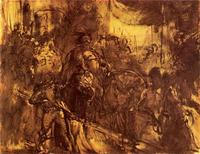
Jan III at Vienna
Jan Matejko
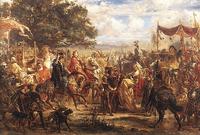
Congress of the Kings
Jan Matejko
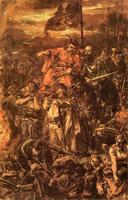
Jan Zizka
Jan Matejko
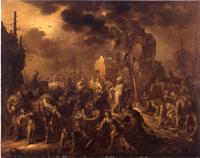
Moses Striking the Rock
Adriaen van de Venne
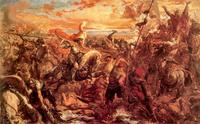
Varna
Jan Matejko
The battle of Putaha
Éloi Firmin Féron
Battle of Arsur
Éloi Firmin Féron
Battle of Grunwald
Jan Matejko
Conquest of Zara
Tintoretto
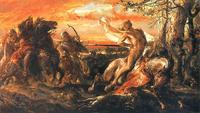
The death of Leszek the White
Jan Matejko
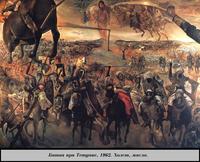
Battle of Tétouan
Salvador Dali
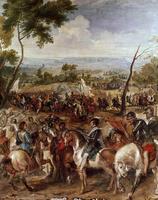
Henry Iv in the Battle of Arques
Peter Paul Rubens
The battle of Issus(fragment)
Albrecht Altdorfer
Sobieski II
Jan Matejko