
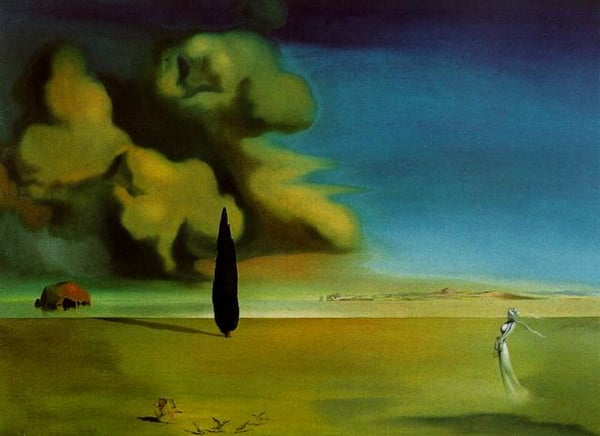
Apparition of My Cousin Carolinetta on the Beach at Rosas
Details
Expertenanalyse zu Salvador Dalis Apparition of My Cousin Carolinetta on the Beach at Rosas
Stil: Surrealism · Genre: landscape
Expert Analysis of Salvador Dalí’s Apparition of My Cousin Carolinetta on the Beach at Rosas
This 1933 painting epitomizes Dalí’s mastery of the paranoiac-critical method, a hallmark of his Surrealist period (1929–1940). At first glance, the work presents a serene beachscape at Rosas (a coastal town near his native Cadaqués), rendered with meticulous realism—a characteristic Dalí employed to lend credibility to the irrational. Yet the landscape itself is a double image: the sloping shoreline, rock formations, and small figures simultaneously coalesce into the profile of his cousin Carolinetta. Her face emerges from the horizon, with the distant sea forming her hair and the sand shaping her chin and neck.
This fusion of landscape and portraiture is central to Dalí’s surrealist project: it forces the viewer to oscillate between two contradictory perceptions—a natural scene and a human apparition. The title’s use of “apparition” underscores the work’s dreamlike, hallucinatory quality, while “cousin” introduces a biographical layer—likely referencing the artist’s young cousin Carolina, whose image is both intimate and spectral.
Significantly, the painting exemplifies Dalí’s obsession with paranoid vision: the ability to see multiple, often erotic or uncanny, forms within ordinary objects. Here, the beach at Rosas—a real place laden with personal memory—becomes a psychological stage where reality dissolves into obsessive fantasy. Unlike earlier Surrealist automatism, Dalí’s method is calculated: every detail (the shadow of a boat, a tiny figure) reinforces the double image, demanding active participation from the viewer.
Within the Surrealist movement, this work stands as a seminal example of optical illusion as psychological revelation. It predates Dalí’s more famous Metamorphosis of Narcissus and The Hallucinogenic Toreador, yet already displays his signature strategy of making the irrational plausible through hyper-realistic technique. The painting’s significance lies in its ability to collapse distance—geographical, temporal, and emotional—transforming a mundane beach into a monument of desire and memory.
Visuell ähnlich
20 Werke mit ähnlicher Komposition und Farbpalette
The Spectre and the Phantom
Salvador Dali
The Echo of the Vold
Salvador Dali

Sugar Sphinx
Salvador Dali
The Birth of Liquid Fears
Salvador Dali
Figure and Drapery in a Landscape
Salvador Dali
Design for the Film 'Spellbound' (1)
Salvador Dali
Eclipse and Vegetable Osmosis
Salvador Dali
The Sense of Speed
Salvador Dali
Landscape with Rock in the Shape of a Triumphal Arch
Salvador Dali
Untitled (Skin of a Beach)
Salvador Dali
Necrophiliac Springtime
Salvador Dali
Design for the set of the film 'Spellbound'
Salvador Dali
Nude in the Desert Landscape
Salvador Dali
Landscape with Mysterious Details
Salvador Dali
Night Spectre on the Beach
Salvador Dali
Surrealist Essay
Salvador Dali
Landscape Near Ampurdan
Salvador Dali
Funeral Symphony (IV)
Mikalojus Konstantinas Ciurlionis
The Isle of the Dead - Centre, Section
Salvador Dali
Morning Ossification of the Cypress
Salvador Dali