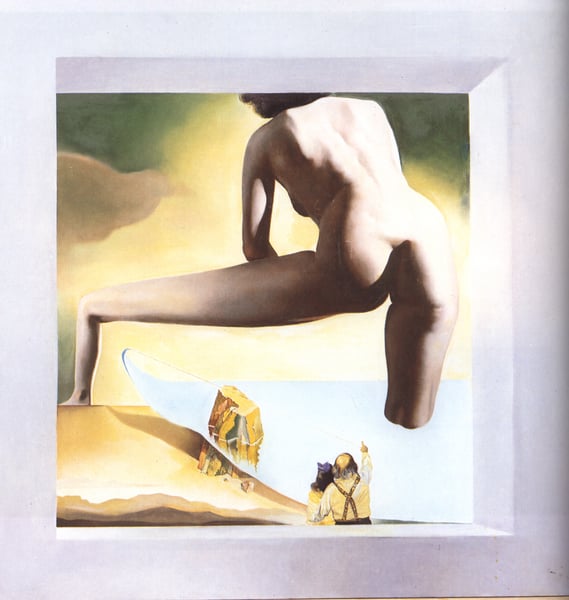
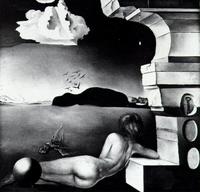
In this work from Dali’s Classic Period (1941–1989), the artist merges his signature Surrealist dislocation with a reverent nod to Renaissance iconography. “Dali Lifting the Skin of the Mediterranean Sea to Show Gala the Birth of Venus” transforms the sea into a peeled, membrane-like curtain—a literal “skin” that Dali himself raises to reveal a mythic scene.
The composition directly quotes Botticelli’s Birth of Venus, but Dali replaces the classical goddess with his wife and muse, Gala, as the focal point. This substitution is central to the work’s significance: it personalizes mythology, turning an ancient allegory into a private Surrealist ritual. The act of “lifting the skin” embodies Dali’s paranoiac-critical method, where everyday reality (the sea’s surface) is reconceived as a permeable, hallucinatory veil.
Technically, the painting displays the hyper-detailed, academic precision Dali perfected in his later years—soft chiaroscuro, luminous Mediterranean light, and a dreamlike recession of space. Yet the surreal twist (a cosmic stage-manager revealing a birth) underscores Dali’s enduring obsession with science, illusion, and the boundaries of perception. Here, the sea is both physical element and symbolic threshold, collapsing the distance between observer, myth, and the unconscious.
Why this work matters: It epitomizes Dali’s mature synthesis of old-master technique, personal mythology, and Surrealist subversion—a hallmark of his Classic Period, where he sought to unite the irrational with the timeless.