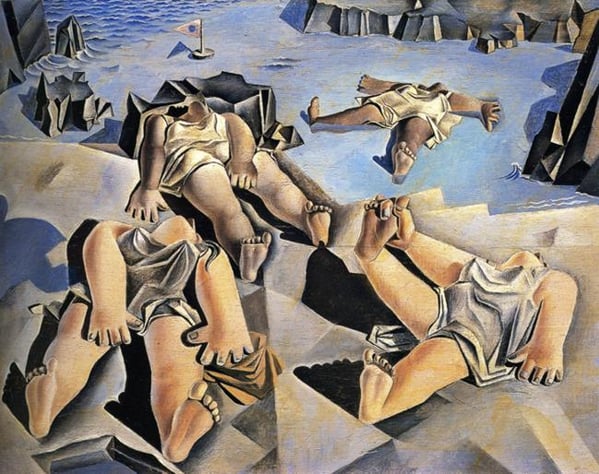
Figures Lying on the Sand
Details
Expertenanalyse zu Salvador Dalis Figures Lying on the Sand
Stil: Cubism, Expressionism · Genre: genre painting
Artwork Analysis: Figures Lying on the Sand by Salvador Dalí
Context and Significance
Created during Dalí’s Early Years (1917–1927), this work belongs to a formative period when the young artist was vigorously absorbing and synthesizing avant-garde influences before fully embracing Surrealism. As a genre painting, it depicts a seemingly ordinary, intimate scene—figures reclining on a shore—but transforms it through the dual lenses of Cubism and Expressionism. This fusion marks a critical transitional moment in Dalí’s development, testing the boundaries between analytical structure and raw emotional intensity.
Stylistic Significance
- Cubist influence: The composition reveals Dalí’s engagement with Picasso and Juan Gris. Forms are fractured into geometric facets, with overlapping planes that flatten space and produce a fragmented, shifting perspective. The sand, figures, and sea are reduced to angular shards, creating a sense of spatial ambiguity—a hallmark of Cubist analysis.
- Expressionist charge: Unlike orthodox Cubism’s cool intellectuality, Dalí injects a palpable tension. The muted, earthy palette (ochres, greys, deep blues) is disrupted by abrupt, almost violent patches of color, and the figures’ poses—while simplified—suggest psychological unease or vulnerability. This emotional weighting aligns with Expressionist aims to convey inner states through distortion and heightened contrast.
Why It Matters
Figures Lying on the Sand is significant as a laboratory for Dalí’s later Surrealist vocabulary. The Cubist fragmentation of the human form anticipates his eventual melting clocks and dislocated anatomy, while the Expressionist atmosphere of anxiety and solitude foreshadows the dreamlike unease of his mature masterpieces. It demonstrates an artist wrestling with modernist formal problems (how to depict reality) while already leaning toward subjective experience (how to depict feeling). In isolating these figures on a barren, geometrized beach, Dalí began to articulate the desolate, symbolic landscapes that would define his Surrealist vision—though here, the logic of Cubism still anchors the dream.
Placement in Dalí’s Oeuvre
This painting is a rare document of a pre-Surrealist Dalí, revealing how he acquired technical discipline from Cubism and expressive urgency from Expressionism before rejecting both for the paranoiac-critical method. For historians, it marks the precise moment when Dalí’s genius for blending precise construction with irrational content first emerged—making it an essential touchstone for understanding his radical artistic journey.
Museum / Gallery
Genre
Visuell ähnlich
20 Werke mit ähnlicher Komposition und Farbpalette
Figure on the Rocks
Salvador Dali
Clay Man
Sabin Balasa
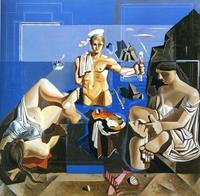
Neo-Cubist Academy (Composition with Three Figures)
Salvador Dali
Invisible Sleeping Woman, Horse, Lion
Salvador Dali
Wedding Travelling in Space
Sabin Balasa
Post Surreal Configuration: Eternal Recurrence
Lorser Feitelson
Rhinocerotic Figure of Phidias' Illisos
Salvador Dali
La Tour
Salvador Dali
Life Saver
Yasuo Kuniyoshi
Désir d'été
Oscar Dominguez
Promontory Palace
Yves Tanguy
Enigma i calma sobre el mar
Angel Planells
Les Métamorphoses
Jean Hugo
Venus with Cupids
Salvador Dali
Study for "Honey is Sweeter than Blood"
Salvador Dali
El mar desconegut
Angel Planells
The Simoniacs
Salvador Dali
Female Bather
Salvador Dali
Waiting
Sabin Balasa
Imperial Monument of Woma-Child. Gala (Utopian Fantasy)
Salvador Dali