Deskundige analyse van Galatea of the Spheres van Salvador Dali
Stijl: Surrealism · Genre: portrait
Expert Analysis: "Galatea of the Spheres" by Salvador Dalí
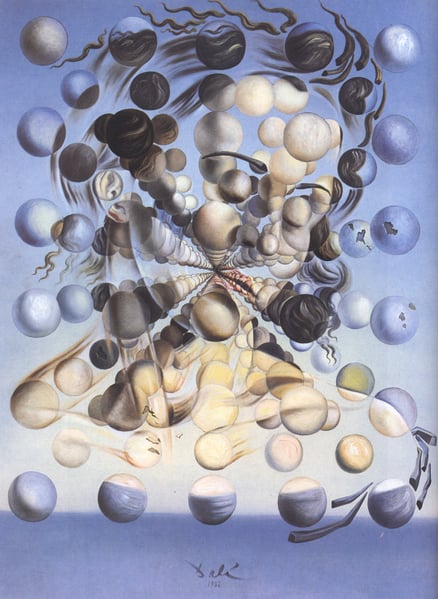
Executed during Dalí’s Surrealism Period (1929–1940), Galatea of the Spheres is a masterful portrait that exemplifies the movement’s core ambition: to dissolve the boundary between reality and the subconscious. While the work is ostensibly a likeness of Dalí’s muse and wife Gala, it is radically transformed through the Surrealist lens.
Significance within Style and Period
-
Deconstruction of the Human Form: Dalí dismantles the conventional portrait into a constellation of floating spheres, each rendered with meticulous, photo-realistic precision. This technique—a hallmark of his “paranoiac-critical method”—creates a hallucinatory illusion: the spheres both are and are not Gala’s face and shoulders. The viewer’s eye oscillates between abstract geometry and recognizable features, a direct Surrealist challenge to rational perception.
-
Period Context: During the late Surrealist period (late 1930s), Dalí increasingly fused his dreamlike imagery with scientific and mathematical motifs—here, the spheres evoke atomic particles, molecular structures, and celestial bodies. This reflects Dalí’s fascination with modern physics (inspired by nuclear fission) and his belief that the subconscious could be mapped through symbolic geometry. The painting thus bridges the earlier, more purely psychological Surrealism of the 1920s with Dalí’s later “nuclear mysticism.”
-
Psychological Depth: Despite the fragmentation, Gala’s identity remains palpable. The warm, earthy tones ground the composition in sensual reality, while the suspended spheres suggest a mind in a state of flux—both stable and explosive. This duality is the essence of Surrealist portraiture: the subject is at once recognizable and alien, concrete and ephemeral.
Why It Matters
Galatea of the Spheres stands as a landmark within Dalí’s Surrealism Period because it synthesizes his technical virtuosity with his conceptual daring. It demonstrates how Surrealism could move beyond simple dream imagery to engage with contemporary science without losing its emotional and symbolic power. The portrait remains one of the most iconic examples of how Surrealist artists reimagined the human figure as a site of mystery, metamorphosis, and cosmic connection.
Visueel vergelijkbaar
20 werken met verwante compositie en kleurenpalet
The Maximum Speed of Raphael's Madonna
Salvador Dali
Dali Nude, in Contemplation Before the Five Regular Bodies
Salvador Dali
Bond of Union
M.C. Escher
Head Bombarded with Grains of Wheat (Particle Head Over the Village of Cadaques)
Salvador Dali
Galatée
Salvador Dali
Time
Abdul Mati Klarwein
The double secret
Rene Magritte
Galaxy
Tihamer Gyarmathy
Apparition of the Visage of Aphrodite of Cnidos in a Landscape
Salvador Dali
Exploded Head
Salvador Dali
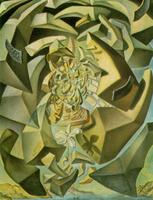
Microphysical Madonna
Salvador Dali
Set2
Evan Magar
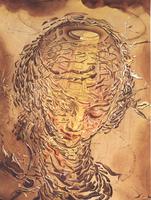
Raphaelesque Head Exploding
Salvador Dali
Locura Daño Cerebral
Martin Pereira
Le vent à tourné
Theo Gerber
Prinzessin Europa mit Engelkräften und Stier
Agnes von Angelis AvA
Solitude entonnoir (Funnel of solitude)
Suzanne Duchamp
Victory over Eternity
Pavel Filonov
Abstract Pointillism
Gabino Amaya Cacho
16 Dots
Chul Hyun Ahn