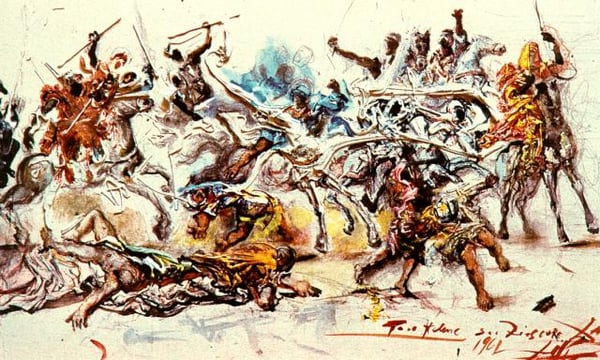
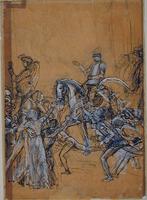
Study for 'The Battle of Tetuan'
Détails
Analyse experte de Study for 'The Battle of Tetuan' de Salvador Dali
Style : Realism · Genre : sketch and study
This study for The Battle of Tetuan (a preparatory work for a larger, unfinished or later painting) is a fascinating window into Salvador Dalí’s artistic evolution during his Classic Period (1941–1989). While Dalí is globally celebrated for his Surrealist hallucinations and dreamscapes, this work belongs to a phase where he consciously returned to Realism—but a realism infused with his own meticulous, hyper-detailed technique and academic rigor. The sketch and study genre is particularly revealing here: it strips away the fantastical iconography of his earlier years and exposes Dalí’s deep engagement with composition, anatomy, and historical narrative.
Significance within its style and period
-
A Return to Renaissance and Baroque Masters: During the Classic Period, Dalí declared himself a “classical” painter, openly admiring and emulating the precision of Raphael, Velázquez, and especially the battle scenes of Jacques-Louis David. This study demonstrates his disciplined handling of line and form—a far cry from the melting clocks of his Surrealist peak. The subject, The Battle of Tetuan, references a real 19th-century Spanish–Moroccan conflict, allowing Dalí to fuse history painting with his own theatrical sense of space.
-
Process and the “Paranoiac-Critical Method” in Realist Guise: Even in a preparatory sketch, Dalí applies his signature paranoiac-critical approach—the deliberate manipulation of multiple, often conflicting perspectives within a single image. Here, the swirling mass of soldiers, horses, and landscape is not merely chaotic; it is meticulously arranged to create a double-image effect. Look for how the battle’s flowing lines might also suggest a hidden, monumental face or body, a hallmark of Dalí’s optical games.
-
Bridging Surrealism and Academic Tradition: This study is a key document of Dalí’s shift from avant-garde provocation to a kind of hyper-realist classicism. It shows that his later obsession with scientific precision and historical scale (seen in works like The Hallucinogenic Toreador) was built on a solid foundation of draftsmanship. The fact that it remains a study—not a finished painting—emphasizes the artist’s painstaking, almost scientific approach to plotting movement, light, and depth.
-
Nostalgia and Universal Conflict: The Battle of Tetuan (a real event from 1860) allowed Dalí to explore themes of heroism, violence, and Spanish identity. In this sketch, the figures are rendered with a sculptural solidity reminiscent of Michelangelo, yet the composition’s vertiginous energy foreshadows Dalí’s later cosmic visions. The study thus stands as a bridge between two eras of his career: the lingering influence of Surrealist instability and the cool, monumental classicism of his maturity.
In essence, this sketch is not merely a preparatory note; it is a microcosm of Dalí’s late-career transformation. It proves that even when working within the Realist tradition, he could not resist infusing the scene with a near-photographic intensity and a hidden layer of symbolic tension—a testament to his restless genius.
Visuellement similaire
20 œuvres à la composition et à la palette proches
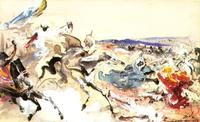
Arabs. Study for 'The Battle of Tetuan'
Salvador Dali
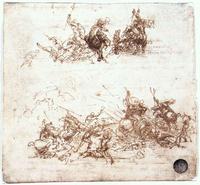
Page from a notebook showing figures fighting on horseback and on foot
Leonardo da Vinci
Head of a woman in the form of a battle
Salvador Dali
Battle of Belly River
Charles M. Russell
Copy of a Rubens Copy of a Leonardo
Salvador Dali
The Making of a Warrior
Charles M. Russell
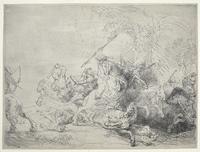
The large lion hunt
Rembrandt
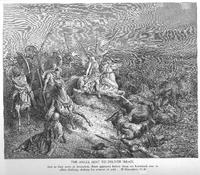
The Angel Is Sent to Deliver Israel
Gustave Dore
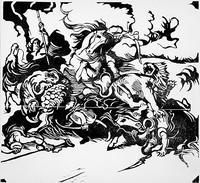
Lion Hunt (after Delacroix)
Franz Marc
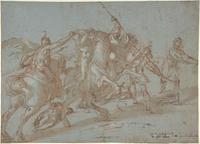
Peter and John Heal a Cripple at the Gate of the Temple
Bartholomeus Spranger
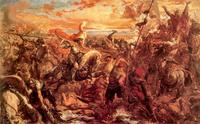
Varna
Jan Matejko
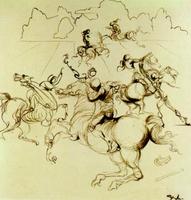
Surrealist Knights for a Four-part Screen, Centre Right,
Salvador Dali
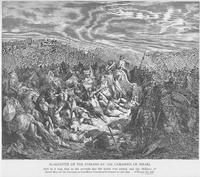
The Israelites Slaughter the Syrians
Gustave Dore
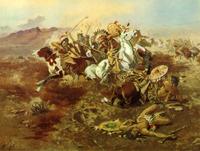
Indian Fight, #1
Charles M. Russell
Capturing the Ottoman Flag
George Stefanescu
The Army of the Amorites Is Destroyed
Gustave Dore
The Game of Gunpowder
Salvador Sánchez Barbudo
The Death of Saul
Gustave Dore
The Entry of Joan of Arc into Orleans
Luc-Olivier Merson
The Camel Corps
Elizabeth Thompson