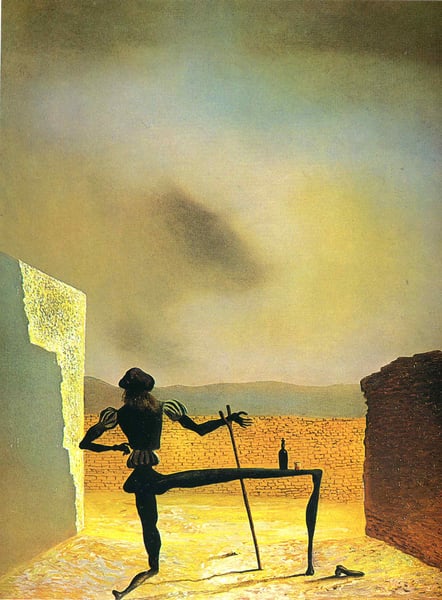
The Ghost of Vermeer van Delft which Can Be Used as a Table
Details
Expertenanalyse zu Salvador Dalis The Ghost of Vermeer van Delft which Can Be Used as a Table
Stil: Surrealism · Genre: symbolic painting
Expert Analysis: "The Ghost of Vermeer van Delft which Can Be Used as a Table" (1934) by Salvador Dalí
Style & Period Context
This painting is a quintessential work of Dalí’s Surrealist Period (1929–1940), a time when he fully developed his paranoiac-critical method—a technique of systematic irrationality that transforms ordinary objects into dreamlike, multi-layered symbols. As a symbolic painting, it employs a loaded visual metaphor: the ghost of the Dutch Old Master Johannes Vermeer is rendered as a transparent, skeletal figure whose back can be plausibly used as a tabletop.
Significance within Surrealism
Dalí’s work is significant for its audacious fusion of reverence and irreverence toward art history. By depicting Vermeer’s ghost as a functional piece of furniture, Dalí challenges the traditional boundary between high art and everyday object, between the sacred and the profane. This aligns with Surrealism’s core mission to disrupt logical categories and liberate the unconscious.
Symbolic & Visual Analysis
The “ghost” is both a homage and a parody: Vermeer is elevated as an immortal presence yet is literally “used” as a table—a subversion of the artist’s role. The transparent, deconstructed form echoes Dalí’s fascination with recurrence and decay (a recurring motif in his work), while the title’s matter-of-fact suggestion of utility reinforces the Surrealist juxtaposition of the incongruous. The calm, classical architecture in the background (a nod to Vermeer’s own interiors) contrasts with the absurd apparition, creating a tension between reality and dream.
Conclusion
This painting exemplifies how Dalí remade the past through a Surrealist lens: it simultaneously celebrates and dismantles artistic tradition, forcing viewers to reconsider what an artwork can be—and what it can become. Its significance lies in its bold, witty merger of the iconic (Vermeer) with the absurd (a table), a hallmark of Dalí’s genius during the Surrealist movement.
Museum / Gallery
Visuell ähnlich
20 Werke mit ähnlicher Komposition und Farbpalette
The Invisible Harp
Salvador Dali
The Ghost of Vermeer Van Delft
Salvador Dali
Romeo Y Julietta con una Testigo
Jose Manuel Capuletti
Atmospherocephalic Figures
Salvador Dali
The Knight at the Tower
Salvador Dali
Krajobraz z wędrowcem
Eugeniusz Zak
Woman, Old Man and Flower Femme
Max Ernst
Le Dejeuner sur l'Herbe (after Manet)
Paul Wunderlich
Landscape with Mysterious Details
Salvador Dali
The Red Guard
Desmond Morris
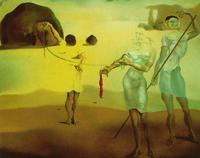
Enchanted Beach with Three Fluid Graces
Salvador Dali
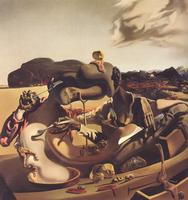
Autumnal Cannibalism
Salvador Dali
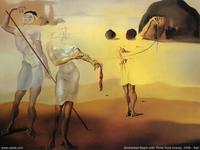
The Enchanted Beach
Salvador Dali
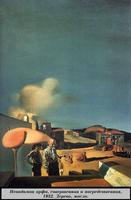
The Invisible Harp, Fine and Medium./Harpe invisible fine et moyenne
Salvador Dali
The duo (The models of the red tower)
Giorgio de Chirico
Masochistic Instrument
Salvador Dali
Morphological Echo'
Salvador Dali
Phenomenon
Remedios Varo
The Spectre of the Angelus
Salvador Dali
Barber Saddened by the Persistence of Good Weather (The Anguished Barber)
Salvador Dali