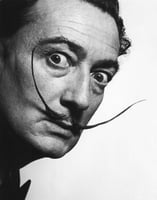
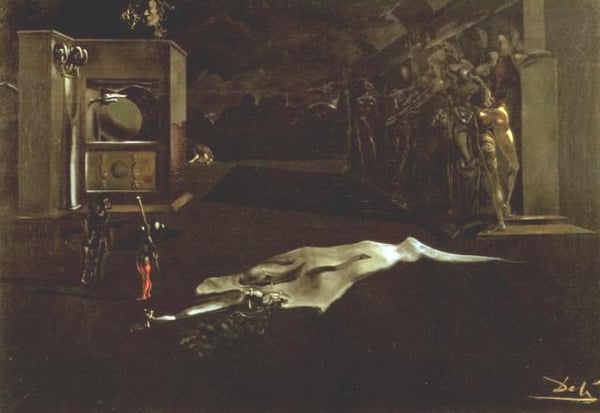
Salvador Dali sanatçısının The Stain eseri hakkında uzman analizi
Tarz: Surrealism · Tür: symbolic painting
Expert Analysis of "The Stain" by Salvador Dalí
Created during Dalí’s Classic Period (1941–1989), "The Stain" exemplifies the artist’s later synthesis of Surrealist irrationality with Renaissance-inspired precision and religious or scientific symbolism. As a symbolic painting within the Surrealist movement, the work transcends mere dreamlike imagery to become a meditation on form, decay, and the subconscious.
Significance within Surrealism and Dalí’s Oeuvre:
Dalí’s Classic Period marked a shift from the overtly erotic and political provocations of his early Surrealist years toward a more disciplined, often spiritual or mystical iconography. "The Stain" likely employs his Paranoiac-Critical Method—a technique that invites multiple, double-readings of a single image. Here, the “stain” itself functions as a visual metaphor: it could be a literal blemish (decay, guilt, the passage of time) or a Rorschach-like catalyst for the viewer’s own subconscious projections. By focusing on an ambiguous, supposedly accidental mark, Dalí subverts traditional hierarchies of composition, elevating the marginal and chaotic to the center of meaning.
Symbolism and Period Context:
During this era, Dalí was deeply influenced by nuclear physics, Catholicism, and the Old Masters (e.g., Velázquez, Leonardo). "The Stain" may therefore reference the idea of memento mori—the imperfection that signals mortality—while also echoing the surrealist fascination with the organic and the accidental. The work’s stark contrast between hyperrealistic rendering (typical of Dalí’s polished technique) and the irrational subject matter creates a tension that defines his best late works. It represents a mature Surrealism: no longer shocking for shock’s sake, but a philosophical tool to explore the boundary between order and chaos, intention and chance.
Conclusion:
"The Stain" is significant as a distilled statement of Dalí’s Classic Period philosophy—a carefully controlled depiction of something inherently uncontrollable. In doing so, it reaffirms Surrealism’s power to find profound meaning in the mundane or disdained, while showcasing the artist’s enduring technical mastery and evolving intellectual preoccupations.
Görsel olarak benzer
İlişkili kompozisyon ve renk paletine sahip 20 eser
Palladio's Thalia Corridoe
Salvador Dali
Invention of the Monsters
Salvador Dali
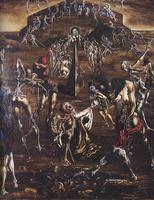
Resurrection of the Flesh
Salvador Dali
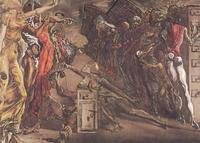
Palladio's Corridor of Dramatic Surprise
Salvador Dali
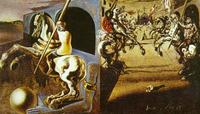
Equestrian Parade (possibly Set Design for 'Romeo and Juliet')
Salvador Dali
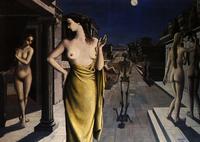
Lunar City
Paul Delvaux
Illumined Pleasures
Salvador Dali
Echo
Paul Delvaux
Melancholy of a Beautiful Day
Giorgio de Chirico
The Font
Salvador Dali
Study for the set of 'Romeo and Juliet'
Salvador Dali
The Last Day of Pompeii
Karl Bryullov
The Lugubrious Game
Salvador Dali
Fall of the Damned
Hieronymus Bosch
Playing in the Dark
Salvador Dali
Portrait of Mrs. Harrison Williams
Salvador Dali
Suburbs of a Paranoiac Critical Town, Afternoon on the Outskirts of European History
Salvador Dali
Composition - Portrait of Mrs. Eva Kolsman
Salvador Dali
Dawn of the Town
Paul Delvaux
L'hommage à Callot
Francis Gruber