
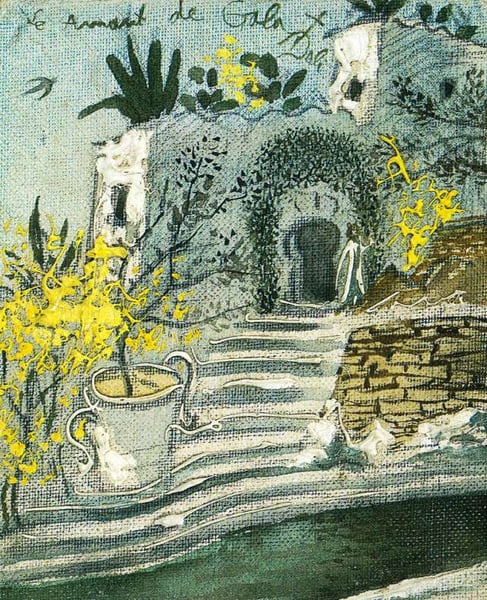
The Swimming Pool in Port Lligat
Dettagli
Analisi esperta di The Swimming Pool in Port Lligat di Salvador Dali
Stile: Expressionism · Genere: landscape
Expert Art Historical Analysis: "The Swimming Pool in Port Lligat" by Salvador Dalí
While Dalí is universally recognized as the high priest of Surrealism, the supplied facts place this work within the Expressionist style, a label that usefully reframes its emotional and psychological intensity. Painted during Dalí’s Classic Period (1941–1989) —a phase when he returned to figurative, often religious or scientific themes—this landscape transforms the everyday scenery of his beloved Port Lligat into a charged, almost hallucinatory vision.
Significance within Expressionism and the Classic Period
-
Subjective Landscape as Emotional Terrain
Expressionism prioritizes inner feeling over objective reality. Here, Dalí does not merely depict a swimming pool; he distorts perspective, flattens spatial depth, and saturates the scene with a brittle, hyper-real clarity. The water’s surface becomes a slippery, reflective plane, while the surrounding cliffs and buildings take on a strangely rigid, theatrical quality. This is not a literal portrait of his home—it is a psychological landscape, where the pool functions as a mirror of the subconscious. -
Synthesis of Meticulous Technique and Dreamlike Rupture
Dalí’s Classic Period is defined by his return to the Old Master precision of Velázquez and Vermeer. Yet in keeping with Expressionist principles, he uses this flawless technique to undermine naturalism. The pool’s architecture seems to warp, the horizon tilts slightly, and shadows fall in illogical directions. This tension between painstaking detail and spatial distortion is the painting’s core significance: it proves that Expressionist emotion can be articulated through the most disciplined of means. -
The Pool as a Liminal Threshold
In this work, the swimming pool is more than a leisure feature—it becomes a boundary between the solid world of the Costa Brava’s rocks and the fluid realm of memory and desire. The empty, still water suggests both absence and potential, a holding space for the artist’s own introspections. This aligns with Expressionism’s drive to convey existential states through everyday motifs. -
Period Context: Dalí’s Later Maturity
The Classic Period saw Dalí merge his earlier Surrealist provocations with a newfound interest in harmony, science (DNA, nuclear physics), and Catholic mysticism. "The Swimming Pool in Port Lligat" exemplifies this synthesis: the rigorous composition and classical framing are disrupted by the eerie quiet of an Expressionist’s inner life. It stands as a testament to Dalí’s ability to reinvent himself while retaining the audacity that defined his career.
Conclusion
This painting is significant because it inverts the expected reading of Dalí. By filtering his late, controlled vision through an Expressionist lens, he demonstrates that emotional truth need not come from chaotic brushwork—it can emerge from the unsettling stillness of a perfectly rendered landscape. In doing so, "The Swimming Pool in Port Lligat" becomes a key transitional work, linking the psychological depth of Surrealism to the subjective fervor of Expressionism within the arc of Dalí’s enduring Classic Period.
Visivamente simili
20 opere con composizione e palette affini
The Wagon Tracks
Joan Miro
Untitled
Pablo Picasso
Ibiza
Frances Hodgkins
Landscape
Pablo Picasso
Corfu
Patrick Procktor
Cagnes-sur-Mer
William H. Johnson
Rosebud
Kay Nielsen
Sketch for decoration of Carmen, Antonia Merce, "La Argentina"
Carlos Saenz de Tejada
Houses among Trees with a Figure
Vincent van Gogh
Kifissia
Nikos Hadjikyriakos-Ghikas

Pergola
Frances Hodgkins
Pear Tree in a Walled Garden
Samuel Palmer
Armenia
Martiros Sarian
Labyrinthe
Josef Sima
Corfe Castle Village
Frances Hodgkins
Zigeunerkind Im Dorf
Otto Mueller
Southern Fisherman Houses
Maria Bozoky

Sol Doirado
Carlos Botelho
Olive Trees, Renoir’s Garden in Cagnes
Henri Matisse
Corsica Corte
M.C. Escher