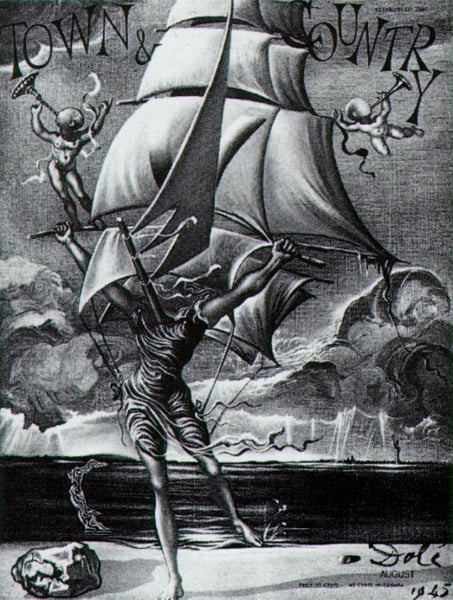
Victory (Woman Metamorphosing Into A Boat With Angels)
Dettagli
Analisi esperta di Victory (Woman Metamorphosing Into A Boat With Angels) di Salvador Dali
Stile: Neo-baroque, Surrealism · Genere: allegorical painting
Expert Analysis: "Victory (Woman Metamorphosing Into A Boat With Angels)" by Salvador Dalí
Dalí’s Victory is a masterwork of his Classic Period (1941–1989), a phase in which he fused the irrational imagery of Surrealism with the formal grandeur of Neo-baroque composition and religious allegory. Painted as an allegorical scene, the work exemplifies Dalí’s shift from pure dream logic toward a meticulous, illusionistic technique reminiscent of the Old Masters, while still retaining the shocking metamorphoses that defined his earlier years.
The title itself encapsulates the Surrealist core: a woman's body undergoes a impossible transformation into a boat, aided by angels—a visual pun on navigation, victory, and spiritual ascension. This metamorphosis is rendered with hyper-realistic precision typical of Dalí’s Classic style, where every curve of the female form is anatomically plausible yet dissolves seamlessly into nautical architecture. The Neo-baroque influence is evident in the dramatic chiaroscuro, the swirling drapery, and the theatrical, almost celestial light that envelops the figures, echoing the altarpieces of Bernini or Rubens but with Dalí’s signature irreverence.
What makes Victory significant within its style and period is its synthesis of Surrealist automatism with classical discipline. By the 1940s, Dalí had famously declared “I am Surrealism,” yet here he proves that Surrealism could be reconciled with traditional painterly values. The angels are not mere decorative elements; they function as psychological emblems of transcendence, drawing on Catholic iconography—a recurring theme in Dalí’s later work—while the woman-boat hybrid suggests a Freudian dream of transformation and release.
As an allegory of victory, the painting likely references both personal triumph (Dalí’s escape from Europe during WWII and his reinvention in America) and universal spiritual conquest. The boat, a symbol of journey and survival, combined with feminine metamorphosis, speaks to the Surrealist fascination with the unconscious as a site of endless becoming. For Dalí, this work stands as a testament to his belief that the irrational could be rendered with the same authority as the sacred—making Victory a pivotal example of his mature, hybrid aesthetic.
Genere
Visivamente simili
20 opere con composizione e palette affini
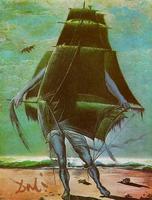
The Ship
Salvador Dali
Don Quixote
Gustave Dore
Full Sail off Sandy Hook Entrance to New York Harbor
Pavel Svinyin
A Voyage to the Moon
Gustave Dore
Fast Clipper (Packet) ship, Dreadnought, under Captain Samuel Samuels
Currier and Ives
Ancient Mariner
Gustave Dore
Scheiber Hugó, Vitorlások,. ,
Scheiber Hugó
The Miniature Ship Red, White, and Blue
Currier and Ives
The seducer
Rene Magritte
THE CLIPPER HAISOW
Montague Dawson
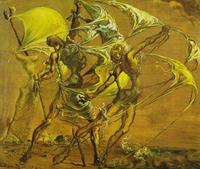
Group of Women Imitating the Gestures of a Schooner
Salvador Dali
The Year's at the Spring
Harry Clarke
Armed Three Master with Daedalus and Icarus in the Sky
Pieter Bruegel the Elder
EL VIAJE DEL PENSADOR
Martin Pereira
Naufragio Della Flotta Di Enea
Agostino Tassi
Invitation
Oleksandr Aksinin
Tempestad en alta mar
Martin Pereira
Dutch Ships Ramming Spanish Galleys off the Flemish Coast in October 1602
Hendrick Cornelisz Vroom
The Storm at Sea
Pieter Bruegel the Elder
A Castle with a Ship Sailing Nearby
Hendrick Cornelisz Vroom