Expertenanalyse zu Katsushika Hokusais Old Fisherman Smoking his Pipe
Stil: Ukiyo-e · Genre: genre painting
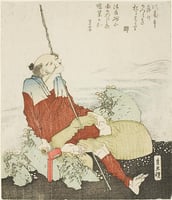
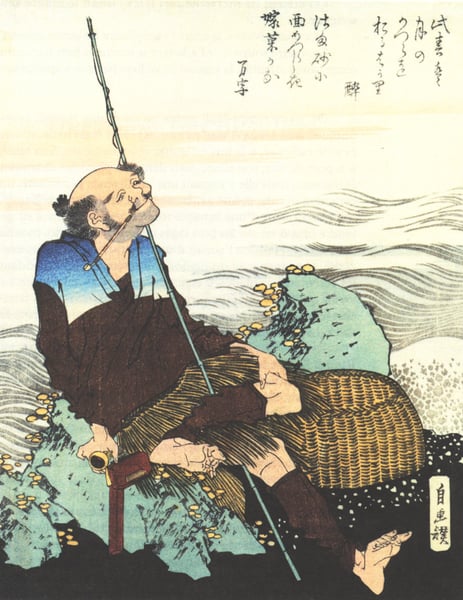
Katsushika Hokusai’s Old Fisherman Smoking his Pipe (1835) is a masterful vignette of everyday Edo-period life, rendered with the artist's characteristic graphic brilliance. The composition centers on a weathered, balding fisherman taking a moment of respite on a rocky shoreline. Hokusai employs classic ukiyo-e woodblock techniques, most notably the striking bokashi (color gradation) on the shoulders of the man’s tunic, which transitions seamlessly from a vivid azure blue to a deep brown. The crisp, undulating linework of the stylized waves in the background creates a dynamic visual tension against the static, relaxed posture of the figure. Every textural detail—from the intricate crosshatching of his woven grass apron and bamboo creel to the golden barnacles clinging to the jagged, sea-swept rocks—demonstrates Hokusai’s meticulous observation and absolute mastery of the medium.
Beyond its technical execution, the artwork operates as a profound character study rich in symbolism. The fisherman leans back, his long kiseru (traditional Japanese pipe) resting easily in his mouth, his eyes cast upward in a gaze of quiet contemplation or perhaps simple, hard-earned exhaustion. The contrast between the turbulent, rhythmic ocean behind him and his serene, grounded pose speaks to a life spent in intimate, respectful dialogue with the formidable forces of nature. Hokusai does not romanticize the man's poverty; rather, he imbues him with profound dignity. The old man mirrors the rocks he sits upon—weathered, enduring, and firmly rooted in his environment.
Created when Hokusai was in his mid-seventies, this genre painting reflects the artist's late-career shift toward deeply empathetic depictions of the working class. While early ukiyo-e focused heavily on the glamorous, ephemeral "floating world" of actors and courtesans, Hokusai found enduring beauty in the mundane and the marginalized. The inclusion of the poetic calligraphy in the upper register elevates this humble scene, suggesting that the life of a simple fisherman is as worthy of artistic and literary contemplation as that of a great scholar or lord. It is a brilliant testament to Hokusai’s humanist vision, capturing a fleeting moment of peace in a life defined by relentless labor.
Museum / Gallery
Visuell ähnlich
20 Werke mit ähnlicher Komposition und Farbpalette
Ichikawa Komazō III as Nitta Yoshisada, actually Oyamada Tarō Takaie
Tōshūsai Sharaku
Portrait of Matsuo Basho
Katsushika Hokusai
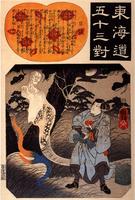
Nissaka Man receiving a child from a ghost
Utagawa Kuniyoshi
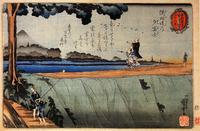
Mount Fuji from the Sumida River embankment
Utagawa Kuniyoshi
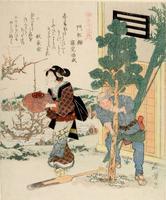
Planting the New Year's Pine
Keisai Eisen
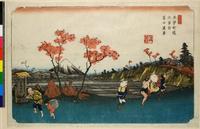
Omiya yado Fuji enkei (no.50)
Keisai Eisen
Senju in the Musachi provimce
Katsushika Hokusai
Okabe - The cat witch
Utagawa Kuniyoshi
Farting at a kappa at the lumber yard in Fukagawa
Tsukioka Yoshitoshi
Nihon hana zue
Ogata Gekko
Yama-uba
Katsushika Hokusai
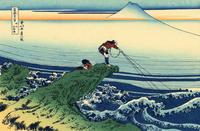
Kajikazawa in Kai Province
Katsushika Hokusai
Climbing on Mt. Fuji
Katsushika Hokusai
Fifty three Stages of the Tokaido (Tokaido Gojusan)
Utagawa Kunisada
Sangi Takamura, abalone fisherman
Katsushika Hokusai
Kuwana
Katsushika Hokusai
Ariwara no Yukihira
Tsukioka Yoshitoshi
Suikoden Triptych the Fishermen
Utagawa Kuniyoshi
Chobenzu
Ike no Taiga
Osho catching a carp
Utagawa Kuniyoshi