Analisi esperta di The back of the Fuji from the Minobu river di Katsushika Hokusai
Stile: Ukiyo-e · Genere: landscape
Expert Analysis: “The Back of the Fuji from the Minobu River” by Katsushika Hokusai
Style & Context:
This work belongs to the Ukiyo-e tradition, specifically the landscape genre (fūkei-ga) that Hokusai revolutionized in the early 19th century. Unlike earlier Ukiyo-e, which focused on courtesans and kabuki actors, Hokusai elevated the natural world as a primary subject. He produced this print as part of his iconic series Thirty-Six Views of Mount Fuji (c. 1830–1832), which cemented the mountain as a national symbol and transformed landscape art in Japan.
Composition & Significance:
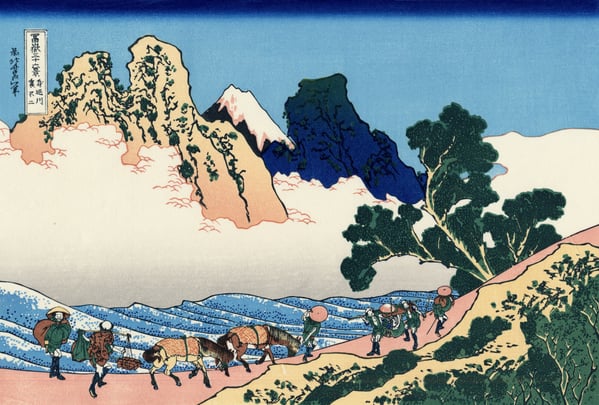
Hokusai’s title explicitly highlights the “back” of Mount Fuji—a rare, unconventional viewpoint. Rather than depicting Fuji’s familiar symmetrical cone from the front, he positions the viewer behind the peak, looking from the Minobu River toward its less-seen northern slopes. This choice reflects Hokusai’s mastery of perspective and his deliberate subversion of typical iconography.
- Dynamic Foreground: The Minobu River cuts diagonally through the scene, its curves and rapids leading the eye toward the distant mountain. Hokusai uses strong, sinuous lines for the water, contrasting with the calm, triangular mass of Fuji.
- Depth & Scale: A deep recession of space is achieved through overlapping hills, trees, and a small bridge—elements that anchor the foreground and middle ground. Fuji itself appears smaller and more distant than in many other views, emphasizing the vastness of the landscape.
- Atmospheric Effects: Soft gradients of blue and subtle clouds suggest early morning or mist, typical of Hokusai’s ability to capture fleeting natural phenomena.
Historical & Artistic Impact:
This print exemplifies Hokusai’s key innovation: the integration of Western linear perspective with traditional Japanese flat patterning. The angled river and receding shoreline show his study of European engravings, yet the bold outlines and flat color areas remain distinctly Ukiyo-e.
Moreover, by showing the back of Fuji—the side seldom venerated in art—Hokusai challenges the viewer to see the mountain as an everyday, accessible presence rather than a distant, idealized icon. This democratic approach to a sacred subject places Hokusai at the forefront of the Meisho-e (famous views) tradition, influencing later artists like Hiroshige and, eventually, European Impressionists such as van Gogh and Monet.
Significance within Ukiyo-e:
“The Back of the Fuji from the Minobu River” is a masterclass in balancing stillness (the mountain) with motion (the river). It demonstrates Hokusai’s lifelong fascination with the relationship between humans, nature, and the sublime—a theme that elevates this print from a mere landscape to a meditation on perspective itself.
Visivamente simili
20 opere con composizione e palette affini
View of Lake Suwa as Seen from Shiojiri Pass
Keisai Eisen
Hodogaya on the Tokaido
Katsushika Hokusai
No. 44, Magome Station
Keisai Eisen
Inume pass in the Kai province
Katsushika Hokusai
Evening Snow on the Asuka Mountain
Hiroshige
Senju in the Musachi provimce
Katsushika Hokusai
Travels Looking at Mt. Fuji
Kitagawa Utamaro
The road connecting Edo (Tokyo) and Kyoto
Hiroshige
Waterfall at Yoshino in Washū
Katsushika Hokusai
Surumaru Daiyu
Katsushika Hokusai
Sarumaru Daiyu
Katsushika Hokusai
Sakanoshita: the Throwing Away the Brush Peak
Hiroshige
Omiya yado Fuji enkei (no.50)
Keisai Eisen
Omiya, pl. 5 from a facsimile edition of Sixty-nine Stations of the Kiso Highway
Keisai Eisen
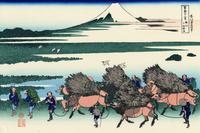
Ono Shindon in the Suraga province
Katsushika Hokusai
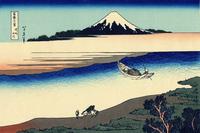
Tama river in the Musashi province
Katsushika Hokusai
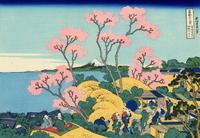
The Fuji from Gotenyama at Shinagawa on the Tokaido
Katsushika Hokusai
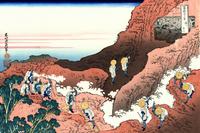
Climbing on Mt. Fuji
Katsushika Hokusai
The coast of seven leages in Kamakura
Katsushika Hokusai
The Fuji seen from the Mishima pass
Katsushika Hokusai