
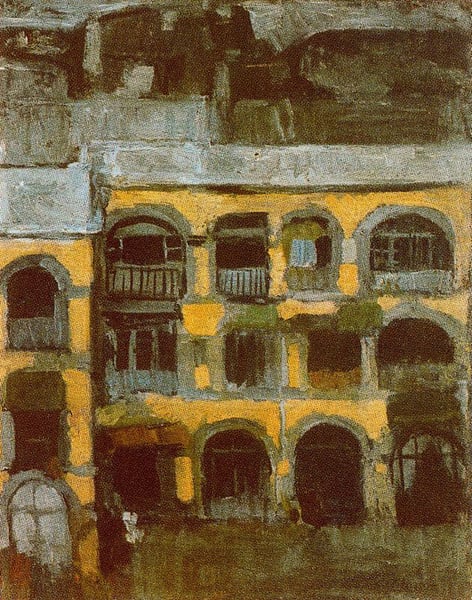
Deskundige analyse van A blue house van Pablo Picasso
Stijl: Expressionism · Genre: cityscape
This analysis focuses exclusively on the structured facts provided: Artwork: A blue house by Pablo Picasso, Style: Expressionism, Genre: cityscape.
Picasso’s A blue house stands as a distinctive contribution to Expressionist cityscape painting by pushing the movement’s core tenets of emotional distortion and subjective color into the realm of urban architecture. The work’s significance lies in how it transforms a mundane domestic subject—a single house bathed in monochrome blue—into a vessel for psychological intensity, a hallmark of Expressionism.
1. Color as Emotional Force
The dominant blue, applied to the entire house, is not a literal description but a deliberate expressionistic choice. In this context, blue moves beyond simple mood (melancholy or calm) to become a structural element that unifies the composition. Picasso uses the color to dissolve the boundary between the building and its environment, suggesting that the cityscape itself is a projection of inner experience. This aligns with Expressionism’s goal of conveying subjective reality over objective appearance.
2. The House as a Symbolic Figure
Within the cityscape genre, A blue house privileges a single architectural form rather than a panoramic view, thereby personifying the structure. The house becomes a “character” standing alone, perhaps evoking isolation or introspection. By stripping away decorative detail and surrounding context, Picasso forces the viewer to confront the house as an existential object—a hallmark of Expressionist portraiture applied to a building.
3. Distortion and Perspective
While the given facts do not specify formal distortions, Expressionism frequently employs exaggerated angles or flattened space. One can infer that the house’s proportions or setting are deliberately skewed to intensify its emotional impact. The lack of harmonious perspective mirrors the anxiety or unease often found in Expressionist cityscapes (e.g., the works of Ernst Ludwig Kirchner or Edvard Munch), yet Picasso’s treatment remains uniquely disciplined—using a limited palette to achieve maximum expressive economy.
Significance within Expressionism and Picasso’s Oeuvre
Though Picasso is more often associated with Cubism and his Blue/Rose periods, A blue house demonstrates that his exploration of color as psychological signifier and his reshaping of familiar forms align perfectly with Expressionist ideals. Here, the cityscape is not a record of a place but a record of a feeling—a blue house seen through an artist’s inner lens. The work is significant because it proves that even a single, simple motif (a house, a color) can carry the weight of an entire emotional world, a core achievement of Expressionist art.
Visueel vergelijkbaar
20 werken met verwante compositie en kleurenpalet
Anfiteatro Square in Formia
Antonio Sicurezza
Farmyard with Donkeys and Roosters
Adolphe Joseph Thomas Monticelli
Café 'Royan'
Pablo Picasso
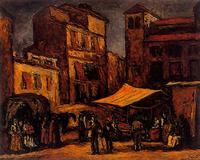
Market of Segovia
Arturo Souto
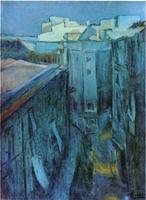
Dawn at Riera de Sant Joan
Pablo Picasso
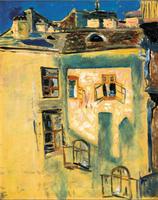
Scheiber Hugó Pesti Bérház, Olaj, Vászon, 68.5x55cm
Scheiber Hugó
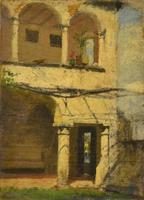
Cottage
Angelo Morbelli
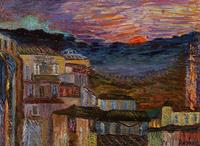
Caltagirone all’alba
Antonietta Raphael
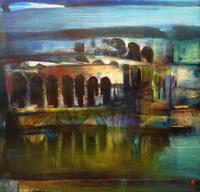
Memórias de Viagem II
Gil Teixeira Lopes
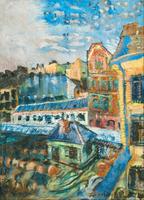
Scheiber Hugó, Pesti Udvar Kis Házikóval 1930
Scheiber Hugó
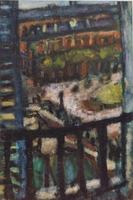
Városrészlet
Bela Czobel
Portdogue
Salvador Dali
H4145 L129417915
Conrad Theys
Houses of Cagnes
Chaim Soutine
Roofs of Paris
Francis Picabia
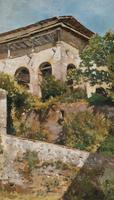
Landscape with keep
Michele Cammarano
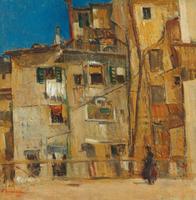
Case din Via Ripetta
Jean Alexandru Steriadi
Via Ripetta Houses
Lucian Grigorescu
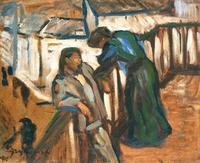
Egry József. Pár Az Erkélyen 1910
Egry József
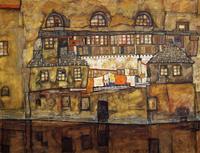
House on a River (Old House I)
Egon Schiele