
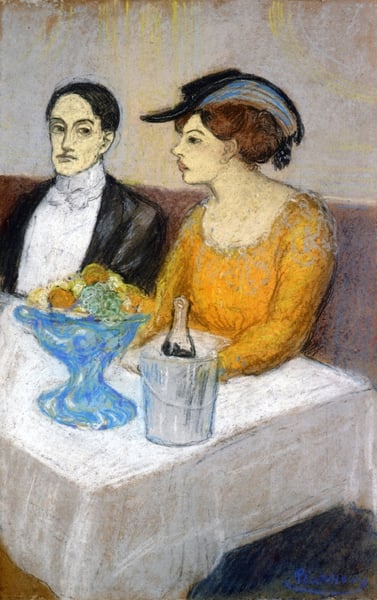
Angel Fernandez de Soto and his Friend
Dettagli
Analisi esperta di Angel Fernandez de Soto and his Friend di Pablo Picasso
Stile: Post-Impressionism · Genere: portrait
The artwork Angel Fernandez de Soto and his Friend (1901) is a significant early work by Pablo Picasso, marking a pivotal moment in his transition from the vibrant palette of his youth into the melancholic, monochromatic realm of his Blue Period (1901–1904). Executed in the style of Post-Impressionism, the painting demonstrates Picasso’s departure from naturalistic representation toward a more expressive, subjective use of color and form.
Significance within the Blue Period:
The double portrait captures Picasso’s friend, the bohemian artist Angel Fernandez de Soto, alongside an anonymous companion in a dimly lit café. The composition is steeped in the Blue Period’s signature mood of isolation, poverty, and emotional desolation. Cool blues, greens, and grays dominate the palette, draining the scene of warmth and suggesting psychological withdrawal. This monotone scheme—influenced by Picasso’s empathy for society’s outcasts and his own recent grief—serves as a vehicle for conveying a shared human sadness, a hallmark of the period.
Post-Impressionist innovations:
Picasso borrows from Post-Impressionist masters—particularly the flattened planes of Paul Cézanne and the symbolic color of Vincent van Gogh—to distort perspective and heighten emotional tension. The figures’ elongated, mask-like faces and rigid, almost sculptural poses hint at the psychological distance between them, even as they sit together. The background dissolves into abstract washes of color, prioritizing mood over spatial accuracy. This treatment of space and color anticipates Picasso’s later, more radical break from representation in Cubism.
Cultural and biographical relevance:
The painting is also notable for its intimate glimpse into the artist’s social circle during his early years in Paris. Fernandez de Soto, a fellow Spaniard and a flamboyant character, is depicted with a glass of absinthe—a recurring symbol of artistic decadence and despair. The work thus functions as both a personal document and a broader commentary on the alienation of the modern artist, themes that resonate deeply within the Blue Period’s canon.
In summary, Angel Fernandez de Soto and his Friend stands as a crucial step in Picasso’s formal and thematic evolution, marrying Post-Impressionist technique with the raw, empathetic pathos that defines his Blue Period, and foreshadowing the modernist upheavals to come.
Museum / Gallery
Visivamente simili
20 opere con composizione e palette affini
At the Café
Emil Nolde
At Mouquin's
William James Glackens
At the Cafe
Pierre-Auguste Renoir
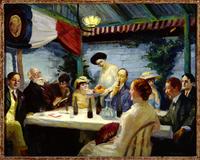
Yeats at Petitpas
John French Sloan
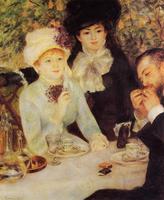
The End of Lunch
Pierre-Auguste Renoir
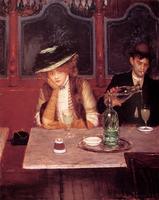
Absinthe drinkers
Jean Béraud
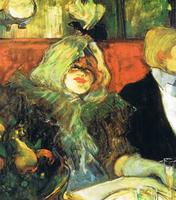
At the Rat Mort
Henri de Toulouse-Lautrec
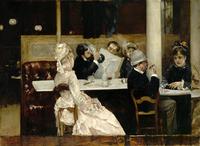
Café Scene in Paris
Henri Gervex
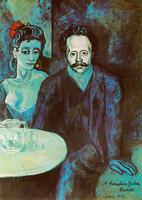
S. Junyer-Vidal with woman beside him
Pablo Picasso
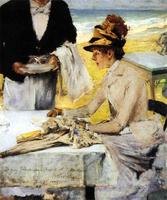
On the Lake, Central Park
William Merritt Chase
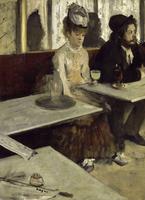
The Absinthe Drinker
Edgar Degas
The café
Federico Zandomeneghi
At the table at Le Perroquet restaurant, Paris
Isaac Israels
Le Lapin Agile, Parisian cabaret
Louis Abel-Truchet
The Ambassadors, People Chics
Henri de Toulouse-Lautrec
People at the Cafe
Theophile Steinlen
At the Moulin de la Galette
Pierre-Auguste Renoir
The Supper
Leon Bakst
Love
Max Kurzweil
The Parisian Life
Juan Luna