
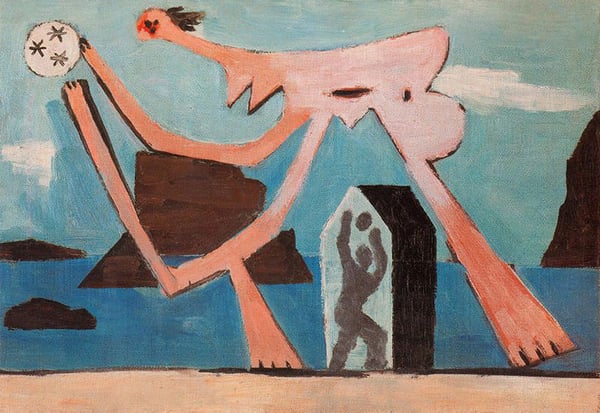
Ballplayers on the beach
Dettagli
Analisi esperta di Ballplayers on the beach di Pablo Picasso
Stile: Surrealism · Genere: genre painting
Expert Analysis of "Ballplayers on the beach" by Pablo Picasso
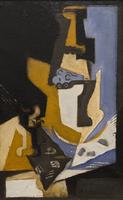
Pablo Picasso’s Ballplayers on the beach (1928) is a compelling example of the artist’s ability to fuse seemingly opposing stylistic impulses—Neoclassicism and Surrealism—into a single, visually arresting genre painting. Executed during his Neoclassicist & Surrealist Period (roughly 1917–1937), the work captures a moment of seaside leisure while simultaneously subverting naturalistic representation through distorted, biomorphic forms.
Significance within Surrealism
As a Surrealist work, Ballplayers on the beach embodies André Breton’s call to liberate the unconscious and challenge conventional reality. Picasso eschews realistic anatomy in favor of exaggerated, almost monstrous figures: limbs twist into unnatural arcs, heads become bulbous or flattened, and facial features are displaced. The beach—a typical setting for modern leisure—becomes a surreal stage where the human body is reinvented. This aligns with Surrealism’s interest in the strange within the everyday, and Picasso’s unique contribution was to marry this psychological disruption with a disciplined, almost sculptural sense of form.
Neoclassical Underpinnings
Despite its Surrealist deformations, the painting retains a Neoclassical clarity of composition and monumentality. The figures are solid, often arranged with a frieze-like balance that recalls ancient Greek vase paintings or Roman reliefs. Picasso’s earlier Neoclassical works (e.g., The Pipes of Pan, 1923) had emphasized serene, voluminous bodies; here, that same weightiness is distorted but not abandoned. The strong outlines, simplified planes, and earthy color palette—ochre, blue, white—evoke the Mediterranean aura of classical antiquity, while the ballplayers’ dynamic poses suggest the timelessness of athletic competition.
Genre Painting Reinvented
As a genre painting—a scene of everyday life—Ballplayers on the beach takes a humble, recognizable activity (sports on a beach) and transforms it into a vehicle for formal experimentation. Picasso’s beach is not a realistic seashore but a stage of ambiguous depth, where figures exist in a flattened space that emphasizes their graphic power. This approach anticipates the artist’s later, more overtly Surrealist works like The Dream (1932) and Guernica (1937), where real-world subjects become fractured and emotionally charged.
Conclusion
Ballplayers on the beach is significant precisely because it exemplifies Picasso’s transitional synthesis: a Neoclassical sense of gravity and order dissolves into Surrealist irrationality. The painting stands as a testament to his ability to push the boundaries of representational art while still anchoring his imagery in recognizable human experience—a hallmark of his genius during one of the most fertile periods of 20th-century modernism.
Museum / Gallery
Visivamente simili
20 opere con composizione e palette affini
Bathers on the beach
Pablo Picasso
Bather
Pablo Picasso
Man and Woman in Front of a Pile of Excrement
Joan Miro
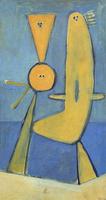
Couple at the seaside
Pablo Picasso
Nuit II (Composition with Frog)
Louis Marcoussis
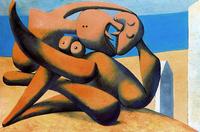
Figures at the Seaside
Pablo Picasso
Naturaleza Muerta Con Tijeras
Maria Blanchard
Painter and his model
Pablo Picasso
Exercise prénuptial
Victor Brauner
Ritratto di Marinetti poeta del Golfo della Spezia
Enrico Prampolini
The cock (robotic cock)
Carloluigi Colombo
Cleopatra's Death
Carloluigi Colombo
Beach game and rescue
Pablo Picasso
Forest Witches
Paul Klee
Adam and Eve
Wifredo Lam
The arrival of the bird
Corneille
Woman and Dog in Front of the Moon
Joan Miro
The beach in Garoupe
Pablo Picasso
Struttura marina
Giuseppe Santomaso
Bodegón
Maria Blanchard