
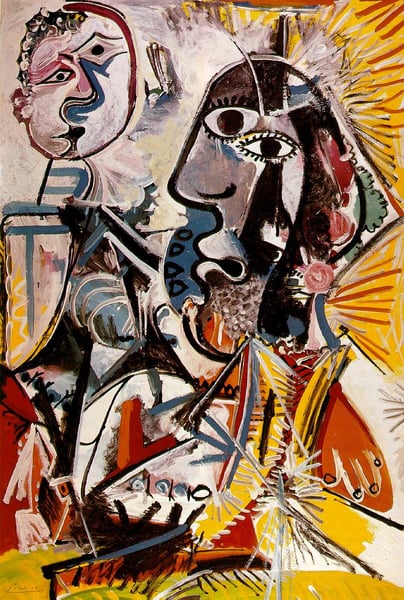
Analisi esperta di Big heads di Pablo Picasso
Stile: Expressionism, Surrealism · Genere: genre painting
Expert Analysis of Pablo Picasso’s Big Heads (Later Years)
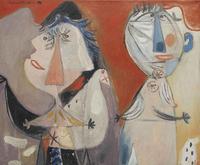
Painted during Picasso’s fertile later period, Big Heads merges the emotional distortion of Expressionism with the dreamlike incongruity of Surrealism. The work stands as a genre painting—a scene of everyday life—yet transforms familiar figures through exaggerated scale and fractured form. This dual stylistic lens allows Picasso to probe the psychological weight of human presence, making the ordinary feel monumental and unsettling.
Significance within Expressionism & Surrealism
- Expressionist charge: The oversized crania amplify raw emotion, compressing anxiety, vitality, or melancholy into a single, looming motif. The scale itself becomes a tool for inner expression, bypassing naturalistic proportion to convey psychological intensity.
- Surrealist dislocation: By isolating and enlarging the heads, Picasso disrupts rational space. The figures hover between reality and fantasy, echoing Surrealism’s interest in the subconscious. The “big heads” function as autonomous symbols, unmoored from their bodies—a hallmark of Picasso’s later willingness to fragment and recompose the human form.
Genre in the Later Years
In his later phase, Picasso revisited intimate, domestic subjects with renewed urgency. Here, the genre scene is not documentary but a stage for formal experimentation. The large, simplified heads recall his earlier volumetric explorations yet push toward a blunt, almost childlike directness—a late-career synthesis of maturity and primal energy.
Overall Significance
Big Heads exemplifies how Picasso, in his final decades, fused Expressionist affect and Surrealist illogic to revitalize a traditional genre. The work’s impact lies in its defamiliarization of the familiar: by magnifying the most expressive part of the body, Picasso compels viewers to confront the inner life behind the public mask, a theme central to both modernism and his enduring legacy.
Visivamente simili
20 opere con composizione e palette affini
African potter lady at work, talking to her material
George Ebrin Adingra
The key
Jackson Pollock
A repudiated woman can find no peace
George Ebrin Adingra
Reflection
Evan Magar
The Blue Phantom
Helmut Sturm
Woman represented as a bird
George Ebrin Adingra
Women know very well how to express their wishes
George Ebrin Adingra
Untitled
Helen Frankenthaler
Wild Beast Roaming around the World
Peter Busa
Blue Figure in a Chair
Arshile Gorky
The kitchen
Pablo Picasso
1951
Karel Appel
untitled
Evan Magar
Armageddon
Artin Demirci
Portrait of Pegeen
Richard Pousette-Dart
Sem título
Joaquim Rodrigo
Picture with a black arch
Wassily Kandinsky
Embrace
Pablo Picasso
-
Karel Appel
Couple et pigeon
Corneille