
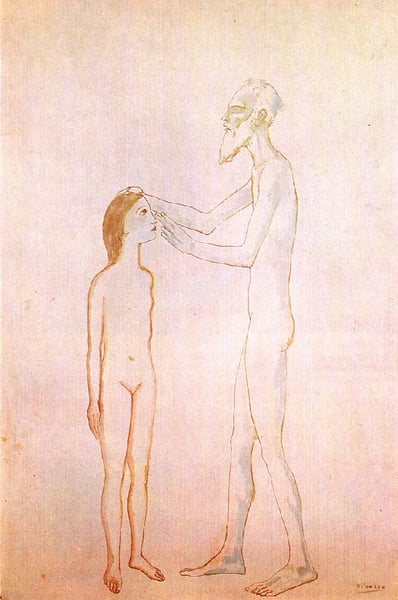
Analisi esperta di Blind man and girl di Pablo Picasso
Stile: Naïve Art (Primitivism) · Genere: genre painting
This analysis focuses on the significance of Pablo Picasso’s Blind Man and Girl within his Blue Period and its connection to Naïve Art (Primitivism).
Painted during Picasso’s famously melancholic Blue Period (1901–1904), Blind Man and Girl stands as a quintessential example of the artist’s empathetic exploration of human suffering and social marginalization. The work’s significance lies in its masterful synthesis of thematic pathos and stylistic innovation. The monochromatic blue palette—dominated by cold, somber tones—creates an atmosphere of profound isolation and despair, a hallmark of this period. The figures, a blind man and a young girl (likely his guide or companion), are rendered with elongated, simplified forms that echo the austerity of the scene. Their downward gazes and physical closeness convey a silent, shared tragedy, emphasizing themes of dependency, loss, and spiritual poverty.
Stylistically, the painting bridges Picasso’s Blue Period emotionalism with the emerging influence of Primitivism. The flattened perspective, reduced modeling, and deliberately awkward, childlike proportions reflect a turn toward Naïve Art—a rejection of academic realism in favor of raw, direct expression. This is especially evident in the stark, almost geometric rendering of the blind man’s face and hands. By stripping away detail, Picasso focuses attention on the universal condition of vulnerability. Blind Man and Girl is therefore significant not only as a poignant document of human hardship but as a pivotal work where Picasso begins to abandon naturalistic representation, paving the way for the more radical formal experiments of his later Rose Period and, ultimately, Cubism.
Visivamente simili
20 opere con composizione e palette affini
Figure study of Tristan
Koloman Moser
Standing female nude
Pablo Picasso
Portrait of nude Casagemas
Pablo Picasso
Idol
Vincent van Gogh
Young naked girl
Luc-Olivier Merson
Study for The Golden Age
Jean Auguste Dominique Ingres
Nude Girl Standing
Oskar Kokoschka
Female Nude
Albrecht Durer
Standing Nude Old Man
Oskar Kokoschka
Female nude, standing, hands clasped at chin
Rupert Bunny
Idol
Vincent van Gogh
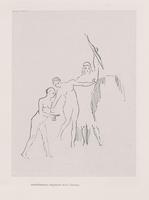
Immediately three goddesses arise (plate 11)
Odilon Redon
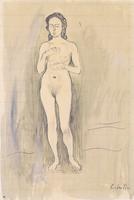
Female Nude (Study for "Truth")
Ferdinand Hodler
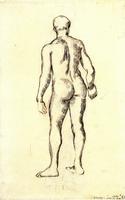
Idol
Vincent van Gogh
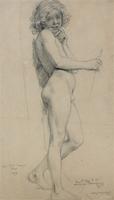
Shepherd (study for The Golden Age at the Musée du Luxembourg)
Diogène Maillart
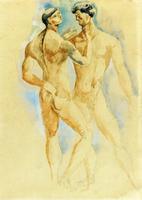
Chinese Boxers
Andre Derain
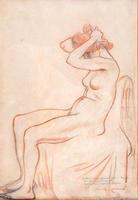
La Modele Nu a la Chevelure Rousse
Theophile Steinlen
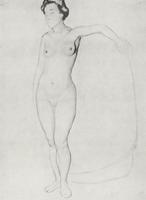
Drawing for the painting's Dream
Kuzma Petrov-Vodkin
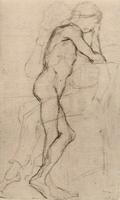
Standing Male Nude
Vincent van Gogh
Naken Manlig Modell, Akademistudie
Albert Edelfelt