
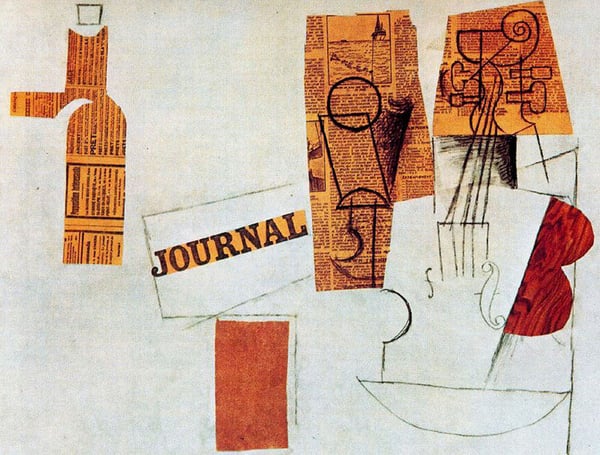
Deskundige analyse van Bottle, glass, violin van Pablo Picasso
Stijl: Synthetic Cubism · Genre: still life
Expert Analysis: Bottle, Glass, Violin by Pablo Picasso
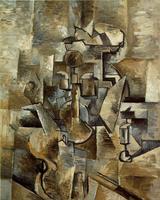
This work exemplifies Synthetic Cubism, a pivotal phase within Picasso’s Cubist Period. Unlike earlier Analytic Cubism, which dissected objects from multiple viewpoints into fragmented facets, Synthetic Cubism builds forms from simplified, often flat shapes and introduces collage-like elements—here, a playful interplay of bottle, glass, and violin as a still life.
Significance within Style and Period:
- Construction over deconstruction: Picasso assembles the objects using bold outlines, overlapping planes, and decorative patterns (such as wood-grain or stippling) rather than dissolving them. This “synthetic” approach marks a shift toward abstraction as a language of sign and symbol.
- Everyday objects reimagined: The violin, glass, and bottle become iconic motifs—their contours abstracted into curves and rectangles that echo musical and domestic rhythms. The inclusion of a newspaper-print or wallpaper-like texture hints at the real-world materials that would soon appear in actual collage works (e.g., Still Life with Chair Caning).
- Spatial innovation: Depth is flattened; the tabletop tilts upward, merging with the picture plane. This challenges traditional perspective, forcing the viewer to read shapes and colors as a unified composition rather than a window onto reality.
What makes it significant: As a mature Synthetic Cubist still life, Bottle, Glass, Violin demonstrates how Picasso distilled the essence of objects into a harmonious, nearly decorative arrangement—yet retained their identity through recognizable silhouettes and clues (like the violin’s f-holes). It marks a moment when Cubism shifted from analytical research to a playful, expressive synthesis, influencing later modern movements such as Constructivism and Art Deco. The work’s balance of abstraction and representation encapsulates Cubism’s revolutionary legacy: seeing not just what an object looks like, but how it can be reimagined through form and color.
Visueel vergelijkbaar
20 werken met verwante compositie en kleurenpalet
Still life with violin and fruits
Pablo Picasso
Violin and Newspaper (Musical Forms)
Georges Braque
Violin
Pablo Picasso
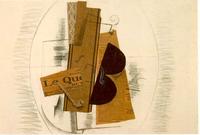
Violin and Pipe, 'Le Quotidien'
Georges Braque
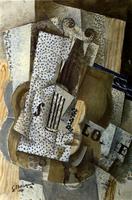
Violin Melodie
Georges Braque
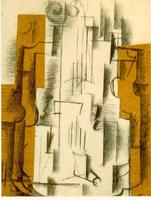
Still life with a violin
Georges Braque
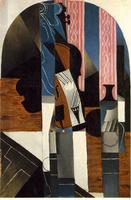
Violin and ink bottle on a table
Juan Gris
Violin and Sheet Music on a Table (Petit Oiseau)
Georges Braque
Violin and print
Juan Gris
Violin and Glass
Juan Gris
Musician's table
Juan Gris
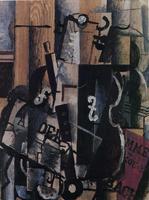
Violin and Clarinet on a Table
Georges Braque
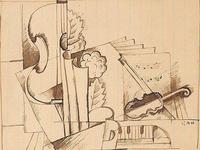
Composition with musical instruments
Gosta Adrian-Nilsson
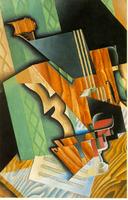
Violin and glass
Juan Gris
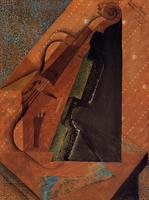
The Violin
Juan Gris
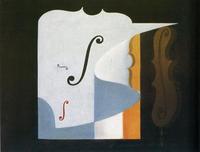
Untitled - Series on Catastrophes
Salvador Dali
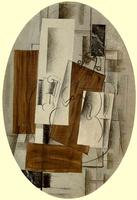
Violin and Glass
Georges Braque
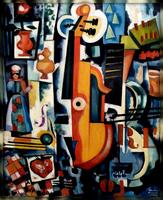
Parto da viola Bom Ménage
Amadeo de Souza-Cardoso
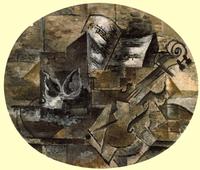
Violin and Musical Score
Georges Braque
Violin and candlestick
Georges Braque