
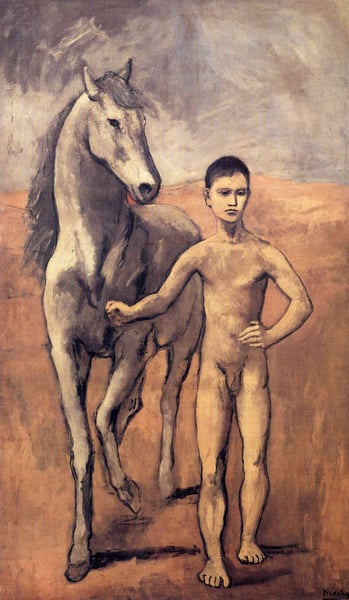
Expert analysis of Pablo Picasso’s Boy leading a horse
Style: Expressionism · Genre: genre painting
This artwork, Boy Leading a Horse, belongs to Pablo Picasso’s Rose Period and is classified as Expressionist genre painting. Its significance lies in the pivotal transition it represents within Picasso’s early career and its embodiment of core Expressionist and Rose Period ideals.
During the Rose Period (c. 1904–1906), Picasso moved away from the somber, blue-toned depictions of poverty and isolation that defined his Blue Period. Instead, he introduced warmer palettes of pinks, ochres, and earth tones, and focused on itinerant performers, harlequins, and pastoral subjects—figures who existed on the margins of society yet radiated a fragile, melancholic dignity. Boy Leading a Horse exemplifies this shift: as a genre painting, it depicts an everyday, non-heroic scene (a boy guiding a horse), but through an Expressionist lens, the image prioritizes emotional resonance over naturalistic accuracy.
The work’s significance within its style and period is threefold:
-
Expressionist subjectivity – Picasso distorts proportion and simplifies form to convey the tender, slightly awkward bond between the boy and the animal. The horse’s heavy, rounded body and the boy’s slender limbs are not anatomically precise; instead, they evoke a sense of vulnerability, trust, and quiet companionship—hallmarks of Expressionism’s focus on inner feeling.
-
Rose Period iconography – The subject of a boy leading a horse aligns with the period’s repeated interest in the relationship between humans and animals (often circus or street performers). This pairing suggests a narrative of guidance, labor, or innocent partnership, themes that Picasso used to explore beauty in the mundane and the poignant in the overlooked.
-
Transitional moment – Created at the cusp of Picasso’s later Proto-Cubist experiments, the painting retains the soft contours and atmospheric space of his earlier work while beginning to flatten and fragment forms. It thus stands as a key document of how Expressionism and the Rose Period’s emotional warmth laid the groundwork for his revolutionary shift toward modernism.
In short, Boy Leading a Horse is significant because it condenses the Rose Period’s gentle melancholy and Expressionism’s emphasis on emotional truth into a single, intimate genre scene, marking a critical stage in Picasso’s artistic evolution.
Museum / Gallery
Visually similar
20 works with related composition and palette
Noturno
Juan Carlos Castagnino
Horse Frightened by a Storm
Eugene Delacroix
Horses with riders
Giorgio de Chirico
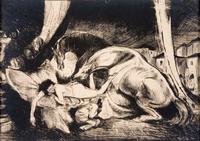
Stallions and Eunuchs
Bruno Schulz
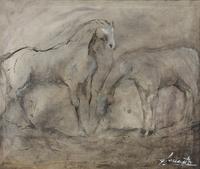
Horses - white/gray I
Małgorzata Serwatka
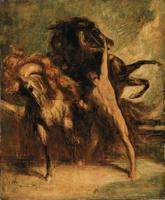
Esquisse pour Automédon avec les chevaux d'Achille
Henri Regnault
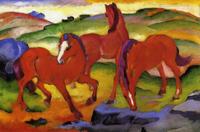
Grazing Horses IV (The Red Horses)
Franz Marc
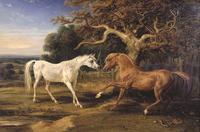
L'Amour de Cheval
James Ward
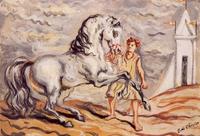
Runaway horse with stableboy and pavilion
Giorgio de Chirico
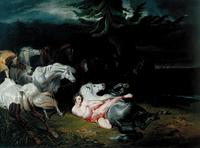
Mazeppa Surrounded by Horses (after Horace Vernet)
John Frederick Herring Sr.
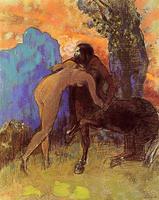
Struggle between Woman and Centaur
Odilon Redon
Horses - white/purple
Małgorzata Serwatka
Two Horses by a Lake
Giorgio de Chirico
Horsemen
Rudolf Láng
Berény Róbert, Lovat Fékező
Berény Róbert
Woodland Romance
Philip Evergood
MERKUR BIETET BATTUS EINE KUH DES ADMETOS AN
Johann Heinrich Roos
Unicorn
Maarten de Vos
Knights and horses by the sea
Giorgio de Chirico
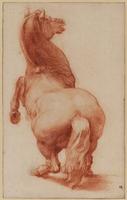
Rearing Horse
Francesco de' Rossi (Francesco Salviati), "Cecchino"