
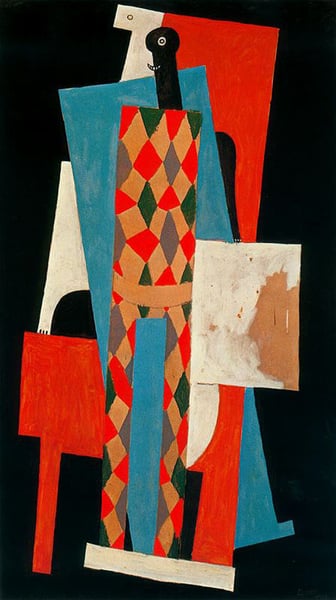
Expertenanalyse zu Pablo Picassos Harlequin
Stil: Synthetic Cubism · Genre: genre painting
Expert Analysis of "Harlequin" by Pablo Picasso
Style & Period Context
Created during Picasso's Cubist Period, this work exemplifies Synthetic Cubism (c. 1912–1919). Unlike the earlier Analytical phase, which deconstructed objects into fragmented, monochromatic planes, Synthetic Cubism reintroduces bold colors, simplified shapes, and collage-like elements. "Harlequin" is a genre painting—depicting a stock character from the commedia dell’arte—and thus ties Picasso’s formal experimentation to theatrical masks and human archetypes, a recurring theme in his work.
Significance within the Style
-
Synthesis of Form and Color
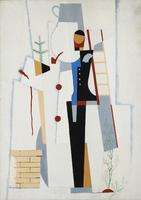
Picasso abandons the near-abstract, gray-brown palette of Analytical Cubism. Instead, he uses flat, vibrant patches of red, yellow, blue, and green to define the harlequin’s costume and background. The diamond-patterned suit—a hallmark of the character—is rendered as interlocking geometric zones, demonstrating how Synthetic Cubism builds form from distinct, self-contained color areas rather than modulating light and shadow. -
Collage Sensibility
Although "Harlequin" is a painting (not a collage), its composition mimics the Synthetic Cubist technique of papier collé. Outlines are discontinuous, shapes overlap like cut paper, and the harlequin’s features (eyes, hat, collar) are reduced to simple, iconic signs. This flattens pictorial depth while keeping the figure readable—a key innovation that freed painting from illusionistic space. -
Personal and Symbolic Weight
The harlequin is a constant presence in Picasso’s art, often interpreted as a self-portrait—the artist as a melancholic performer or outsider. In Synthetic Cubism, this figure becomes a vehicle for exploring multiple viewpoints simultaneously: the sitter is seen frontally and in profile, his body constructed of interlocking fragments. This duality mirrors the commedia character’s own blend of comedy and pathos.
Why It Matters
"Harlequin" marks a pivotal moment when Cubism moves from analysis to synthesis, embracing decorative boldness and symbolic condensation. It demonstrates how Picasso could infuse a traditional genre subject with radical formal language, making the everyday iconic and the iconic abstract. The painting stands as a bridge between Cubism’s deconstruction of representation and its later, more playful and expressive phases—a testament to Picasso’s ability to reinvent both style and meaning.
Museum / Gallery
Visuell ähnlich
20 Werke mit ähnlicher Komposition und Farbpalette
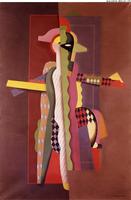
Arlequin Dansant
Georges Valmier
Bushbaby
Jasper Johns
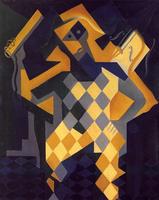
Harlequin with Violin
Juan Gris
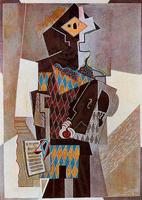
Harlequin with violin
Pablo Picasso
Head of a man
Pablo Picasso
Untitled
Gustave Buchet
Draft costume (Front)
Fernand Leger
Wine, Women and Song
Will Barnet
Untitled
Carlos Merida
Les Goudes
Maurice Esteve
Les Goudes
Maurice Esteve
Man with pipe
Pablo Picasso
Wall Picture with Metals
Willi Baumeister
Harlequin and woman with necklace
Pablo Picasso
Hockey
Willi Baumeister
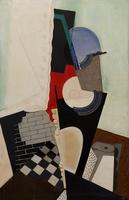
Naturaleza Muerta Composición
Maria Blanchard
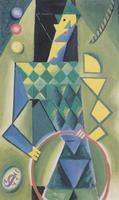
Šašek
Josef Capek
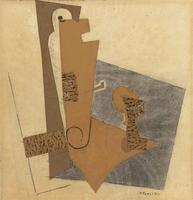
La bouteille
Henri Laurens
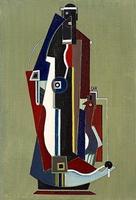
Vertical figure
Gosta Adrian-Nilsson
Kominík a Sněhulák
Jindrich Styrsky