
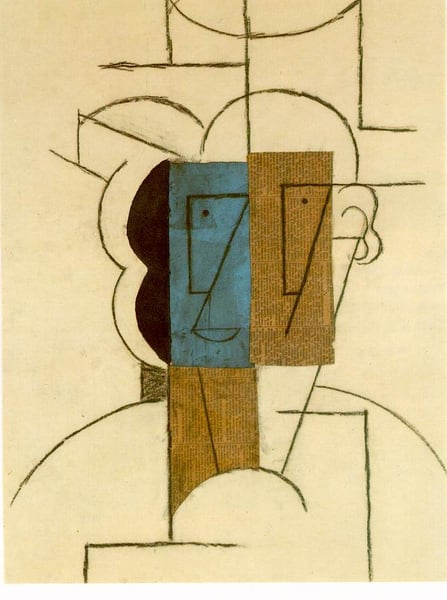
Expert analysis of Pablo Picasso’s Head of a man with hat
Style: Synthetic Cubism · Genre: portrait
This portrait exemplifies the defining characteristics of Synthetic Cubism, a phase in which Picasso moved away from the fragmented, monochromatic analysis of form seen in Analytic Cubism toward a more simplified, decorative, and compositional approach. In Head of a Man with Hat, the subject is reduced to essential geometric planes and bold, overlapping shapes. The hat acts as a clear, readable signifier of identity, while the face is constructed through flat, interlocking facets rather than naturalistic modeling. The artwork’s significance lies in how it demonstrates Picasso’s innovative synthesis of disparate visual elements—combining a recognizable motif (the hat) with abstract, two-dimensional geometry. This piece marks a key moment in the Cubist Period where representation becomes a playful assembly of signs, paving the way for later collage and mixed-media experimentation. The portrait’s simplified, almost iconic quality reflects Synthetic Cubism’s emphasis on constructed reality over observed reality, highlighting Picasso’s revolutionary redefinition of portraiture itself.
Visually similar
20 works with related composition and palette
Head
Auguste Herbin
Cubist Composition
Auguste Herbin
Cubist Composition
Auguste Herbin
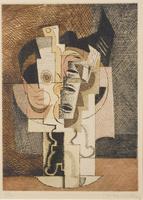
La Table
Louis Marcoussis
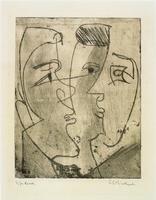
Three Faces
Ernst Ludwig Kirchner
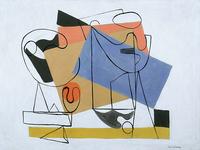
Abstraction
Ilya Bolotowsky
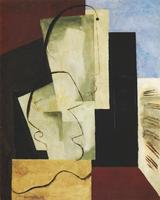
Concert
Louis Marcoussis
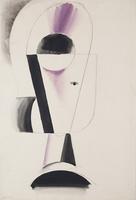
Study of a head
Josef Capek
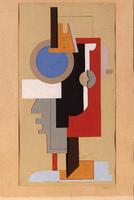
Abstrakte Komposition
Willi Baumeister
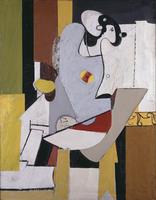
Blue Figure in a Chair
Arshile Gorky
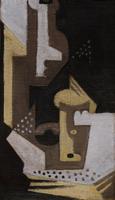
Cubist Composition
Maria Blanchard
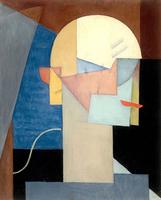
Cubist Portrait
Vytautas Kairiukstis
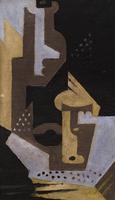
Bodegón Con Frutero, Periódico Y Vaso. Naturaleza Muerta (La Botella)
Maria Blanchard
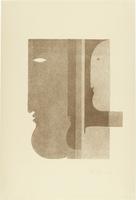
Two Profiles to the Left, One to the Right (Zwei Profile nach links, eines nach rechts)
Oskar Schlemmer
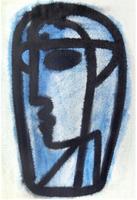
Decorative Head
Vilen Barsky

Saviour's Face - Christ
Alexej von Jawlensky
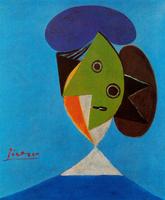
Bust of a woman
Pablo Picasso
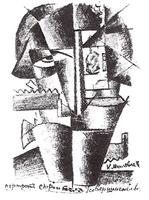
Portrait of Ivan Kliun
Kazimir Malevich
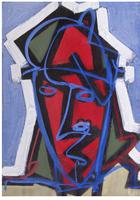
Image
Vilen Barsky
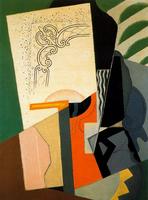
Composición Cubista
Maria Blanchard